“He is mentally incompetent!” my dad screamed in court. I stayed silent. The judge leaned forward and asked, “You really don’t know who he is?” His attorney froze. Dad’s face went pale. “Wait… what?”
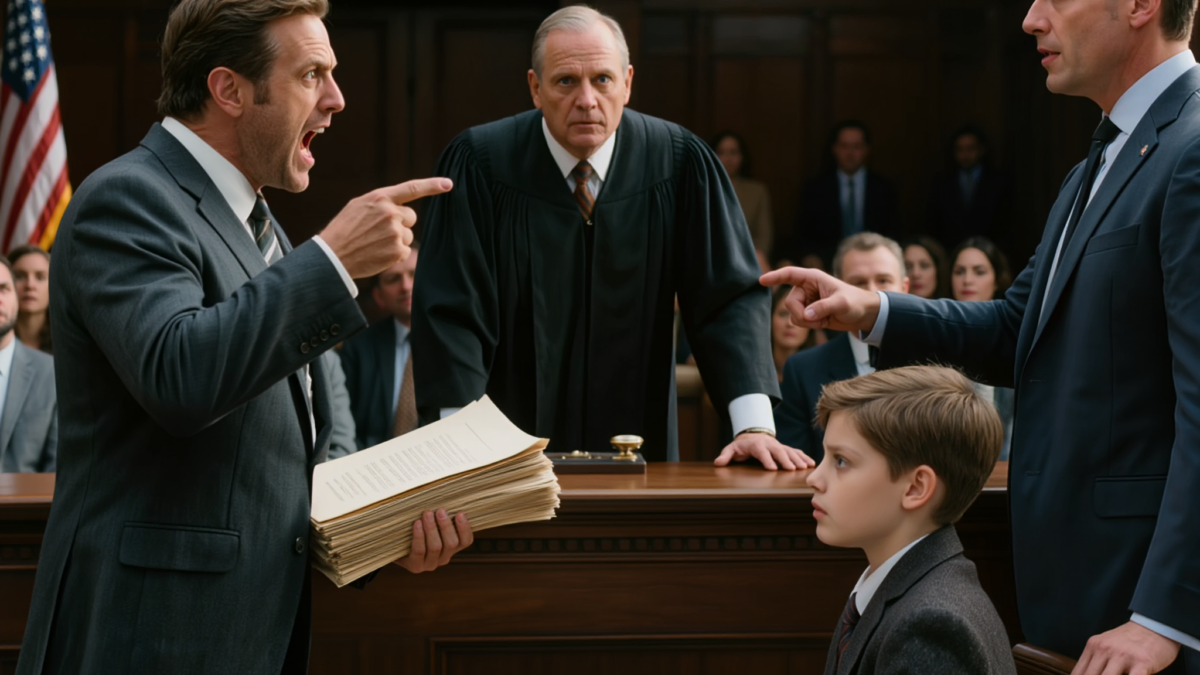
“He is mentally incompetent!” my father shouted across the courtroom.
I stayed silent.
Judge Samuel leaned forward, studied the man standing across from me, and asked, “You really don’t know who he is, do you?”
My father’s attorney froze. The confidence vanished from my father’s face as he looked down at the document being pressed into his hands.
“Wait… what?”
The courtroom was suffocatingly quiet. It was the kind of silence that felt heavy enough to press against your eardrums. The only sound came from the rhythmic tapping of the court reporter’s fingers against her machine. An American flag stood behind the judge’s bench, perfectly still beneath the soft fluorescent lights. Văn bản đã dán (1)
I sat at the defense table with my hands resting flat on the polished mahogany. I didn’t fidget. I didn’t lower my eyes. I simply stared straight ahead, letting the cool metal of my watch press against my wrist.
Across the aisle, my father, Carter Caldwell, was giving the performance of his life.
His face had turned crimson. The veins in his neck stood out above the collar of his expensive custom-tailored shirt. He paced beside the podium, waving a thick stack of papers through the air as though they contained everything he needed to prove his case.
Carter was a lawyer, and a courtroom had always been his favorite stage. But that morning, he wasn’t defending a client.
He was trying to strip his own son of the right to control his life.
“He needs a conservatorship, Your Honor,” Carter declared, pointing an accusing finger directly at my chest. “Look at him. He is an embarrassment to our family legacy. He is twenty-nine years old, living in a shoebox apartment and working some imaginary consulting job that doesn’t provide a real salary.”
He turned toward the judge, gathering momentum from the sound of his own voice.
“He is deeply unstable. He cannot be trusted with his own financial decisions. If this court does not intervene, he will waste his entire inheritance on his delusions.”
I didn’t blink.
I watched the man who was supposed to protect me argue that I should lose control of my bank accounts, my medical decisions, my property, and nearly every other part of my life.
Next to him sat his attorney, Eli, a slick, aggressive litigator who had built his reputation by intimidating witnesses until they stopped trusting their own memories. He was supposed to be Carter’s bulldog.
But that morning, Eli was sweating.
A bead of moisture rolled down his temple as he scrolled through a digital file on his tablet. Moments earlier, the bailiff had handed him a sealed document from the judge. Whatever Eli had found inside it was making his fingers tremble.
Judge Samuel sat high behind the bench. He was in his late sixties, with a face that looked carved from stone and a pair of eyes that seemed to miss nothing.
He allowed Carter to continue for another minute.
He let my father dig deeper with every accusation.
“My son cannot be trusted to make basic life decisions,” Carter said, striking the podium with the flat of his hand. “Look at him. He hasn’t spoken a single word to defend himself because he knows I’m right. He needs professional help, and he needs it today.”
Judge Samuel slowly picked up his wooden gavel.
He didn’t strike it. He merely held it for a moment, allowing the weight of the wood to rest in his palm. Then he placed it back on the bench and looked at Carter.
“Are you quite finished, Mr. Caldwell?”
His voice was calm, but it carried enough authority to drain the energy from the room.
Carter straightened his tie and drew a heavy breath.
“I’m only trying to save my son, Your Honor.”
“Save your son,” Judge Samuel repeated.
He put on his reading glasses and lifted the paper the bailiff had delivered. He read in silence for several seconds.
The tension tightened until the room felt airless.
Then he lowered the document and looked over the rim of his glasses.
“Mr. Caldwell, you really don’t know who he is, do you?”
The arrogant sneer disappeared from Carter’s face.
“Excuse me?”
“He is my son,” Carter continued. “He is a troubled young man who needs—”
“Stop talking,” Judge Samuel ordered.
It wasn’t a request.
Eli made a strained sound and grabbed Carter by the sleeve.
“Carter,” he whispered urgently. “Sit down. Look at the document. Look at the signature.”
Carter tore his arm away.
“What are you doing? I’m making a point to the judge.”
Eli pushed the paper against Carter’s chest.
Carter finally glanced down.
His face went pale.
“Wait… what?”
To understand how a father and son ended up on opposite sides of a courtroom, fighting over the son’s basic rights, you have to understand the family that existed long before that hearing.
The resentment didn’t erupt overnight.
It spread slowly beneath the polished surface of our lives.
My father was one of the most recognizable attorneys in our city. He had built his identity around the appearance of success. He wore thousand-dollar suits, drove luxury cars, belonged to an exclusive country club, and made sure his name appeared at every charity dinner attended by judges, developers, and local politicians.
To the outside world, Carter Caldwell was a pillar of the community.
Behind closed doors, he demanded complete obedience and treated affection like a reward that had to be earned.
I was his greatest disappointment.
I was never the son he wanted. I had no interest in becoming an aggressive trial attorney or spending my life arguing for applause. I liked numbers. I liked puzzles. I liked finding the tiny inconsistency everyone else overlooked.
I became a forensic accountant.
I traced missing funds, identified corporate fraud, audited complicated supply chains, and reconstructed financial records that companies believed had disappeared forever. It was quiet, highly technical work performed behind the scenes.
To Carter, that meant it didn’t count.
If your name wasn’t on a billboard or printed above the fold of a newspaper, he considered you invisible.
The true star of the Caldwell family was my older brother, Julian.
Julian was handsome, charming, and remarkably skilled at spending money he hadn’t earned. He called himself an entrepreneur, which usually meant launching a startup every six months, burning through my father’s money, and quietly abandoning the company once the bills arrived.
No matter how often Julian failed, my parents described him as ambitious.
No matter how much I achieved, they described me as stagnant.
I remembered the previous Thanksgiving with painful clarity.
The dining room smelled of roasted turkey, rosemary, butter, and expensive red wine. My mother, Vivien, had spent a week decorating the house until it resembled a holiday spread from a glossy American lifestyle magazine. Autumn candles flickered along the fireplace mantel. Crystal glasses stood beside the china Carter only allowed us to use twice a year.
We were seated around the long mahogany table when Julian entered, twirling a shiny key fob around one finger.
“Just picked her up today,” he announced, flashing his familiar million-dollar smile.
He held out the key.
“Ferrari 488. Cherry red. The dealer practically begged me to take it off the lot.”
My mother clapped her hands together.
“Oh, Julian, that’s wonderful. You work so hard, sweetheart. You deserve to treat yourself.”
I nearly choked on my water.
Julian didn’t work hard. Julian barely worked at all. He had never earned a stable salary in his life, and the Ferrari had been financed through a credit line connected to my father.
Carter lifted his glass of scotch.
“To my eldest son,” he said. “A man who knows how to command respect on the road and in life.”
They touched glasses.
Then Carter’s eyes moved toward me.
The warmth left his expression.
“And what about you, Mason?” he asked. “Still playing with your little spreadsheets? Still doing that consulting thing?”
I placed my fork beside my plate.
“I’m a forensic accountant, Dad. I run my own firm now. We recently signed a major contract.”
I didn’t mention that it was a federal contract worth millions of dollars. I had learned not to share victories in that house. My family would either minimize them or find a way to claim they had made them possible.
Carter laughed.
It was a sharp, mocking sound.
“A firm? You work out of your apartment, Mason. Is that what we’re calling unemployment now? Consulting?”
He tossed his napkin onto the table.
“It’s a cute hobby, son, but let’s be honest. You don’t have a stable salary. You don’t have a real career. You’re playing pretend.”
Julian smirked as he cut into his turkey.
“Come on, Dad. Take it easy on him. Not everyone has the drive to be a CEO. Some people are meant to stay in the background.”
Heat rose along the back of my neck.
I looked at my mother, hoping for a single word in my defense. Vivien raised her wineglass and refused to meet my eyes.
She always took their side.
Always.
“I’m doing fine,” I said, keeping my voice level.
“Doing fine isn’t the Caldwell way,” Carter replied. “You’re an embarrassment, Mason. A twenty-nine-year-old man who can’t even afford a respectable car. It’s pathetic.”
I didn’t argue.
I didn’t raise my voice.
I picked up my fork and continued eating.
They could believe I was a failure. They could believe I was broke.
The truth was that my “cute little hobby” brought in more revenue in one month than Carter’s law firm produced in an entire year.
But I kept that knowledge to myself.
Silence had become my armor.
That Thanksgiving dinner was only a symptom of a much deeper fracture. The real break had occurred several years earlier, after my grandmother’s funeral.
My grandmother was the only person in the family who had ever truly seen me. She understood Carter’s need for control, and she saw Julian’s endless dependence for what it was.
When she died, the reading of her will sent a shock wave through the Caldwell family.
She left the majority of her estate to me.
The inheritance included a protected trust worth several million dollars. Carter received a vintage watch. Julian received nothing.
The moment the attorney finished reading the document, Carter threw a water glass against the wall of the conference room.
He demanded that the will be challenged. He claimed my grandmother had not been thinking clearly. He threatened the attorney, the witnesses, and eventually me.
The estate documents were ironclad.
The money was mine.
From that day forward, the inheritance placed a target on my back.
Julian made the first move.
At the time, I was engaged to a woman named Chloe. We had been together for three years. She was beautiful, ambitious, and socially polished. I believed she loved me.
But Chloe was drawn to status, attention, and expensive things.
After the funeral, when tension inside the family reached its peak, Julian began appearing at my apartment more often. He arrived in tailored suits, talked loudly about business deals that never seemed to close, and left his premium credit cards on the counter where Chloe could see them.
One Tuesday evening, I returned home from work earlier than expected.
The apartment was silent.
I walked into the bedroom and found Chloe’s closet doors standing open. Half of her clothes were gone. Her suitcases had disappeared.
On the kitchen counter, beside a folded sheet of paper, sat my engagement ring.
The note was brief.
“Mason, I’m sorry. I can’t do this anymore. You’re too quiet, too stagnant. I need someone with ambition. I’m leaving with Julian.”
I stood in the empty kitchen for nearly an hour, staring at the page.
My brother hadn’t pursued Chloe because he loved her. He wanted to prove he could take something from me. It was punishment for receiving the inheritance he believed should have been his.
I called my mother.
I needed someone to say it was wrong. I needed one person in my family to acknowledge what Julian had done.
“Mom,” I said, my voice breaking despite my effort to control it. “Chloe left me. She moved in with Julian.”
A long silence followed.
Then Vivien sighed.
It wasn’t a sigh of sympathy. It was the exhausted sound she made whenever my pain inconvenienced her.
“Well, Mason, you have to look at it from her perspective.”
I gripped the phone more tightly.
“What perspective?”
“Julian has a bright future. He’s charismatic. He’s going places. You isolate yourself. You can’t blame a woman for wanting security.”
My chest tightened.
“Security? Mom, Julian is broke. He drained his college fund ten years ago. He lives on Dad’s credit cards. I’m the one with a steady career.”
“Don’t raise your voice at me,” she snapped. “Your brother is trying his best. Maybe if you shared some of your grandmother’s money with him, he wouldn’t have to struggle.”
She paused before delivering the sentence she had been working toward.
“You’re being very selfish, Mason.”
I ended the call.
I didn’t cry. I didn’t throw anything. I didn’t drive to Julian’s place and demand an explanation.
A cold realization simply settled over me.
I didn’t have a family.
I had a collection of people who shared my DNA and measured my value according to what they could extract from me.
From that day on, I locked away the part of myself that still expected fairness from them. I threw everything I had into my work.
If they wanted to see me as weak, invisible, and unsuccessful, I would allow it.
I would become a ghost.
As a forensic accountant, I followed money for a living. People could lie. Numbers rarely did.
About a year after Chloe left, my firm was hired to audit a midsize corporation going through a complicated bankruptcy. During the investigation, I had to trace a series of wire transfers made to outside vendors.
One of those vendors was Caldwell & Associates, my father’s law firm.
Late one evening, I sat at my desk while blue light from my monitor reflected against my glasses. Because Carter’s firm was a vendor involved in a federal audit, I had lawful access to its public disclosures and the financial records it had submitted through the client portal.
I began reviewing the documents out of professional curiosity.
What I found changed everything.
Carter wasn’t merely struggling.
He was financially drowning.
His firm was losing money from every direction. He was three months behind on payroll. He had taken out high-interest loans from questionable creditors simply to keep the lights on. He was paying old obligations with new debt, creating a cycle that could not continue.
The legal problems were even worse.
Public court records showed that Carter had been losing cases at an alarming rate. He had mishandled a major divorce settlement for a high-profile client after missing a filing deadline. Two former clients had sued him for professional negligence.
He had also mixed client funds with operating money to pay personal expenses, including country club dues.
The expensive suits, luxury dinners, cigars, and carefully maintained reputation rested on a foundation of debt and deception.
I needed to know how deep the problem went.
The credentials Carter had submitted for the audit portal were embarrassingly weak. His password was his own name followed by the number one.
Once I reviewed the internal ledgers made available for the audit, the picture became catastrophic.
Carter needed at least half a million dollars to avoid bankruptcy, cover payroll, and address the professional complaints threatening his law license.
He was cornered, and a desperate man with Carter’s ego could become dangerous.
I exported the relevant records, stored them in a secure encrypted file, and logged out.
A normal father might have called his family, admitted his mistakes, downsized his lifestyle, sold the large house, and started over.
Carter wasn’t interested in humility.
A few weeks later, I drove to my parents’ house to retrieve old boxes I had left in the attic. Carter’s Porsche was not in the driveway, so I assumed no one was home.
I let myself in with my old key.
As I passed the heavy oak doors of Carter’s home office, I heard voices inside.
“The bank rejected the loan extension, Vivien,” Carter said. His voice sounded exhausted. “We’re out of options.”
I stopped in the hallway and pressed my back against the wall.
“What about Julian?” my mother asked. “Can he ask some of his investor friends?”
Carter gave a bitter laugh.
“Julian doesn’t have investor friends. He’s an idiot who bought a Ferrari on my credit line. The bank is threatening to foreclose on this house. If the State Bar learns what happened with the client funds, I could lose everything.”
Silence filled the office.
Then my mother spoke again.
Her voice had dropped to a whisper.
“What about Mason?”
My heart began pounding.
“Mason won’t give me a dime,” Carter replied. “He’s sitting on millions from his grandmother’s inheritance, living like a pauper in that downtown apartment, and he won’t help his own father.”
“I didn’t say we should ask him,” Vivien said.
Her tone was so calm that it frightened me more than anger would have.
“I’m saying Mason hasn’t been acting right lately. He’s withdrawn. He doesn’t socialize. He works strange hours. He might be depressed. He may not be capable of making sound decisions.”
I closed my eyes.
I knew exactly where she was going.
“If he were declared legally incapacitated,” Vivien continued, “you could petition for control of the trust. You could manage the inheritance for his benefit. We could save the house, save your firm, and make sure Mason receives the help he needs.”
Carter didn’t object.
He didn’t say, “No. He’s my son.”
Instead, I heard ice clink against a glass.
“Dr. David owes me a favor,” Carter said slowly. “I got him out of that malpractice case five years ago. He’s a licensed psychiatrist. If he signs an affidavit stating that Mason is a danger to himself, we can request an emergency evaluation.”
“A 5150 hold,” Vivien said, referring to California’s seventy-two-hour involuntary evaluation process. “Three days would give you enough time to file an emergency conservatorship petition with Judge Samuel.”
I couldn’t listen any longer.
I stepped away from the wall, moving carefully so the rubber soles of my shoes made no sound against the hardwood floor. I slipped through the front door and walked to my car.
My hands were shaking.
Not from fear.
From a level of anger so intense that it burned in my throat.
My own parents were planning to have me confined under a false psychiatric claim, strip away my legal independence, and seize my inheritance to repair the consequences of their own choices.
They believed I was passive.
They believed I would panic, break down, and surrender.
They had no idea how carefully I had learned to prepare.
They wanted a fight.
I was going to give them a reckoning.
Their first move came on a Tuesday night.
Rain fell in sheets against the windows of my apartment. At 11:30 p.m., I sat at the kitchen island drinking black coffee and running a complex data analysis for a technology client.
My apartment was spotless, quiet, and completely ordinary.
A heavy pounding shook the front door.
It wasn’t a neighbor’s knock. It was the kind of pounding that demanded immediate attention.
I saved my work, closed the laptop halfway, and looked through the peephole.
Two police officers stood in the dim hallway. One of them rested a hand near his duty belt.
I unlocked the deadbolt and opened the door.
“Can I help you, officers?”
The older officer had a thick mustache and a nameplate that read WYATT. He looked me over, then glanced past my shoulder, scanning the apartment for signs of disorder.
“Mason Caldwell?”
“Yes. That’s me.”
Officer Wyatt removed a folded yellow document from his jacket.
“Mr. Caldwell, we received an emergency call from your family. We have an involuntary psychiatric evaluation order signed by a licensed physician. We need you to step into the hallway and come with us.”
For a moment, the air seemed to leave my lungs.
Even though I knew my parents were planning something, hearing the words spoken aloud felt like a physical blow.
They had actually done it.
They had activated the plan.
“A psychiatric hold,” I repeated, keeping my hands visible and my voice even. “Officer, I assure you there has been a serious misunderstanding. I am perfectly calm, and I am not a danger to myself or anyone else.”
The younger officer stepped forward.
“Sir, the affidavit states that you are experiencing severe delusions, that you may be a danger to your own safety, and that you have displayed erratic and threatening behavior. We don’t want any trouble. Please come with us for an evaluation.”
Threatening behavior?
I hadn’t raised my voice in years.
“May I see the document?”
Wyatt hesitated, then handed it to me.
The order appeared on official letterhead. It described severe psychiatric instability, financial delusions, and an immediate need for a seventy-two-hour involuntary evaluation.
If the officers took me that night, Carter could appear before a judge the following morning. He could ask the court to freeze my accounts and grant him temporary control of the trust.
I would be isolated while my family dismantled my life.
Cold perspiration formed along my neck.
I understood how precarious the moment was. One raised voice, one sudden movement, one visible sign of panic, and the officers might interpret my reaction as confirmation of the affidavit.
I took a slow breath and allowed the analytical part of my mind to take over.
“Officer Wyatt,” I said, “I understand that you’re doing your job. But please look at me, and look at my apartment.”
I stepped aside and gestured toward the brightly lit living room. My files were organized. Financial charts glowed on the laptop screen. A mug of coffee sat beside a legal pad covered in calculations.
“I’m working with an overseas client. I don’t abuse alcohol or drugs. This report is a malicious fabrication submitted by my father, who is facing bankruptcy and trying to seize my grandmother’s trust.”
Wyatt frowned.
His eyes moved from the yellow document to the orderly apartment and back to me.
“A doctor signed this,” he said. “Dr. David Miller.”
I nodded.
“Dr. Miller is my father’s golf partner. I haven’t seen him in seven years. I can prove it.”
I asked for permission to retrieve my laptop. Wyatt nodded while continuing to watch me closely.
I carried the computer to the doorway, opened my home security system, and turned the screen toward them.
“I have motion-activated cameras at my front door and in my living room. You can review the footage from the past six months. You will not find a single incident of threatening behavior. You also won’t find Dr. Miller entering this apartment to evaluate me.”
The younger officer leaned toward the screen.
“There’s more,” I said.
I opened an encrypted audio file.
“My father is attorney Carter Caldwell. His firm is insolvent. Three weeks ago, I recorded a conversation in which he and my mother discussed using a false psychiatric hold to obtain power over my inheritance.”
I pressed play.
Carter’s unmistakable voice filled the room.
“Dr. David owes me a favor. If he signs an affidavit stating Mason is a danger to himself, we call the police.”
Then my mother’s voice followed.
“A 5150 hold. Three days would be enough.”
Officer Wyatt’s jaw tightened.
He looked at his partner. The younger officer shook his head.
Submitting false information to law enforcement and fabricating a medical evaluation could carry serious consequences.
“Mr. Caldwell,” Wyatt said, his tone changing completely, “I’m sorry we disturbed you. Based on what you’ve shown us, we are not taking you anywhere tonight.”
I released a breath I hadn’t realized I was holding.
“Thank you, officers. I appreciate your professionalism.”
Wyatt folded the document.
“I’ll be filing a report. If you decide to pursue charges against Dr. Miller or your father, I will document exactly what happened here.”
“Not yet,” I said. “But I’ll keep your card.”
The officers left.
I locked the door and rested my forehead against the cool wood. My heart was beating so fast that the room seemed to tilt.
My parents had tried to remove me from my home and take away my freedom.
I returned to the kitchen island and saw an unread email in my secondary inbox. It had come from Gray, the private investigator I had hired a week earlier to monitor Julian’s financial activity.
The email contained photographs of Julian smiling inside a high-end auto dealership as he signed paperwork extending the financing on his Ferrari.
There was also a screenshot of a message he had sent Carter.
“Make sure Mason gets taken in tonight. The Ferrari payment is due Friday. Don’t mess this up, Dad.”
Julian hadn’t been an innocent bystander.
He had been encouraging Carter to move forward because he was afraid of losing his car.
I picked up my phone.
I needed to know whether any trace of compassion remained in the woman who had given birth to me.
It was nearly 1:00 a.m. when I called Vivien.
She answered on the second ring, breathless and theatrically panicked.
“Mason? Oh my God. Where are you? Are you at the hospital? The police called us. They said you were having an episode.”
“Mom,” I interrupted.
My voice was cold.
“The officers are gone. I’m sitting in my apartment. I played the recording of you and Dad planning the entire thing.”
Silence.
The panic disappeared from her voice.
“Mason,” she said, dropping into the low, careful tone she used whenever manipulation replaced emotion. “Listen to me. You’re confused. Your father is trying to protect you from yourself.”
“By using a false medical order?”
My grip tightened around the phone.
“By trying to have me confined so you could seize my inheritance and protect Julian’s Ferrari?”
“How dare you?” she snapped. “Julian is your brother. He’s struggling. Your father’s firm is experiencing a temporary cash-flow problem. We are a family. Families share their burdens.”
She drew a sharp breath.
“You’re sitting on millions of dollars while the rest of us are losing sleep over bills. You have always been cold and ungrateful.”
Pain flared in my chest, but I forced it down.
“So your solution was to tell the court I couldn’t manage my own life?”
Vivien began to cry. They were the familiar tears she used whenever facts stopped favoring her.
“We only need the money, Mason. Please sign power of attorney over to your father. Let Julian help manage the trust. We’ll make sure you’re taken care of.”
She paused.
“Please don’t tear this family apart.”
She was blaming me for resisting them.
“You broke this family, Mom,” I said softly. “Now I’m going to make sure none of you can do this to me again.”
I ended the call.
I didn’t block her number. I placed the phone facedown on the counter.
The last small piece of love I still carried for my parents disappeared in that moment.
I was no longer thinking like their son.
I was an auditor, and my family’s ledger was deeply in the red.
I didn’t sleep.
I brewed another pot of coffee, opened my encrypted files, and began drafting a plan to hold them accountable.
If Carter wanted to play high-stakes legal games, I would show him how a forensic accountant studied the board.
The following morning, I met my best friend and business partner, Nathan, at a quiet downtown diner.
Nathan was a brilliant corporate strategist, the kind of man who could locate a legal opening in what appeared to be a solid wall. More importantly, he was the only person I trusted completely.
I slid a manila folder across the sticky table.
Nathan opened it and reviewed the false psychiatric order, the ledgers from Carter’s firm, and the photographs of Julian at the dealership.
He gave a low whistle and took a drink of coffee.
“Your father is something else. You could take this to the district attorney today. He could lose his law license within days.”
“Too fast,” I said, looking through the rain-streaked window.
Nathan lowered his cup.
“What do you mean?”
“If I report him immediately, he’ll call himself a victim. He’ll appear on television and claim his troubled son framed him. Then he’ll file for bankruptcy, escape as much debt as possible, and let everyone else absorb the damage. Julian keeps the car. Vivien cries to her friends.”
I looked back at Nathan.
“I don’t want a temporary consequence. I want to remove every tool he uses to control people. The firm. The house. The cars. The reputation.”
Nathan studied me for several seconds.
Then he leaned back.
“All right. What’s the plan?”
“We’re incorporating a holding company today,” I said, pulling out a legal pad. “We’ll fast-track it through Delaware and structure the ownership through two limited liability companies.”
“What are we calling it?”
“Vanguard Holdings.”
Nathan clicked his pen.
“And what will Vanguard do?”
“Vanguard will acquire distressed assets. Its first target will be toxic debt in the legal sector.”
Nathan stopped writing.
His eyes widened as he understood.
“Mason, you want to buy your father’s debt.”
“Not merely buy it. I want control of the obligations he can no longer pay.”
I opened another section of the folder.
“Gray confirmed that Carter is defaulting on a major loan held by First National Bank. The bank is preparing to call the loan and seize the firm’s assets. Carter is desperate for a lifeline.”
Nathan looked down at the documents.
“And we’re going to offer one.”
“We’re going to offer something that looks like a lifeline.”
We spent the next four hours creating the corporate structure.
By noon, Vanguard Holdings was a legally registered entity. I transferred three million dollars of my grandmother’s inheritance into its operating accounts.
I wasn’t wasting the money.
I was placing it where it could finally protect me.
By 2:00 p.m., I was sitting across from Matthew, a director at First National Bank. He was balding, exhausted, and wearing a suit that looked as though he had slept in it.
When I introduced myself as a representative of Vanguard Holdings, he regarded me with skepticism.
Then I presented proof of funds.
His attitude changed immediately.
“Mr. Caldwell,” he said, “I have to be honest. The debt portfolio for Caldwell & Associates is toxic. Carter Caldwell misses payments and threatens our loan officers with lawsuits. His firm is almost insolvent. Why would a private equity company want to purchase this?”
“Vanguard sees potential in distressed assets,” I replied. “We specialize in aggressive restructuring. We’re prepared to buy the complete debt portfolio, including the loans, credit lines, and liens on office equipment, for ninety cents on the dollar. Cash today.”
Matthew looked close to tears.
He had smiled in Carter’s face for years, but he was willing to sell the debt to a stranger if it cleared the problem from his own books.
“I’ll have the transfer documents prepared immediately,” he said, shaking my hand.
Within forty-eight hours, the transaction was complete.
First National Bank was out.
Vanguard Holdings became the senior secured creditor of Caldwell & Associates. Every desk, computer, and piece of office equipment used as collateral was now subject to a lien controlled by my company.
But I knew Carter.
If he learned that a faceless corporation had purchased his debt, he might panic and seek bankruptcy protection before I was ready.
I needed him comfortable.
I needed him arrogant.
I needed him to believe he was winning.
Nathan, acting as Vanguard’s chief operating officer, called him.
He offered Carter a flattering story. Vanguard, Nathan explained, was an investment group interested in supporting aggressive, high-profile attorneys. The company admired Carter’s legal mind and wanted to inject fresh capital into Caldwell & Associates so the firm could expand.
Carter accepted the praise without question.
His ego wouldn’t allow him to wonder why a mysterious company wanted to rescue him. He assumed the business world had finally recognized his genius.
Two days later, Nathan sent a financing agreement to Carter’s office.
The proposal offered a $650,000 cash infusion.
At first glance, it resembled an ordinary private financing arrangement. The true power rested in the details.
I had helped draft the structure with corporate counsel, making sure every provision was enforceable.
Paragraph 12, Section B contained a cross-collateralization provision and a conduct-based default clause. If the firm defaulted on the loan, or if Carter, as guarantor, engaged in documented misconduct or public disparagement against Vanguard or its authorized representatives, the entire debt would accelerate.
The $650,000, combined with the older debt Vanguard had purchased from the bank, would become due within twenty-four hours.
The agreement also contained a personal guarantee.
If the firm could not satisfy the obligation, Vanguard could pursue Carter’s personal assets according to the terms of the contract: his pension, the house, certain luxury property, and the Ferrari loan he had co-signed for Julian.
I sat in my apartment and watched the secure digital portal.
A notification appeared.
DOCUMENT OPENED BY C. CALDWELL.
Ten minutes later, another notification arrived.
DOCUMENTS SIGNED.
Carter hadn’t read them.
He hadn’t asked Eli to review the provisions. He had simply scrolled to the signature page and accepted the money.
I authorized the wire transfer.
Six hundred fifty thousand dollars entered the operating account of Caldwell & Associates.
What did Carter do with it?
He didn’t pay the employees whose wages were overdue. He didn’t settle the professional negligence claims.
The next day, Gray sent photographs.
Carter had used part of the money to finance an elaborate renovation of his country club locker room. He bought Vivien a diamond necklace. He paid the late fees on Julian’s Ferrari.
He was celebrating with money from the company that controlled his debt.
He had signed away his protection without realizing it.
With the financial structure in place, I turned my attention to the physical setting.
Caldwell & Associates rented the entire third floor of an old downtown building called the Meridian. It was an aging brick structure with worn stonework and outdated elevators, but it had good bones.
Carter frequently mocked the building as a dump. He stayed only because the rent was inexpensive.
I contacted a commercial real estate broker named Luke and instructed him to approach the owner on behalf of Vanguard Real Estate, a subsidiary of the holding company.
We offered twenty percent above market value in cash.
The owner accepted immediately.
Within a month, Vanguard owned the Meridian.
I owned the building that housed my father’s law firm.
I replaced the negligent property management company, upgraded the security system, repaired the elevators, and renovated the lobby. I invested half a million dollars in the restoration.
The most important project was the top floor.
I converted the penthouse level into a modern office and private living space. It had floor-to-ceiling windows, biometric locks, and a private elevator.
I moved out of my small apartment and into the Meridian.
I was living directly above my father’s head.
Every weekday at 8:30 a.m., I stood near the windows with a cup of coffee and watched Carter arrive in his leased BMW. I watched him bark instructions at the valet and walk through the lobby as if he owned the property.
He didn’t know that the roof above him, the floor beneath his Italian shoes, and the air-conditioning flowing through his office belonged to the son he had tried to have confined.
To protect my anonymity, I maintained a mailbox in the lobby labeled Unit 4B. It was only a mail drop, but anyone checking the building directory would assume Mason Caldwell rented a small studio in the rear of the property.
The stage was set.
All I needed to do was wait for Carter to make his next move.
I didn’t wait long.
Two months after Vanguard purchased his debt, Carter filed an emergency conservatorship petition in family court. He alleged that I was mentally incompetent and incapable of managing my grandmother’s inheritance.
He attached another letter from Dr. David Miller.
It was his final attempt to reach the trust.
Carter believed he was bringing me into a courtroom he understood better than I did.
He didn’t know that I controlled the debt attached to his firm, the building beneath it, and the financing keeping his life intact.
That brought us back to Judge Samuel’s courtroom.
“You really don’t know who he is, do you?”
The question hung in the air.
Carter’s prepared speech vanished. He adjusted his silk tie, trying to restore his authority.
“Your Honor, I know exactly who he is. He is my son. He is an unstable young man who lives in terrible conditions. Have you seen the address on his mail?”
He pointed toward me again.
“He lives in the Meridian. It’s a crumbling brick building downtown. He refuses to let his mother visit because he’s ashamed of the way he lives. It’s probably a studio apartment with rats in the walls. The building doesn’t even have a proper doorman.”
Carter turned toward the judge with renewed confidence.
“And you expect me to believe he is competent to manage a multimillion-dollar inheritance?”
I pressed my tongue against the inside of my cheek to keep my expression neutral.
The Meridian.
He called it a crumbling brick building.
I called it a historic restoration project.
He was correct about the rats. They had been there when I bought the property six months earlier.
Then I hired exterminators.
I hired contractors.
I restored the lobby and converted the entire top floor into my home.
Carter believed I was a tenant in Unit 4B. He didn’t know Unit 4B was only the mail drop I used to protect my identity.
He stood beside the podium, breathing heavily, convinced that he had exposed me.
He didn’t realize that by insulting the Meridian, he had insulted his own landlord in open court.
Judge Samuel removed his reading glasses.
He no longer looked angry.
He looked tired of Carter, which was far worse.
“Mr. Caldwell,” he said, “I’m going to give you ten seconds to sit down and remain silent. If you make another unsupported statement about the respondent’s mental condition, I will hold you in contempt.”
Carter opened his mouth.
Eli seized his sleeve and pulled him into the chair.
Eli continued staring at the document the bailiff had handed him.
“Good,” Judge Samuel said.
He selected another document from the stack.
“Now that we have heard your opinion, let us consider the facts. According to this deed, the crumbling building you mentioned is not merely the place where your son receives mail.”
The judge slid a heavy sheet of paper across the bench.
The bailiff carried it to Eli.
Eli read it, and his breathing became shallow.
“The Meridian,” Judge Samuel said, “does contain a mail drop identified as Unit 4B. You were correct about that detail. Mason Caldwell does not rent the unit, however.”
The judge looked directly at Carter.
“He owns the building. The entire building, including the commercial suites on the third floor currently occupied by Caldwell & Associates.”
Carter blinked.
He looked at the deed in Eli’s hands, then at me, then back at the judge.
His mind seemed unable to arrange the information into something he could accept.
“That’s impossible,” he said. His booming courtroom voice had diminished to something thin and uncertain. “My landlord is a corporate entity. I pay rent to Vanguard Real Estate. I signed the lease renewal last month. I have never written a rent check to my son.”
“Vanguard,” Judge Samuel repeated.
He reached into a thick manila folder.
“That name appears frequently in these financial records. Vanguard Real Estate. Vanguard Capital. Vanguard Holdings.”
Carter’s eyes widened.
He recognized the final name.
Vanguard Holdings was the company that had injected $650,000 into his failing business. It was the only reason Caldwell & Associates remained open.
Judge Samuel lifted a heavy binder and opened it to the first tab.
“According to your firm’s financial disclosures, Vanguard Holdings is your senior secured creditor and primary source of new financing. The company acquired your distressed debt from First National Bank and later transferred $650,000 into your operating account. Is that correct?”
Carter straightened.
This was business. He believed he understood business.
“Yes, Your Honor,” he said, forcing confidence into his voice. “Vanguard is a private investment group. They saw the enormous potential in my firm. They recognized my legal ability and chose to support a winner.”
He turned and sneered at me.
“Unlike my son, who wouldn’t recognize a capital investment if it landed in front of him. Vanguard believes in me.”
I watched him construct the explanation he needed.
It was almost tragic.
He genuinely believed a group of distant investors had studied his declining divorce and custody practice and decided he was a brilliant opportunity.
“Vanguard believes in you,” Judge Samuel said dryly.
He turned the binder so Carter could see the state-filed incorporation records.
“That is interesting, Mr. Caldwell, because according to these Delaware documents, the sole incorporator, chief executive officer, and primary signatory of Vanguard Holdings is Mason Caldwell.”
The air seemed to disappear from the room.
Carter stared at the signature at the bottom of the page.
It was mine.
The same signature I had placed on birthday cards he barely acknowledged. The same signature printed on the lease renewal he had signed without reading.
“No,” Carter whispered. “No. This is a trick. This is fraud.”
He turned to Eli.
“Tell him. Tell the judge this is forged. My son does not run a private investment company. He plays with spreadsheets in a tiny apartment. He doesn’t have the ability to complete an acquisition like this.”
Eli stared at the desk.
He wouldn’t look at Carter.
He wouldn’t look at me.
Finally, he shook his head.
“The seal is authentic, Carter. The notary has been verified. He owns Vanguard.”
Carter tore his arm away from his attorney.
“Get off me, Eli. I’m not going to sit here while my son makes a mockery of this court.”
He turned toward Judge Samuel, his confusion shifting into anger.
“Look at him. Look at that inexpensive suit. Look at those scuffed shoes. Does that look like a chief executive to you? Successful people don’t live like they have nothing. He is lying. This is part of his instability.”
I glanced down at my shoes.
They were slightly scuffed.
I had damaged them the previous week while inspecting inventory at a client’s warehouse. I hadn’t replaced them because I didn’t care.
Unlike Carter, I had never needed to wear my net worth on my feet.
Real power didn’t need to announce itself.
“Mr. Caldwell,” Judge Samuel warned, “I will not caution you again.”
Carter was beyond listening.
The truth was too damaging to his ego, so he searched desperately for another explanation.
Then a triumphant expression spread across his face.
“Wait a minute,” he said. “I understand now.”
Eli’s shoulders dropped.
“Carter, don’t.”
My father ignored him.
“You thought you were so smart, didn’t you, Mason?”
He laughed, but the sound lacked control.
“Your Honor, my son has just admitted to a major regulatory violation in open court. He has handed us the victory.”
Eli grabbed Carter’s sleeve again.
“Carter, stop talking. Please sit down.”
“Be quiet, Eli.”
Carter turned his full attention toward me.
“You are not a lawyer, Mason. You are a glorified bookkeeper. Under Rule 5.4, nonlawyers cannot own equity in a legal practice. It is prohibited.”
He struck the table and leaned forward as though delivering a closing argument.
“You cannot own my firm. The agreement is void. You broke the rules because you wanted to pretend you were important. I will have you investigated for fraud. I’ll recover every dollar of the inheritance you stole from Julian and me.”
He looked up at the judge, nearly trembling with confidence.
“Dismiss this fake company’s claim, Your Honor. Rule 5.4 protects me. He is not my employer. He is not my partner. He has no authority over Caldwell & Associates.”
I didn’t move.
I let his words settle across the silent courtroom. I let him experience the highest point of his false victory.
Then I leaned forward.
For the first time that morning, I spoke.
“You’re right, Carter.”
His smile widened.
He believed I was surrendering.
I stood and walked around the defense table. My shoes clicked against the hardwood floor in a slow, steady rhythm.
Eli drew his briefcase closer to his chest as I approached. Carter remained upright, still clinging to the idea that a technical rule would save him.
I stopped in front of him.
I could smell stale scotch on his breath. I could see perspiration forming above his lip.
“I cannot own equity in your law firm,” I said. “I know Rule 5.4. I reviewed our state’s professional conduct rules before Vanguard completed a single transaction.”
Carter’s smile began to weaken.
“But you didn’t read the agreement you signed last month, did you?”
A flicker of doubt crossed his eyes.
“What are you talking about? You bought the firm.”
“I didn’t invest in your firm, Carter.”
I looked directly at him.
“I bought your debt.”
I gestured toward Judge Samuel. The judge nodded and directed the clerk to release the file of loan agreements.
I placed the heavy file on the table in front of Carter.
It landed with a solid thud.
“Two years ago, you were already failing. Three banks rejected your loan applications. You couldn’t cover payroll. Your handling of client funds placed your license at risk, and you lost an important custody case after missing a deadline.”
Carter’s face twitched.
“That was temporary. It was a cash-flow issue.”
“It was insolvency.”
I opened the file.
“Vanguard purchased your bank loan, your credit line, and the liens on your office equipment. Then it extended $650,000 to Caldwell & Associates on a senior secured basis.”
I allowed the words to settle.
“I am not your business partner. I am your senior secured creditor. I do not own your legal practice. I control the collateral securing its debt.”
Eli placed his head in his hands.
He understood.
“Every desk, computer, and other item pledged as collateral becomes subject to enforcement if you default.”
I turned to the highlighted section of the agreement.
“Paragraph 12, Section B. The conduct and disparagement provision. Publicly attacking the guarantor or questioning the legal competence of Vanguard’s authorized representative during a recorded court proceeding triggers acceleration of the debt.”
I tapped the page.
“You have spent this hearing calling me incompetent, fraudulent, unstable, and incapable of managing money. Every statement is now part of the official record.”
I checked my watch.
“You defaulted. The debt is due in full.”
The remaining color left Carter’s face.
“I don’t have that money,” he said. “You know I don’t. There’s only twelve thousand dollars in the operating account, and the credit cards are at their limits.”
I turned toward the bench.
“Your Honor, as the sole owner of Vanguard Holdings, I am formally accelerating the loan. The creditor enforcement motion and supporting documents are already before the court. I request authorization to begin lawful recovery against the pledged corporate assets of Caldwell & Associates.”
Eli rose.
“Your Honor, please. If Vanguard removes the equipment and freezes the accounts, the firm will close. Clients will be affected.”
“I accept your resignation, Eli,” I said without looking at him.
Carter finally lost the last of his courtroom composure.
He grabbed his phone from the table and began tapping rapidly.
“I planned for this,” he said. “I knew you were attempting a takeover. I have the bankruptcy filing ready. I’m submitting a Chapter 7 petition now. Once the automatic stay takes effect, you get nothing. The firm may close, but you cannot reach me.”
He leaned back, gripping the phone and breathing heavily.
He believed he had found checkmate.
Bankruptcy could protect the business estate from immediate creditor action.
I shook my head.
It was almost painful to watch him remain so predictable.
I reached inside my jacket and removed one final document.
“Bankruptcy may protect certain company assets while the case is pending,” I said. “It does not erase a properly executed personal guarantee.”
Carter stopped moving.
“What?”
“You didn’t read the fine print.”
I placed the document over his phone.
“Paragraph 4, Section C. Cross-collateralization and personal guarantee. If the company becomes insolvent and its assets do not satisfy the debt, the remaining obligation transfers to the guarantor according to the agreement you signed.”
Silence filled the courtroom.
“You didn’t merely bankrupt the firm, Carter.”
I looked into his eyes.
“You exposed your own estate.”
I turned the document toward him.
“Vanguard can pursue lawful claims against the house, the vacation cottage, eligible portions of the retirement assets, the country club interest, and the Ferrari loan you guaranteed for Julian.”
I leaned closer and lowered my voice.
“You signed away the protection you thought you had.”
Judge Samuel struck the gavel once.
“The conservatorship petition is denied with prejudice. The evidence presented by Mr. Carter Caldwell and Dr. David Miller has been referred for further review. The creditor enforcement order is granted subject to all applicable protections for clients and confidential records.”
He looked directly at Carter.
“The commercial eviction at the Meridian may proceed. The residential enforcement order provides twenty-four hours for compliance.”
Eli packed his briefcase and left the courtroom without saying another word to his client.
Carter remained seated.
For the first time in my life, he looked small.
He stared at the wall while the illusion of the Caldwell legacy disappeared around him.
I walked out without looking back.
My shoes clicked against the courthouse’s marble hallway, a steady rhythm that sounded like closure.
I didn’t feel an explosive rush of victory.
I felt relief.
The pressure that had rested on my chest for twenty-nine years was gone. The burden had finally been lifted.
That evening, I stood in the lobby of the Meridian with two professional security guards, a commercial locksmith, and representatives from the liquidation company.
We rode the elevator to the third floor.
The glass doors of Caldwell & Associates were locked, but the office lights remained on.
The locksmith drilled through the brass cylinder, and the doors opened.
The office was empty.
Carter hadn’t returned to pack his personal desk. He had simply left.
I walked to the reception area. Mounted on the wall behind the desk was a heavy bronze plaque.
CARTER CALDWELL, SENIOR PARTNER.
I took hold of the edge and pulled. The plaque separated from the drywall with a dull crack.
I placed it inside a cardboard liquidation box.
The team would inventory the leather chairs, mahogany desks, computers, and other secured property the following morning. Client documents would be handled according to court orders and professional confidentiality requirements.
I wasn’t interested in making a profit from dismantling the office.
The $650,000 had never felt like an ordinary investment.
It was the price of my freedom.
My phone vibrated.
The caller ID displayed Julian’s name.
I answered but said nothing.
“Mason!” he shouted. His voice was frantic, and traffic noise suggested he was standing outside. “What did you do? A tow truck just came to my apartment. They took the Ferrari. They showed me a repossession order with Vanguard’s name on it.”
I remained silent.
“You can’t do this,” he continued. “I need that car.”
“You don’t need a Ferrari, Julian,” I said. “You need a job. The free ride is over.”
“You vindictive—”
He stopped himself and drew a breath.
“Dad is falling apart. Mom is packing suitcases. They’re taking the house, Mason. Our house. You have to fix this.”
“Call the bank,” he demanded. “Tell them it was a mistake.”
“It wasn’t a mistake.”
I looked around the abandoned office.
“It was an audit, and the accounts failed.”
I ended the call.
A moment later, a message from Vivien appeared.
It was a long block of text filled with crying emojis.
“Mason, please. You are destroying this family. We have nowhere to go. Have mercy on your father. We love you. Please call me.”
I stared at the message.
I remembered standing in the hallway outside Carter’s office while she calmly suggested using a false medical order to take control of my inheritance.
I remembered the absence of mercy in her voice.
I didn’t reply.
I opened her contact profile.
I didn’t block her.
I deleted her.
Then I deleted Julian.
Then Carter.
They were no longer family members stored in my phone. They were three disconnected numbers that no longer had access to my life.
I erased them digitally as thoroughly as I had separated them from my finances.
I rode the private elevator to the penthouse and poured a glass of cold water.
Standing beside the floor-to-ceiling windows, I looked across the city skyline. Thousands of lights flickered in the darkness below.
I took a slow breath and listened to the complete silence of my home.
Sometimes you don’t need to defeat a toxic family through confrontation.
Sometimes you establish firm boundaries, step back, and allow their own decisions to produce the consequences.
A year passed.
Time has a way of balancing records no accountant could ever fully calculate.
Without Carter’s manipulation and Vivien’s guilt, my life moved forward faster than I had imagined.
Vanguard Holdings evolved from a defensive corporate structure into a legitimate and profitable auditing and distressed-assets company. Nathan and I expanded our operations, leased a large commercial office in the financial district, and hired fifty accountants and legal analysts.
My federal contracts doubled.
I wasn’t merely surviving.
I was thriving.
I continued living in the Meridian penthouse. I liked the building. It reminded me of where I had started and what I had overcome.
I kept the Unit 4B mailbox for the irony.
On weekends, I read, traveled, and occasionally played terrible rounds of golf with Nathan. I didn’t purchase a collection of sports cars. I traded my old sedan for a reliable SUV.
That was enough.
True wealth wasn’t about displaying money.
It was the quiet comfort of knowing I no longer needed anyone’s permission to exist.
I was happy.
Actually, genuinely happy.
My mind was clear. My conscience was settled. My circle of friends was small, but every person in it was loyal.
During that first year, I didn’t actively search for information about my former family. I didn’t monitor their social media accounts or ask mutual acquaintances for updates.
I no longer cared enough to follow them.
But gossip traveled quickly through the legal and financial circles of the city.
Six months after the hearing, I saw Eli at a coffee shop near the courthouse. He looked older and more tired, but far less anxious.
He offered to buy my coffee, and we sat together for a few minutes.
“Carter was disbarred,” he said, stirring his black coffee. “The State Bar investigated the bankruptcy records. They found the ledgers showing that he had mixed client money with personal and operating accounts. His license was revoked permanently.”
I took a drink.
“Was he charged?”
“He narrowly avoided incarceration after cooperating, surrendering his license, and claiming severe financial and emotional distress.”
“Where is he now?”
Eli shook his head.
“He works in retail. He sells luxury watches at a department store in the suburbs.”
There was an irony in that I couldn’t ignore. My grandmother had left Carter a vintage watch. In the end, watches were almost all he had left.
“Vivien left him,” Eli continued. “She filed for divorce after the house was foreclosed. She moved to Florida to live with her sister. Last I heard, she was working as a receptionist at a dental clinic.”
It made sense.
Vivien had loved the status of being a wealthy attorney’s wife. Without the house, the country club, and Carter’s professional reputation, there was nothing left for her to perform.
“And Julian?” I asked.
Eli gave a humorless laugh.
“Julian collapsed after the Ferrari was repossessed. Chloe left when she realized he had no money. He tried to launch another technology startup, but nobody would finance him without Carter’s signature. He’s waiting tables at a downtown steakhouse and renting a room.”
I nodded.
It wasn’t a tragedy.
It was gravity.
They had constructed their lives on entitlement, borrowed status, and money that belonged to other people. Once that foundation disappeared, the collapse was inevitable.
Dr. David Miller also faced consequences.
Officer Wyatt kept his promise and completed a detailed report. The recording of Carter’s plan and the false affidavit reached the state medical board.
Dr. Miller’s license was suspended while regulators investigated the fabricated evaluation and possible insurance irregularities. He never returned to private practice.
I thanked Eli for the coffee and walked back to my office.
I didn’t feel the need to celebrate anyone’s downfall.
The ledger was balanced.
People sometimes ask whether I regret what I did. They ask if I feel guilty for dismantling my relationship with my own family.
Society teaches us that blood creates a permanent obligation. It tells us that parents must be forgiven regardless of what they do and that walking away is an act of cruelty.
I learned something different.
Respect has to move in both directions.
Love should never be used as leverage.
Carter and Vivien didn’t treat me like a son. They treated me like an account they expected to control. They saw my independence as an obstacle between them and the money they wanted.
When they attempted to take away my freedom through a false claim, they broke the basic trust that makes a family possible.
I didn’t ruin them.
I stopped allowing them to use me.
I used the tools Carter valued most—money, contracts, and the law—to force him to face the consequences of his own decisions.
Power isn’t the ability to shout louder than everyone else in a courtroom.
It isn’t a cherry-red Ferrari or a country club membership paid for with borrowed money.
Real power is the quiet certainty that comes from knowing who you are and understanding what you can build with your own work.
Real power is standing inside a storm without surrendering your judgment, then watching the people who tried to control you fail against the boundaries you created.
I am Mason Caldwell.
I am not an embarrassment.
I am not incompetent.
I am a man who rebuilt his life after finally walking away from the people determined to tear it apart.
And the view from the top of the Meridian is absolutely beautiful.








