My father mocked my carpentry shop at Thanksgiving, praised my younger brother’s new $280,000 CEO job, and handed me a $38,000 contract to become his assistant. Fourteen people waited for me to sign. Then the board chairman’s phone rang, his face went gray, and he walked past my brother to say, “Julian, I need to speak with you privately.”
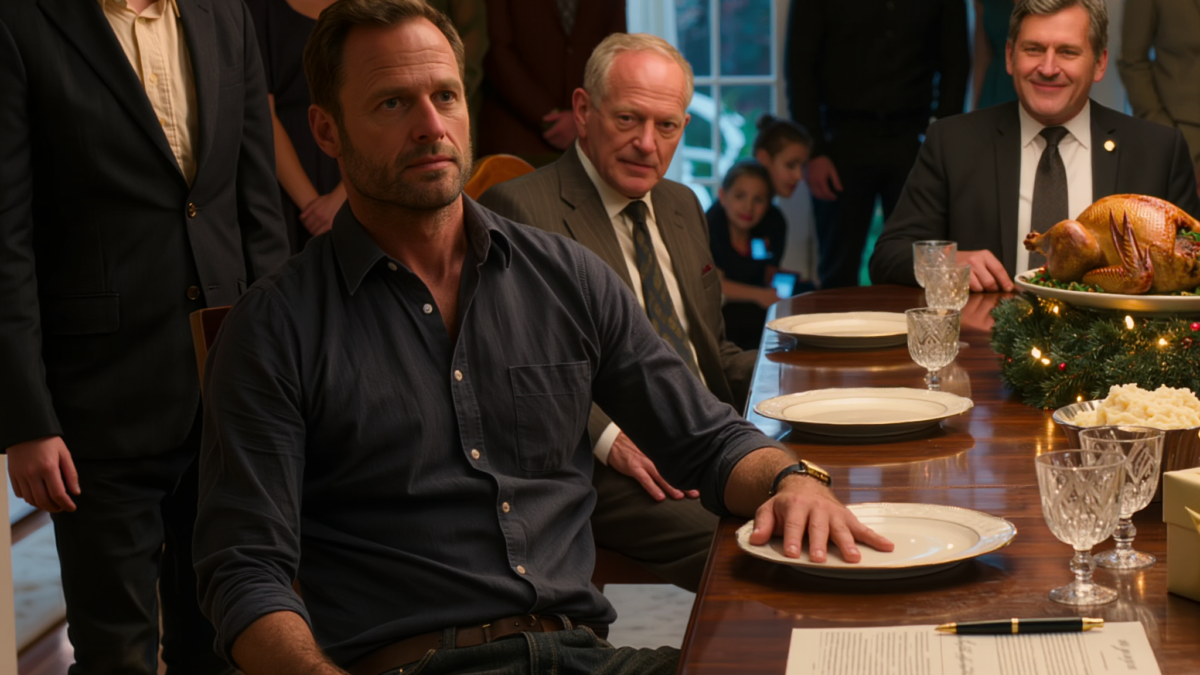
I’m Julian, 34 years old. Last Thanksgiving, my dad slid a small cream-colored gift box across our crystal-lined dining table and told the entire room it was going to change my pathetic life.
Inside was a contract to become my younger brother’s personal assistant.
While I was sitting there trying to keep the peace and make it through a family holiday, my own father looked me dead in the eye and said, “Dreams are for people who can afford them, son. We just don’t want you to be our shame. Take the job.”
They laughed at me—my parents, my brother, and my sister-in-law. They all chuckled at my expense in front of the fourteen people seated around that table.
But there was one thing they didn’t know.
Not a single person in that dining room knew I was the silent majority owner of a logistics empire worth close to $900 million. They thought I was a struggling carpenter who needed to be saved.
Now they were the ones begging for a second chance.
To understand the full weight of that Thanksgiving dinner, you have to understand the deeply rooted dynamic of my family.
We grew up in one of those pristine, hypercompetitive suburban neighborhoods in North Carolina where the height of your lawn and the badge on your car seemed to determine your worth at the monthly HOA meetings.
My father, Garrison, was a man who measured love entirely in numbers. He was a mid-level financial executive who had clawed his way up from nothing, and he wore his insecurities like a heavy, suffocating overcoat.
To him, if you brought home a six-figure salary, had a healthy 401(k), and carried an impressive title, you earned your place at his table. You received his respect, his time, and his affection.
Anything less, and you were a cautionary tale. A liability.
For years, I was that liability. I was the cautionary tale they whispered about at neighborhood barbecues.
My younger brother, Preston, was the golden child. He was three years younger than me, but light-years ahead in my father’s eyes.
Preston played the corporate game perfectly from the moment he was old enough to understand it. He wore the right clothes, spoke with the right arrogant inflection, and attended a prestigious business school using the massive college fund my parents had meticulously saved for him.
He kissed the right rings and shook the right hands.
I, on the other hand, never fit into that sterile, money-obsessed world.
I liked working with my hands. I liked the raw, honest smell of sawdust, the quiet hum of a well-tuned engine, and the peace that came from not having to prove my worth to a room full of superficial strangers.
I built things. Tangible things.
By the time I reached my mid-thirties, the narrative in the Holloway family had been set in concrete. Preston was the rising star, the corporate savior destined for greatness.
I was Julian, the guy who owned a dusty little woodworking shop on the edge of town and was supposedly barely scraping by.
They genuinely believed I was one bad month away from losing my shop, my home, and my dignity. They thought I was constantly on the verge of begging them for grocery money.
I let them believe it.
I even leaned into it, because secrecy is a strange and powerful thing. At first, you use it as a shield to protect yourself from constant, biting judgment. Over time, that shield hardens into a fortress.
Once you move inside that fortress, the quiet becomes addictive.
I didn’t want their fake admiration. I knew exactly how they would react if I suddenly appeared at a family gathering in a custom Italian suit and stepped out of a chauffeur-driven car.
There would be sudden fawning, manufactured pride, and hands reaching out for a piece of the pie.
The thought made my stomach turn.
I wanted to see exactly how my family treated someone they believed had nothing to offer them. I wanted to see their true faces after the masks came off.
They thought I was drowning in the shallow end.
They had no idea I owned the ocean.
The gift box on the dining table was supposed to be my salvation, the grand finale of their twisted charity. It had been meticulously wrapped in cream paper with a gold ribbon, a physical manifestation of their condescension.
It was supposed to be the glorious moment my brother reached down from his corporate pedestal and pulled me out of the mud, cementing his position as the benevolent, successful king of the family.
The contract inside offered a salary of $38,000 a year.
The job description essentially involved carrying Preston’s briefcase, fetching his coffee, picking up his dry cleaning, and becoming a human prop that made him look more important to his new board of directors.
It was a role designed for humiliation.
When my dad pushed the box toward me, the room went silent. The clinking of expensive silverware stopped.
Fourteen pairs of eyes locked onto me.
They were waiting for gratitude to wash over my face. They expected me to break down, thank them profusely, and finally admit defeat in front of their wealthy friends.
I looked at the contract.
I looked at the shiny gold foil on the Larkser HomeGoods letterhead.
Then I looked at my brother’s smug, expectant smile. It looked so much like my father’s that it made my chest tighten.
I didn’t feel angry. I didn’t feel humiliated.
I felt a deep, profound sense of pity for the people sitting around that table.
The contract in front of me wasn’t a lifeline.
It was a confession.
It was undeniable proof that they didn’t want a son or a brother. They wanted a subordinate. They wanted a servant they could parade around to make themselves feel better about their empty lives.
I slowly pushed my chair back. The heavy mahogany legs scraped across the pristine hardwood floor, the harsh sound echoing throughout the quiet room.
I took a deep breath beneath the weight of every judgmental stare.
But as insulting as that gift box was, it was actually the least terrible thing to happen in that house that night.
To understand the bomb that went off during dessert, you have to know what happened three days earlier.
The trap wasn’t set at the dinner table in front of the guests. It was set on an ordinary Tuesday, and my family had no idea that I already held the detonator.
Three days before Thanksgiving, the air in North Carolina was crisp and carried the smell of impending winter.
I was kneeling on the hard concrete floor of my woodshop just outside Asheville. The shop was my sanctuary. It smelled of raw cedar, tung oil, and old coffee.
I was carefully sanding the edges of a custom memory box for one of my regular customers, Fiona.
Fiona was a sweet, sharp-witted older woman who lived just down the street. She leaned against my workbench and told me about her daughter’s incredibly messy divorce.
It was a nightmare: a bitter custody battle, vicious fights over real estate, and lawyers draining the family’s bank accounts.
The cedar box I was building was for Fiona’s young grandson to keep his favorite baseball cards in. It was meant to be a small physical safe haven amid the chaos of a broken home.
I listened, nodded, and let the repetitive rhythm of the sandpaper ground my thoughts. I didn’t offer unsolicited advice. I simply gave her a quiet place to vent.
To Fiona, the local hardware store owner, and the rest of the town, I was just Julian the carpenter—the quiet, reliable guy who drove a rusted 2008 Ford F-150, wore flannel shirts that had seen better days, and charged fair prices for honest work.
At exactly 4:00 p.m., Fiona paid me in cash, thanked me with a warm pat on the shoulder, and left.
The moment the bell above the heavy wooden door chimed shut, locking out the rest of the world, my entire demeanor shifted.
I wiped the fine layer of sawdust from my jeans, threw the deadbolt on the front door, and climbed the narrow, creaking wooden stairs to the loft above the shop.
The loft looked nothing like a humble carpenter’s workspace.
It was a highly secure, soundproofed office that had cost more to build than the rest of the property was worth.
I sat behind a massive oak desk I had built with my own hands, opened a state-of-the-art biometric safe hidden behind a false wall panel, and removed an encrypted, heavy-duty laptop.
I logged into a secure server through a private VPN and joined a scheduled video call.
My chief operating officer, Nadia, was already on the screen. She looked immaculate in a sharp blazer, seated against the sleek backdrop of our corporate headquarters in Charlotte.
Nadia was a force of nature.
She handled the public face of everything. She was a ruthless negotiator, the shark in the boardroom who never backed down.
“Julian,” she said, skipping the small talk entirely. “The acquisition papers for the Midwest routes are finalized. The lawyers have reviewed the inheritance clauses and real estate transfers. We need your digital signature to close before the market opens tomorrow.”
I opened the documents and reviewed them meticulously.
It was an $11 million acquisition of a massive regional trucking fleet, a strategic move that would solidify our market dominance across three states.
I scanned the terms, checked the liability clauses my lead attorney had highlighted, and entered my multifactor digital signature.
Eleven million dollars, authorized in seconds by a man with cedar sawdust in his hair.
“Done,” I said, leaning back in my chair. “How are our quarterly financial projections looking heading into the holidays?”
“Stronger than ever,” Nadia replied, adjusting her glasses as a rare smile touched her lips. “Cedar Line Freight is currently valued at just under $900 million. We’re dominating the supply chain sector. Profit margins are up twelve percent, and the trade press is losing its mind again. They’re publishing theories about the identity of the majority owner.”
They called me the ghost of the logistics industry.
Every truck, warehouse, and asset I owned was layered behind a complex web of holding companies, blind trusts, and strict nondisclosure agreements.
Nadia gave the magazine interviews. Nadia sat on the industry panels.
I pulled the strings from a dusty loft in a small town, completely invisible.
Why the secrecy?
To answer that, I have to go back twelve painful years.
When I was 22, I wasn’t a ghost. I was loud, overly ambitious, fiercely optimistic, and desperate to prove myself to a father who respected only wealth.
I took out a massive personal loan, emptied my small college fund, and started a high-end catering supply company.
I worked grueling 80-hour weeks. I poured my blood, sweat, and tears into building the business from the ground up.
Then I made one fatal, naive mistake.
I trusted the wrong business partner.
His name was Derek. He was charming, well connected, and completely morally bankrupt.
He slowly skimmed funds, breached our most important vendor contracts, funneled money into offshore accounts, and left me holding the bag when the company abruptly collapsed.
I lost everything.
The bankruptcy was brutal, public, and humiliating.
I came home for Thanksgiving that year feeling hollowed out beneath the weight of massive debt. I was desperate for a little grace, a hand on the shoulder, or even one sentence from my father.
We’re proud of you for trying, son. You’ll bounce back.
Instead, I walked through the front door and into a meticulously planned ambush.
My father had arranged the formal living room like a courtroom. He sat in his oversized leather recliner like a judge preparing to deliver a sentence.
My mother sat rigidly beside him, her face devoid of empathy.
Preston, who was just beginning his shiny entry-level corporate career, sat smirking on the expensive sofa, clearly enjoying the spectacle.
They made me sit on a small, hard ottoman in the center of the room.
I felt like a criminal on trial.
My father didn’t offer a single word of sympathy. He conducted a surgical autopsy of my failures, listing every mistake and every dollar I had lost.
He treated my crushed dreams and broken spirit like a stain on the Holloway family name.
“You simply don’t have the stomach for real business, Julian,” my father said, his voice dripping with disgust and disappointment. “Dreams are for people who can afford them. You can’t. Stop playing pretend, and stop embarrassing us in front of our friends.”
I sat on that ottoman, staring at the intricate pattern of the Persian carpet, and felt something essential inside my chest snap.
It was like attending a funeral for the son they wanted me to be.
In that moment, I realized their love was entirely transactional. It depended on salary, job title, and the prestige I could bring to their social circle.
I left the house the next morning before sunrise.
I didn’t say goodbye.
I took a grueling night-shift job at a freezing distribution center outside Charlotte. I started at the absolute bottom, working on the loading dock and lifting heavy boxes until the muscles in my back screamed.
But I didn’t complain.
I watched.
I learned the logistics network from the inside out. I identified the inefficiencies costing the industry millions.
By 24, working on a cheap laptop in a tiny apartment, I had taught myself to code. I built proprietary routing software that reduced wasted fuel mileage by nearly twenty percent.
Instead of selling it to my corporate bosses for a small bonus, I quit.
I started Cedar Line Freight with one leased truck, my software, and a relentless drive.
I built my empire in the dark. I built it in the shadows, where my family couldn’t window-shop my success, critique my methods, or claim credit for my work.
I became the ghost because the ghost never had to sit on a little ottoman and be lectured by a man who respected only the balance in a bank account.
Back in the loft, after ending my call with Nadia, my personal phone buzzed on the desk.
It was a group text.
The chat was titled Thanksgiving Prep. It had been created by my sister-in-law, Valerie.
Valerie was a piece of work. She came from old money, drove luxury cars she hadn’t paid for, and treated anyone earning less than six figures like hired help.
As the messages loaded on my cracked phone screen, my blood ran cold.
In her rush to coordinate the perfect dinner, Valerie had forgotten to remove my number from the recipient list.
The messages were a detailed script for my impending humiliation.
Valerie wrote, “Okay, the seating chart is set. Julian is at the far end near the kitchen door, so he’ll be out of the main photos.”
My father replied, “Perfect. I’ll give the main toast right after we pour the expensive wine. I’ll formally announce Preston’s promotion and salary. Make sure everyone applauds loudly.”
My mother wrote, “It’s $280,000. I’m making sure the neighbors hear about it tomorrow. But remember, nobody mentions the assistant job yet. Don’t spoil the surprise.”
Valerie responded, “Right. Let him feel small first. Let the contrast sink in. Then Preston will hand him the gift box before dessert.”
My father added, “If we spring it on him in front of Carlton, he won’t dare make a scene. He’s too meek and embarrassed by his life. He’ll sign the contract just to save face in front of a real CEO. We’ll finally get him out of that pathetic woodshop and earning a respectable salary under his brother’s supervision.”
I sat perfectly still, staring at the glowing screen.
I watched the typing bubbles appear and disappear as they gleefully perfected the choreography of my social execution.
Not one person noticed I was in the group.
Not one person expressed even a hint of concern about how cruel the plan was.
They weren’t organizing a family holiday dinner.
They were arranging a targeted intervention disguised as an ambush, designed to break my spirit and force me into submission.
A younger, more fragile version of me might have immediately confronted them or refused to attend.
But I wasn’t that broken kid anymore.
I was a man who commanded thousands of employees and moved millions of dollars in freight across the country before breakfast.
I didn’t reply. I didn’t block the numbers.
I calmly turned off the screen, went downstairs, and picked up my broom to sweep the cedar sawdust from the floor.
I decided then that I would attend the dinner.
I would walk directly into their trap wearing my faded flannel shirt and scuffed work boots.
They thought they were playing chess against a defenseless pawn.
They didn’t realize they were already in checkmate against the king.
I thought the group chat represented the full depth of their delusion.
I was wrong.
The real storm was coming from a direction none of them—especially my golden brother—expected.
On Thanksgiving morning, the autumn air was biting and carried the sharp promise of winter.
I stood in my small kitchen drinking black coffee from a chipped ceramic mug when my phone rang.
It was Grandpa Winston.
Grandpa Winston was 85, sharp as a tack, and the only person in the Holloway family who had ever treated me like a complete human being.
He was a retired mechanic who had built his life with his own hands. He didn’t care about the square footage of your house or the brand of your watch.
He cared about the strength of your spine.
He firmly believed true inheritance wasn’t found in real estate portfolios, stock options, or trust funds. It was found in the integrity and resilience you passed down to your children.
“Julian?” His gravelly voice came through the speaker, tired but firm. “You coming tonight to this circus?”
“I’m seriously debating it, Grandpa,” I said, watching steam rise from my coffee.
A long pause hung on the line.
“Don’t debate, boy. Come. Your father is strutting around town like a peacock with a brand-new feather, and your brother is acting completely insufferable. They’re up to something. I can smell it on them. I need you there to keep me sane before I lose my temper and throw a turkey through the window.”
“They’re always up to something, Grandpa,” I muttered, looking through the kitchen window at my old Ford in the driveway.
“Listen to me, Julian,” Winston said, his tone softening slightly. “Money makes people loud. It makes them arrogant and blind. But true worth is quiet. It doesn’t need to shout to be heard. Don’t let them make you forget who you are. Just be there. Show them your quiet strength.”
“All right, Grandpa. I’ll be there for you.”
I hung up with a tight knot in my chest.
For Winston, I would willingly walk through fire. I had no idea how hot the flames would become that evening.
Ten minutes later, my secure corporate phone rang with its distinct emergency tone.
It was Nadia again.
Nadia never called on a major holiday unless the building was literally on fire or the market was crashing.
“Julian, we have a serious, immediate problem, and it requires your direct executive authority,” she said, her voice tight with urgency.
“Talk to me.”
I instantly shifted from supportive grandson to company owner.
“It involves one of our mid-tier corporate accounts, a large retail conglomerate called Larkser HomeGoods. We currently handle its entire Southeast distribution network.”
I knew Larkser.
It was a bloated, aging retail chain struggling to compete with agile e-commerce companies.
“What’s the issue?” I asked. “Are they defaulting?”
“They’re bleeding out fast. Their logistics invoices are ninety days past due. They’ve missed three major volume commitments in a row. Our financial analysts dug into their public filings and back-channel data. Larkser is on the verge of catastrophic bankruptcy. They’re dodging our collection attorneys, and Wall Street is already discussing a possible shareholder lawsuit over fraudulent accounting.”
I frowned and ran a hand over my jaw, mentally calculating the exposure.
“Then we cut them off immediately. Terminate the contract for severe breach of payment. Freeze the inventory in our warehouses. Why is this an emergency on Thanksgiving morning?”
“Because,” Nadia said slowly, emphasizing every word, “Larkser hired a brand-new CEO three weeks ago. The board brought him in to be the ultimate fall guy—a sacrificial lamb who would take the legal and public pressure when the company collapsed.”
“And?” I asked, still not seeing the personal connection.
“Julian, the new CEO is Preston. Your brother.”
The silence in my kitchen was deafening.
The low hum of the refrigerator was the only sound.
I stopped breathing for a second.
“Repeat that.”
“Preston is the new CEO of Larkser HomeGoods. We completed the background check this morning. The board is using him. They lured him in with a prestigious title and a $280,000 salary to stroke his ego, but it’s a glass cliff.”
She continued before I could respond.
“According to Gideon in cybersecurity, Larkser’s board is panicking behind closed doors. They’re demanding an immediate good-faith cash injection from Preston—$200,000 of his personal money—to secure a desperate bridge loan and make payroll next week. If he doesn’t pay by Monday, they intend to place the impending collapse on his gross negligence and sue him into oblivion.”
My brother, the golden child and supposed corporate genius, was being played like a cheap, out-of-tune fiddle.
He was walking around town bragging about a promotion that was actually a carefully disguised financial death sentence.
And the massive debt his sinking company owed?
It was owed directly to Cedar Line Freight.
It was owed to me.
I looked at the cracked screen of my personal phone and thought about Valerie’s group chat.
They planned to humiliate me over a $38,000 assistant position, blissfully unaware that Preston was about to lose his savings, his house, his marriage, and his career to the logistics empire I secretly owned.
“Julian?” Nadia asked. “Do I initiate the termination protocol? We can legally seize all their inventory in our warehouses by midnight and force them into liquidation.”
I gripped the edge of the kitchen counter until my knuckles turned white.
I thought about my father’s cruel words twelve years earlier. I pictured Preston’s smug face looking down at me.
I could press one button and destroy my brother’s life.
I could do it legally, cleanly, and anonymously. The lawyers would handle everything.
“No,” I said, my voice surprisingly calm. “Hold the termination protocol. Don’t send the collection attorneys. Freeze the account exactly as it is, and don’t let them know we’ve identified the problem.”
“Are you sure? We’re exposing ourselves to millions in liability.”
“I’m sure, Nadia. I’m going to a family dinner tonight. I’ll handle Larkser’s board personally.”
By 5:30 that evening, the sun had disappeared beneath the horizon, casting long shadows over my parents’ sprawling suburban estate.
I parked my rusted F-150 at the curb, directly behind a gleaming, brand-new Porsche 911.
Preston’s new toy.
He must have financed it the moment he received the offer letter, unaware that he was driving a ticking time bomb that could soon be repossessed.
I killed the engine and sat inside the quiet cab for a long moment, mentally preparing myself for the war zone.
I wore clean, dark jeans, scuffed leather work boots, and a simple, unbranded navy button-down shirt.
No Rolex. No designer labels.
Just Julian the carpenter.
The failure.
I walked up the manicured stone path as the cold wind bit at my face, then knocked firmly on the heavy oak door.
My mother, Sylvia, answered.
She was dripping in expensive pearls and wore a tailored silk dress that cost more than the Kelley Blue Book value of my truck.
The bright, overly white smile she had been giving the wealthy neighbors instantly tightened into a thin line of disappointment when she saw me.
She glanced over my shoulder to make sure none of her country club friends were watching, then grabbed my arm with her sharp nails and yanked me into the foyer.
“Julian, really?” she hissed, looking over my boots and jeans. “You couldn’t have worn a tie or a suit that actually fits? Preston’s board chairman is here. You look like you just came from a filthy construction site. Try not to embarrass us tonight, please.”
“Happy Thanksgiving, Mom,” I said smoothly, stepping out of her grip, my face an unreadable mask. “It’s good to see you, too. You look very festive.”
The enormous house smelled of roasted turkey, imported wine, and overpowering perfume.
The formal living room looked like a glossy page from a luxury real estate catalog.
Valerie stood beside the massive stone fireplace, laughing too loudly with a crystal champagne flute in her hand.
Preston held court at the center of the room. He looked impossibly arrogant in a tailored, slim-fit Italian suit, gesturing broadly as he spoke.
Then I saw the older man standing near the mahogany wet bar, sipping a dark drink.
He had silver hair and sharp, predatory eyes. His bespoke suit projected quiet, generational wealth.
I recognized him immediately.
Carlton, chairman of the board at Larkser HomeGoods.
He was the man plotting behind closed doors to use my brother as a human shield for his failing, corrupt company.
I had met Carlton two years earlier in a high-security, glass-walled boardroom in downtown Charlotte. Cedar Line Freight had outbid his company for a massive multistate warehouse contract.
I had sat at the head of the table, flanked by my attorneys, and personally rejected the desperate merger proposal Carlton had presented.
As I entered the living room, Carlton’s sharp eyes drifted across the crowd and landed on me.
He took a slow sip of bourbon. His eyes narrowed.
He studied my face, looked down at my worn work boots, and then returned his gaze to my eyes.
A flicker of troubling confusion crossed his weathered features.
You could almost hear the gears grinding inside his head.
He recognized the facial structure, the cold eyes, and the unwavering stance, but the context was wrong. Completely upside down.
He was trying to reconcile the ruthless, untouchable logistics magnate he had met in Charlotte with the seemingly poor carpenter being quietly scolded by Sylvia in the foyer.
My father marched over and clapped me forcefully on the shoulder.
It wasn’t an affectionate gesture. It was a display of dominance designed to show everyone who was in charge.
“Julian,” Dad boomed loudly enough for Carlton to hear over the music. “Glad you could tear yourself away from the wood shavings and dust for one evening. Come over here. Let me introduce you to someone actually important.”
He aggressively steered me toward the bar.
“Carlton, this is my other son, Julian. He tinkers with wood on the south side of town. Keeps him busy, I suppose.”
Carlton extended a manicured hand. His grip was firm and testing.
“Julian, have we met before? You look incredibly familiar.”
I looked him directly in the eye and offered a mild, slightly confused smile.
“I don’t think so, sir. Unless you’ve been shopping for a custom cedar birdhouse. I sell them at the farmers market on weekends.”
Carlton stared at me.
He didn’t laugh.
He kept watching me like a ghost he couldn’t place, a threat he couldn’t accurately measure.
In that moment, looking into the eyes of the man who was preparing to sacrifice my brother, I knew the trap was perfectly set.
Dinner was a masterclass in psychological warfare disguised as a polite holiday gathering.
The dining table was long enough to seat a medieval king and his court. Fine bone china had been arranged perfectly, and the antique silverware was polished to a blinding shine.
My mother had maliciously curated the seating arrangement for maximum effect.
Preston and Valerie sat at the center, flanking Carlton and his elegant wife, Penelope.
They were the stars of the show.
I had been deliberately placed at the far end, near the swinging kitchen door, beside Grandpa Winston.
I was positioned like a member of the hired help waiting for scraps.
“You look sharp, kid,” Winston mumbled as he passed the bowl of heavily buttered mashed potatoes. “Don’t let the circus animals get to you tonight. They’re barking loud.”
“I brought peanuts, Grandpa,” I whispered, taking a slow sip of ice water. “I’m just here for the show.”
“Let them bark.”
And what a show it was.
As soon as the expensive red wine had been poured into every glass, my father stood and tapped his crystal goblet with a heavy silver spoon.
The sharp ringing sound cut through the polite chatter and demanded total silence.
“Family, friends, honored guests,” Garrison began, projecting his voice as though he were addressing a hostile shareholder meeting rather than a family dinner. “We are gathered today to give thanks for our many blessings. And this year, the Holloway family has an unprecedented amount to celebrate.”
He turned his gaze toward Preston, his chest swelling with pride.
“To my son Preston, a true man of vision, relentless drive, and ambition. At just 32 years old, he has officially been named chief executive officer of Larkser HomeGoods.”
My father paused, allowing the title to hang in the air before delivering the figure he had been waiting to announce.
“A position commanding a base salary of $280,000 a year, plus lucrative stock options and a comprehensive benefits package.”
The table erupted in polite, admiring applause.
Valerie beamed a thousand-watt smile and placed her manicured hand on Preston’s sleeve.
Preston gave a practiced, fake display of humility, soaking in the admiration like a sponge.
“It takes a rare caliber of man to carry that kind of corporate responsibility,” my father continued, slowly pacing behind his chair. “A man who understands the value of hard work, higher education, and constantly climbing the ladder. Not everyone has that drive. Not everyone understands what it takes to succeed in the real world.”
Garrison’s eyes traveled down the length of the table.
They passed the wealthy guests and Valerie before settling entirely on me.
The room seemed to grow ten degrees colder.
“Some people,” my father said, his voice dropping into a tone of patronizing pity, “are content merely to survive. They hide away in dusty, drafty garages, playing with saws and wood glue while the real world passes them by. But family is family. We support our own, even when they struggle to discover their purpose or earn a respectable living.”
Agonizing silence settled over the table.
It was heavy, suffocating, and brutally awkward.
Penelope immediately looked down at her plate, visibly uncomfortable with the public shaming.
Fiona’s sweet, trusting face flashed through my mind, along with my quiet life and the carefully built sanctuary of my shop.
My father had reduced my entire existence to a childish joke so his golden boy could shine more brightly in front of the guests.
I didn’t react.
I didn’t turn red with anger or lower my head in shame.
I calmly cut a piece of turkey, chewed it slowly, and swallowed.
Then I looked at my father with the mild, detached curiosity of someone watching a poorly acted and predictable play.
Carlton watched me intently.
He hadn’t touched his wine.
His sharp gaze moved from my father’s dominant posture to my unnerving stillness.
The gears inside his head were still turning, faster now, trying to solve the puzzle of my presence.
“Actually,” Carlton said suddenly, his deep, authoritative voice slicing through the tension.
He leaned forward, resting his elbows on the table. He addressed the room, but his eyes remained fixed on me.
“Speaking of logistics, supply chains, and the real corporate world, Larkser has been dealing with an absolute titan in the industry—a highly secretive company called Cedar Line Freight. They have a stranglehold on the Southeast distribution network.”
Carlton paused and took a deliberate sip of bourbon.
“Their owner is a complete mystery to the board. The financial press calls him the ghost because he’s invisible. Fascinating character. Utterly ruthless in negotiations. I met him once, two years ago, in Charlotte. He didn’t say much, but he commanded the entire room without raising his voice. Eighteen million dollars moved on a single nod.”
Carlton tilted his head.
“You remind me of him, Julian. Something in the eyes. The same quiet intensity.”
My mother released a sharp, nervous laugh that sounded like thin glass cracking.
“Julian? Oh, Carlton, please. You’re far too kind. Julian doesn’t know the first thing about corporate supply chains or boardrooms. If a problem doesn’t involve a hammer, a rusty nail, and a piece of scrap wood, he’s hopelessly lost.”
“Right,” Carlton said softly, his eyes never leaving mine. “It must be a strange coincidence.”
“A ghost?” Valerie chimed in from the center of the table, swirling her red wine with a cruel smirk. “Sounds spooky and, honestly, a little cowardly. Hiding behind teams of lawyers and accountants instead of facing people like a real man.”
“I don’t know, Valerie,” I said, projecting my calm voice down the full length of the table. “Sometimes a ghost is simply someone who grew tired of dealing with people who value only the flesh, blood, and bank accounts they can exploit.”
Valerie blinked rapidly. Her practiced smile faltered for a moment.
Preston shifted uncomfortably in his expensive chair and tugged at his collar.
“Well,” my father interrupted, annoyed that the spotlight had drifted away from Preston, “let’s move on to dessert. Preston, I believe you have something special to share with your brother.”
The trap began to spring exactly as Valerie’s leaked messages had described.
Preston cleared his throat and stood, buttoning his suit jacket.
He walked to the antique side table, picked up the cream-colored box with its gold ribbon, and carried it slowly down the length of the dining room.
He stopped beside my chair and looked down at me with manufactured benevolence.
“Julian,” he said loudly enough for the neighbors to hear, “we all know things have been tough for you. The woodworking thing is a nice, quaint hobby, but it’s time you had a stable career. Security. A retirement plan. A future you can be proud of.”
He placed the beautifully wrapped box beside my plate.
“I have officially authorized a brand-new position at Larkser HomeGoods. Executive personal assistant to the CEO. It pays $38,000 a year with full medical benefits. You’ll work directly under me. I can mentor you, Julian. I can finally teach you how the real world operates and show you how to become successful.”
My mother clasped her hands and looked at me with wide, demanding eyes.
“Isn’t that incredibly generous of your brother, Julian? Say thank you to Preston.”
“Take the lifeline, son,” my father said sternly from the head of the table. His tone brooked no argument. “Don’t let your foolish pride ruin this opportunity. It may be the only real chance you ever get to make something of yourself.”
I looked down at the box.
Then I looked at Preston’s arrogant face.
Inside my jacket pocket, my secure corporate phone vibrated violently—a single, long pulse.
Nadia’s emergency signal.
The crisis at Larkser had reached its breaking point.
I placed my rough, calloused hand on the smooth gift box and traced the edge of the silk ribbon with my thumb.
The whole room held its breath, waiting for the broken prodigal son to accept his lowly place at the bottom of the family hierarchy.
I picked up the heavy gold pen they had placed beside the contract.
Feeling its weight in my hand, I met Preston’s eyes.
“Thirty-eight thousand?” I asked quietly.
My voice was barely above a whisper, but it carried through the silent room.
“It’s a starting salary, Julian,” Preston said, puffing out his chest. He completely missed the danger in my expression. “If you do well fetching files and managing my schedule, we can discuss a small raise next year.”
I nodded slowly.
I lowered the sharp tip of the gold pen toward the signature line.
Before the ink touched the paper, a piercing ringtone shattered the silence.
It wasn’t my phone.
It was Carlton’s.
Carlton pulled his sleek device from his breast pocket and glanced at the glowing screen, initially wearing an annoyed frown.
The instant he saw the caller’s name, the blood drained from his face.
His tan, aristocratic complexion turned sickly gray.
“Excuse me,” Carlton muttered, his voice trembling as all his authority vanished.
He shoved his chair backward with such force that it tipped over and crashed onto the hardwood floor.
He ignored it and hurried out of the dining room, disappearing into the dark hallway to answer the call.
The smug smiles on my family’s faces froze.
Shock, confusion, and alarm rippled around the table.
I set the gold pen down with a soft click.
The storm hadn’t merely arrived at the Holloway house.
It had kicked the front door off its hinges, and I was the only person holding an umbrella.
The dining room entered a strange state of suspended animation.
The crash of Carlton’s chair echoed beneath the high, vaulted ceiling. You could feel the pressure in the room change, like the terrifying calm before a tornado touched down.
My father, who had been standing tall and victorious moments earlier, slowly lowered himself into his seat.
A deep crease formed between his brows.
He stared at the empty space where the board chairman had been sitting, bewildered by the breach of high-society etiquette.
Preston released a nervous, high-pitched laugh.
It died almost instantly.
He looked around the table, searching for someone—anyone—to smile and normalize the situation.
No one did.
Valerie stopped swirling her wine. She adjusted her diamond necklace with a trembling hand and suddenly looked very small in her designer chair.
The arrogant smirk she had worn all evening disappeared.
“Well, business never sleeps, I suppose, even on a holiday,” my father said loudly, trying to reclaim control of the evening.
He gestured toward the cream-colored box.
“Go ahead, Julian. Pick up the pen and sign. Let’s make this a celebratory evening before the turkey gets cold.”
I didn’t touch the pen.
I didn’t look at the contract.
I sat perfectly still, my calloused hands resting on the polished table, and listened to the sounds bleeding through the walls.
Through the drywall, I could hear Carlton’s muffled, elevated voice.
He no longer sounded like a confident, wealthy board chairman. He sounded panicked, like a man watching his real estate portfolio, inheritance, and immaculate reputation catch fire at the same time.
Then the second shoe dropped.
Preston’s phone began ringing.
It vibrated loudly against the table beside his half-eaten plate.
The bright screen illuminated the faces nearby. The caller ID displayed a name in bold letters.
Marcus — Larkser Board.
Preston’s artificial confidence evaporated in real time.
The blood drained from his face, leaving a pale, sickly sheen of sweat across his forehead.
He stared at the phone as though it were a venomous snake that had slithered onto the Thanksgiving table.
His Adam’s apple moved sharply against his tight collar as he swallowed.
“You should probably answer that, little brother,” I said smoothly. “It looks important. A chief executive officer has to handle difficult calls, right? That’s why you receive the massive salary and corner office.”
My mother shot me a venomous glare.
“Hush, Julian. Give your brother a moment of peace. Don’t be jealous because his phone rings with important business while yours only rings for birdhouse orders.”
Preston ignored her.
He picked up the phone with shaking, uncoordinated hands and pressed it to his ear, keeping his terrified eyes on the white tablecloth.
“Hello, Marcus. Yes, I’m at a family dinner. It’s Thanksgiving. What is so urgent that it couldn’t wait until Monday morning?”
The room was so quiet that we could hear furious shouting leaking from the earpiece.
I couldn’t make out every word, but I heard enough.
Immediate liquid funds.
Massive shareholder lawsuit.
Severe breach of fiduciary duty.
Preston closed his eyes.
His expensive haircut suddenly looked ridiculous. His slim-fit Italian suit no longer resembled corporate armor. It looked like a very expensive straitjacket.
“Marcus, please, you have to listen to me,” Preston whispered, turning away from the table in a desperate attempt to hide his crumbling expression. “I cannot wire $200,000 tonight. The banks are closed. It’s a federal holiday. I need until Monday morning to liquidate personal assets. You explicitly promised me a standard grace period when I accepted the promotion.”
The shouting from the other end grew louder and more hostile.
“I don’t have it in liquid cash right now,” Preston hissed, his voice cracking. “If you leak this to the financial press tomorrow, the stock will tank before the market opens Friday. We’ll all face a catastrophic lawsuit. Give me 48 hours to work this out.”
He slowly pulled the phone away from his ear and stared at the dark screen in horror.
Marcus had hung up.
Preston lowered the phone to the table. His hands shook so badly that his crystal wine glass rattled against the wood.
Valerie grabbed his arm, digging her manicured fingers into his jacket.
“Preston, honey, look at me. What is going on?” she demanded, her voice stripped of its usual Southern-belle charm. “What $200,000? What shareholder lawsuit? What are you talking about?”
Before Preston could invent an explanation, the heavy door of my father’s private study clicked open down the hallway.
Heavy, hurried footsteps approached.
Carlton reappeared beneath the grand archway.
He looked as though he had aged ten years in five minutes.
His expensive bespoke suit was rumpled. Sweat covered his forehead, and he dabbed at it with a monogrammed silk handkerchief.
He ignored my father at the head of the table.
He ignored Preston, the man his company had supposedly hired to run its entire retail empire.
Carlton walked directly past them, his eyes fixed on me, and stopped behind my chair at the far end of the table.
“Julian,” he said.
His voice had been stripped of arrogance, wealth, and authority. It was the naked plea of a drowning man.
“I need to speak with you privately. Right now.”
My father stood so abruptly that his chair scraped across the floor.
His face flushed dark red with anger and confusion.
“Carlton, what on earth is going on? Speak to Julian? He’s a carpenter. He works in a garage. If there is a serious business emergency at Larkser HomeGoods, you need to speak with Preston. He is your chief executive officer.”
Carlton slowly turned his head and looked at my father with unfiltered pity.
It was the expression you give a clueless man standing on a live landmine.
“Garrison,” Carlton said coldly, all former warmth gone, “your younger son is a useless figurehead. He is irrelevant to the current crisis. I need to speak to the man who actually holds the power in this room.”
He looked back at me with desperate eyes.
I took my time.
I picked up my white linen napkin, slowly wiped the corners of my mouth, and placed it beside my untouched plate.
Then I stood and smoothed the front of my faded flannel shirt.
I looked down the length of the table at Preston. He stared at me with wide, uncomprehending eyes.
“Show me the way to the study, Carlton,” I said.
I followed the older man down the dark hallway into my father’s private study.
The room was Garrison’s sanctuary, a monument to his insecurities.
It was lined with leather-bound books he had never read and framed, expensive diplomas intended to intimidate guests.
Carlton closed the mahogany door and turned the brass lock with a loud click.
The instant we were alone, the powerful chairman of Larkser HomeGoods collapsed against the edge of the oak desk.
He looked at me, breathing heavily, as the final pieces of the puzzle snapped together in his mind.
“It’s you,” Carlton breathed, rubbing his face with shaking hands. “The cold eyes. The lack of reaction at the table. The way you looked at that employment contract like it was trash. You’re the majority owner of Cedar Line Freight. You’re the ghost.”
I walked to the large leather armchair by the window.
It was the exact chair my father had occupied when lecturing me about my failures, lack of ambition, and supposed inability to survive in the real world.
I sat down comfortably and crossed one ankle over my knee.
“My corporate attorneys normally handle these desperate, informal meetings,” I said flatly. “But since we’re guests in my father’s home on Thanksgiving, I’ll give you exactly two minutes to explain why your board member Marcus is threatening my younger brother with a massive financial lawsuit.”
Carlton swallowed.
He looked like a guilty man standing before an executioner.
“Cedar Line Freight,” he began, his voice wavering. “Your logistics company initiated a systemwide freeze on our accounts twenty minutes ago. Every distribution center we have across the Southeast has gone dark. Your dispatchers are refusing to move a single pallet of our inventory.”
He stepped closer.
“If those trucks don’t leave the loading bays before midnight, Larkser defaults on our critical holiday retail commitments. We’ll be functionally bankrupt before the banks open Monday.”
“That is generally what happens when a major corporation fails to pay its logistics invoices for ninety consecutive days,” I replied, casually examining my fingernails. “You owe my firm more than $14 million in past-due receivables.”
“We were securing a bridge loan,” Carlton pleaded, raising his hands in surrender. “We needed more time to finalize the paperwork. The board panicked when your freeze hit the system. Marcus panicked. They’re trying to force Preston to contribute $200,000 of his money to appease the bank auditors and demonstrate good faith. If he refuses, they’re going to blame the impending bankruptcy on his mismanagement and sue him for everything he owns.”
“You deliberately hired my brother as a human shield,” I said, holding his terrified gaze. “You selected him because he’s arrogant, eager for an impressive title, and shockingly naive. You lured him with a salary you knew you might never pay, intending to throw him under the bus the moment my collection attorneys arrived.”
Carlton stared at the Persian rug.
He didn’t deny it.
He couldn’t.
“Julian, please,” he said, looking up with open desperation. “I’m begging you. I swear I didn’t know he was your brother. If I’d known Preston Holloway was connected to the ghost, I never would have allowed the board to target him. You have to lift the freeze.”
His breathing grew heavier.
“If you liquidate our assets, I lose my legacy. My inheritance. My personal real estate is tied up as company collateral. I’ll lose everything I spent forty years building.”
I let him sit in silence and drown in his own panic.
I thought about my father’s speech at the dinner table. I thought about Preston pushing that insulting contract across the polished wood.
They wanted to see me broken.
They wanted to watch me beg for scraps.
Instead, I sat in my father’s chair while an industry titan begged me for his financial life.
“Your legacy is built on corporate fraud and the exploitation of naive people, Carlton,” I said, my voice dropping to an icy whisper. “You don’t get to ask favors from me.”
I stood.
“You’re going to walk back into that dining room. You’re going to sit in your chair. Then you’re going to listen carefully to what I say to my family.”
I unlocked the study door and walked down the dimly lit hallway.
My work boots made dull, rhythmic thuds against the expensive hardwood floor.
It sounded like a countdown.
Carlton followed with his head bowed, like a condemned prisoner being led toward the gallows.
When I reentered the dining room, the atmosphere was thick with anxiety.
My father paced beside the grand bay window with his hands clasped tightly behind his back.
My mother rubbed her temples, a severe headache clearly setting in as she lost control of her perfect evening.
Valerie typed furiously on her phone, ignoring Preston, who sat frozen in his chair and stared at his empty plate.
Everyone stopped moving the moment I entered.
Their eyes darted to Carlton, praying that the chairman would restore order and explain the terrifying chaos.
He said nothing.
He silently returned to his chair, pulled it upright, and sat heavily, staring at his trembling hands.
I walked to my designated place at the far end of the table—the seat reserved for the family failure.
I looked at the cream-colored box.
Then I picked up the heavy gold pen they had provided for my surrender.
Preston slowly raised his head. A flicker of pathetic hope appeared in his red, terrified eyes.
He genuinely thought I was going to sign.
Even as his professional world collapsed, he believed he could still exert some control over me. He desperately needed one victory, one subordinate he could command, so he could feel powerful again.
“Julian,” Preston rasped, his voice stripped of bravado. “Please sign the contract. Let’s finish the celebration. Let’s go back to normal.”
I looked at my younger brother.
In that moment, I didn’t hate him.
I felt an overwhelming sadness for the boy our father had molded into a hollow, insecure shell of a man.
I placed the pen against the thick paper.
Then, with one slow, forceful movement, I dragged the metal tip across the page and ripped the contract in half.
My mother gasped and clutched her pearl necklace.
My father stopped pacing. His face twisted with rage.
“What the hell is wrong with you, Julian?” he roared, his voice rattling the crystal glasses. “Your brother is offering you a lifeline. A real salary. A real future. Health insurance. And you destroy it out of childish jealousy.”
He pointed a trembling finger at me.
“You are exactly what I always said you were—a failure, an ungrateful and pathetic embarrassment to this entire family.”
I didn’t raise my voice.
I didn’t need to.
I looked at him and felt the power of the truth vibrating inside my chest.
“Larkser HomeGoods is functionally bankrupt, Dad.”
The sudden change in subject derailed his anger.
He blinked.
“What the hell are you talking about?”
I turned toward Preston, who stared at me as though I had grown a second head.
“Your shiny new company is carrying more than $40 million in unsecured corporate debt. Its logistics invoices are over ninety days past due. The board didn’t hire you because of your vision, your expensive suits, or the MBA Dad paid for.”
I let the next words land slowly.
“They hired you to be the fall guy. They selected you to absorb the legal pressure from an impending shareholder lawsuit involving gross financial mismanagement.”
“Shut up!” Valerie snapped, slamming her hand onto the table and rattling the silverware. “You have no idea what you’re talking about. You build wooden birdhouses in a dusty garage. Preston is a chief executive officer. You’re jealous.”
I ignored her and kept my eyes on my brother.
“Right now, Marcus is demanding that you wire $200,000 of your savings into a fraudulent bridge loan. If you do it, you may legally tie yourself to their decisions. When the company files for Chapter 11 bankruptcy on Monday, the creditors could pursue your personal assets. Your house. The Porsche in the driveway. Your 401(k). They could drag you into federal court for gross negligence.”
Preston’s mouth opened and closed, but no sound came out.
His face was the color of wet ash.
“This is absurd,” my father scoffed, though his voice no longer carried its usual certainty.
He looked down the table at Carlton.
“Carlton, for God’s sake, tell this idiot to sit down and stop inventing lies to ruin his brother’s evening.”
I didn’t wait for Carlton.
I reached into my jacket, removed my secure corporate phone, and unlocked the screen.
“The reason I know Larkser’s financial numbers before you do, Preston, is that most of its crippling logistics debt is owed directly to Cedar Line Freight.”
I saw the exact moment the realization struck my father.
His eyes widened.
He remembered Carlton’s story about the ghost, the invisible logistics magnate in Charlotte.
“Cedar Line Freight practically owns the Southeast distribution network,” I continued so everyone could hear. “We manage every warehouse, supply route, and truck Larkser relies on to survive.”
I looked directly at my father.
“I founded Cedar Line twelve years ago. I founded it the morning after you sat me down in your living room and told me dreams were only for people who could afford them.”
The room seemed to stop breathing.
“I own the majority of the company. As of this morning, its market valuation is just under $900 million.”
Silence.
Complete, total, suffocating silence.
It was the sound of fourteen arrogant worldviews shattering at once.
My mother released a strange, breathy laugh. It was the defensive sound of a mind refusing to process reality.
“Julian, this isn’t funny anymore. Please stop this cruel joke. It’s Thanksgiving. Let’s eat dessert.”
I turned toward Carlton.
“Would you like to explain who initiated the systemwide freeze on your entire corporation twenty minutes ago? Would you like to tell my family who holds the power to end your company tonight?”
Every head at the table turned toward him.
Carlton stared at the untouched wine in his glass, then slowly raised his heavy head.
His face was a portrait of defeat.
“He’s telling the truth,” he rasped.
The words were quiet, but they struck the room like a wrecking ball.
“Julian Holloway is the majority owner of Cedar Line Freight. He holds Larkser’s existence in the palm of his hand. If he doesn’t lift the freeze tonight, Larkser files for bankruptcy on Monday, and Preston goes down with the company.”
My father stumbled backward into the wallpapered wall.
He grabbed the edge of an antique credenza with white-knuckled hands to keep from falling.
His eyes were wide and bloodshot. He stared at me like I was a powerful stranger who had entered his home and taken control of everything.
Preston slid lower in his chair and covered his face with both hands.
He released a low, agonized sound I hadn’t heard since we were children scraping our knees on the driveway.
It was the sound of complete, inescapable defeat.
Valerie’s jaw hung open.
Her old-money superiority had vanished, replaced by naked shock and fear. She looked from me to Preston and then to Carlton as the reality of her impending financial ruin and loss of social status crashed over her.
I stood at the end of the table and looked at the family that had spent twelve years treating me like dirt beneath their expensive shoes.
I had exposed their lies and destroyed their illusions in the only language they understood.
Power and wealth.
The silence following my revelation felt like trying to breathe underwater.
The Holloway family hierarchy had collapsed. A toxic system built on false pride, job titles, and bank balances was burning to the ground in front of me.
My father was the first to recover.
I watched his expression cycle through shock, confusion, fear, and finally a calculated pivot.
Garrison was a corporate survivor. He knew how to adapt when power shifted inside a boardroom—or a dining room.
He pushed himself away from the wall, straightened his body, and brushed imaginary dust from his suit jacket.
After one shaky breath, his face transformed into a mask of artificial pride.
“Julian,” he said, lowering his voice into a warm paternal tone that made my stomach turn.
He stepped toward me with his arms open.
“My brilliant, incredible son. I knew it. Deep down, I always knew you had this kind of potential. A logistics empire. Nine hundred million dollars. I’m so proud of you. You’ve outdone us all.”
He reached for an embrace.
I deliberately stepped backward and raised one hand.
“Don’t,” I said. “Do not take another step toward me.”
My father froze with his arms awkwardly extended.
Annoyance flashed across his eyes before he replaced it with wounded hurt.
“Julian, please. I’m your father. I’m expressing pride in your success. Why are you pushing me away?”
“You don’t get to be proud of me tonight, Dad.”
I looked at him with unfiltered disgust.
“An hour ago, in this room, you called me a failure and a pathetic embarrassment. You plotted with Mom and Valerie to humiliate me in front of your wealthy friends. You tried to force me into a degrading job for $38,000.”
I pointed at his chest.
“You didn’t love me an hour ago. The only thing that changed is a number—a massive number attached to my bank account.”
His jaw tightened.
“You don’t love me. You never did. You love the number. You love the prestige. And you don’t get to claim any part of my success, because I built my life specifically to keep it as far away from you as possible.”
My father’s face turned a mottled red. The muscles in his jaw jumped beneath his skin.
He lowered his arms.
The fake paternal warmth disappeared, leaving only the cold, calculating man I had always known.
I turned away from him and looked at Preston.
My brother was shattered.
He slumped forward in his expensive chair, openly crying into his hands while Valerie whispered frantically for him to pull himself together.
The golden child faced public humiliation, a shareholder lawsuit, the loss of his home, and total financial ruin.
“Preston,” I said quietly.
My voice no longer held the same sharp edge. There was only pity.
He looked up. His eyes were red and swollen, and his face was wet with tears.
He was terrified.
He genuinely believed I was going to finish the job—to press a button, liquidate the company, and destroy his life in revenge for years of cruelty.
“I’m not going to let a corrupt board send you to federal prison for its decisions,” I told him.
Preston released a ragged gasp of relief.
“But I’m also not going to let you walk away without learning what things actually cost in the real world.”
I turned toward Carlton, who watched me with wide, pleading eyes.
“Listen carefully,” I said in the same unforgiving tone I used during multimillion-dollar negotiations. “Cedar Line Freight will extend Larkser’s payment terms. I will lift the asset freeze tonight. We will keep the supply chain moving through the next critical fiscal quarter so the company doesn’t default.”
Carlton released a shaking breath and sagged into his chair.
“Thank you, Julian. My God, thank you.”
“I’m not finished.”
He fell silent.
“There are strict, nonnegotiable conditions.”
I held up one finger.
“First, the $200,000 personal cash requirement disappears tonight. Preston does not wire one dollar of his savings into your sinking company.”
A second finger.
“Second, I’m demanding an immediate, independent financial audit of Larkser’s entire operation. I choose the firm. It receives unrestricted access to every ledger, account, and real estate holding. If you hide anything, I bury you legally and financially.”
Carlton nodded frantically as sweat dripped from his chin.
“Agreed. Whatever you want. We agree.”
“Third,” I said, looking at Preston, “he resigns as chief executive officer, effective immediately.”
Preston flinched and inhaled sharply.
But he didn’t argue.
He slowly nodded, accepting the consequence.
“He’s stepping away from the vanity title,” I continued, making sure my father heard every word. “Instead, Larkser will offer him a mid-level management position in regional operations. He will do real work, manage real logistics, and earn a standard salary based on performance—not his ability to wear a suit and repeat corporate buzzwords.”
I looked directly at my brother.
“You’re going to learn how a company operates from the ground up. No golden parachute. No corrupt board protecting you. No college fund to fall back on. Just work.”
Preston stared at me.
The shock slowly gave way to a profound realization.
The brother he had mocked, belittled, and looked down on was the only person willing to protect him when the wolves arrived.
He said nothing.
He stood on shaking legs, wiped his face with the sleeve of his expensive, ruined suit, and gave me one deep, respectful nod.
I didn’t stay for dessert.
I didn’t wait for my mother’s inevitable tears and manipulative apology. I didn’t listen to Valerie’s frantic backpedaling.
I walked through the heavy front door into the freezing night and climbed into my rusted F-150.
Then I drove away feeling lighter, freer, and more powerful than I had in twelve years.
Time has a funny way of shifting your perspective after the dust settles and the adrenaline fades.
A full year passed after that explosive Thanksgiving dinner.
The independent audit I forced on Larkser HomeGoods read like a weather report from inside a Category 5 hurricane.
The corruption ran deep.
Carlton officially resigned from the board in late February, which was polite corporate language for being forced out under threat of legal action before a shareholder vote could publicly humiliate him.
Larkser shrank to nearly half its former size. It closed dozens of underperforming stores and sold large pieces of real estate to cover its debts.
What remained was a smaller, more honest company that paid its logistics invoices on time.
Preston stayed.
He actually stayed.
He sold the Porsche 911 to pay off personal debts. He left the massive suburban mansion and moved into a modest three-bedroom townhouse.
He accepted the regional operations manager position I had demanded for him.
For the first time in his life, he worked grueling 50-hour weeks entirely outside the spotlight.
He called me a few months later, sounding exhausted but grounded. He told me it was the first paycheck in his life he was certain he had actually earned.
The nauseating arrogance was gone.
In its place was quiet, steady humility.
Valerie surprisingly stayed with him, though her loud, snobbish complaints at family events stopped completely.
As for me, I kept the woodshop.
I continued building custom cedar boxes for Fiona and furniture for the locals.
I simply no longer had to hide in the shadows.
The secret of the ghost eventually leaked to the local press the following spring, the way enormous secrets eventually do.
The town buzzed with wild gossip for about three weeks, shocked that the dusty local carpenter was a logistics billionaire.
Eventually, the news became old, and I was simply Julian again.
I used part of my quiet wealth to do something I had always wanted to do.
I bought Grandpa Winston’s house at fair market value and placed the deed entirely in his name, ensuring he would never again have to worry about bank loans or losing his home.
It was Winston who finally gave me the missing piece of the puzzle concerning my father.
We sat on his back porch one warm afternoon in May, drinking iced tea.
Winston looked at me with deep, complicated sorrow in his weathered eyes.
“You broke your father’s reality that night, Julian,” he said softly, staring across the green yard. “But you need to understand why he built that twisted reality in the first place.”
Winston leaned heavily against his cane and sighed.
“Thirty-five years ago, before you were born, Garrison tried to start a small manufacturing company. It failed. He went bankrupt, and we lost the family home.”
His voice grew quieter.
“Our relatives were cruel. They mocked him at every gathering. They treated him exactly the way he treated you. He became terrified of poverty and humiliation. He swore he would never be weak again.”
Winston turned toward me.
“He built armor out of money and titles to protect himself. Then he forced that armor onto you and Preston because he believed it was the only way to survive.”
I listened quietly.
It didn’t excuse my father’s emotional abuse. It didn’t erase the cruelty, the planned intervention, or the years of pain.
But for the first time, I saw Garrison not as an evil monster, but as a deeply traumatized and terrified man passing untreated generational wounds to his children.
That understanding allowed me to release some of my anger.
I stopped hating him.
I started pitying him.
The following Thanksgiving looked entirely different.
Only six of us sat around a much smaller wooden table. There were no crystal goblets, no calligraphy place cards assigning social status, and no job titles mentioned under any circumstances.
My father looked older and more tired, but significantly less rigid.
He was slowly learning to exist in a world where he couldn’t control his sons with money or shame.
During dinner, he tried to tell my mother about my business. He stumbled awkwardly over his words, visibly afraid of stepping out of line or sounding arrogant.
“Julian’s company—the logistics firm,” Dad said, looking toward me for approval. “It is a significant operation. He’s doing very well.”
He stopped himself before mentioning the $900 million valuation to elevate his own status.
That clumsy correction, repeated in a dozen different ways throughout the year, was what genuine change looked like at 65.
It was slow.
It was uncomfortable.
And it required constant effort.
After dessert, my father pulled me into the hallway.
He didn’t deliver a grand speech.
He handed me a heavy, unadorned wooden box.
I opened the latch.
Inside was a beautiful vintage set of high-carbon steel wood chisels—the exact kind of tools he had spent years mocking me for using.
I looked up.
He couldn’t meet my eyes. He stared at the floor and cleared his throat.
“You were right about what things really cost in this world, Julian,” he said quietly, his voice rough with genuine emotion. “I’m sorry it took me a lifetime to realize it.”
I closed the box and nodded.
“Thank you, Dad. It’s a start.”
Across the hallway, Grandpa Winston caught my eye and gave me a slow, deliberate wink, steady as a lighthouse cutting through a storm.
Money is loud.
It shouts for attention, demands respect, and blinds people to the truth.
But true worth is quiet. It doesn’t need a massive salary, an impressive title, or a captive audience to exist.
It simply stands its ground.
That year, for the first time in my life, my family finally lowered its voice.
And I stopped hiding inside the silence.
When the people you love only see you when you shine—when they value you only for the title or paycheck you bring to their table—the bravest response isn’t to hide your light.
It isn’t to blind them with success out of revenge, either.
It is to stand in plain sight at your full size and let them decide what they will do with the view.
That is my story.
One dinner, one incredibly insulting contract, and a signature I never gave.








