At My Parents’ Anniversary, Mom Volunteered My Home for Dad Without Asking Me
My mother announced that my father would be living with me for the winter before I even knew there was a plan.
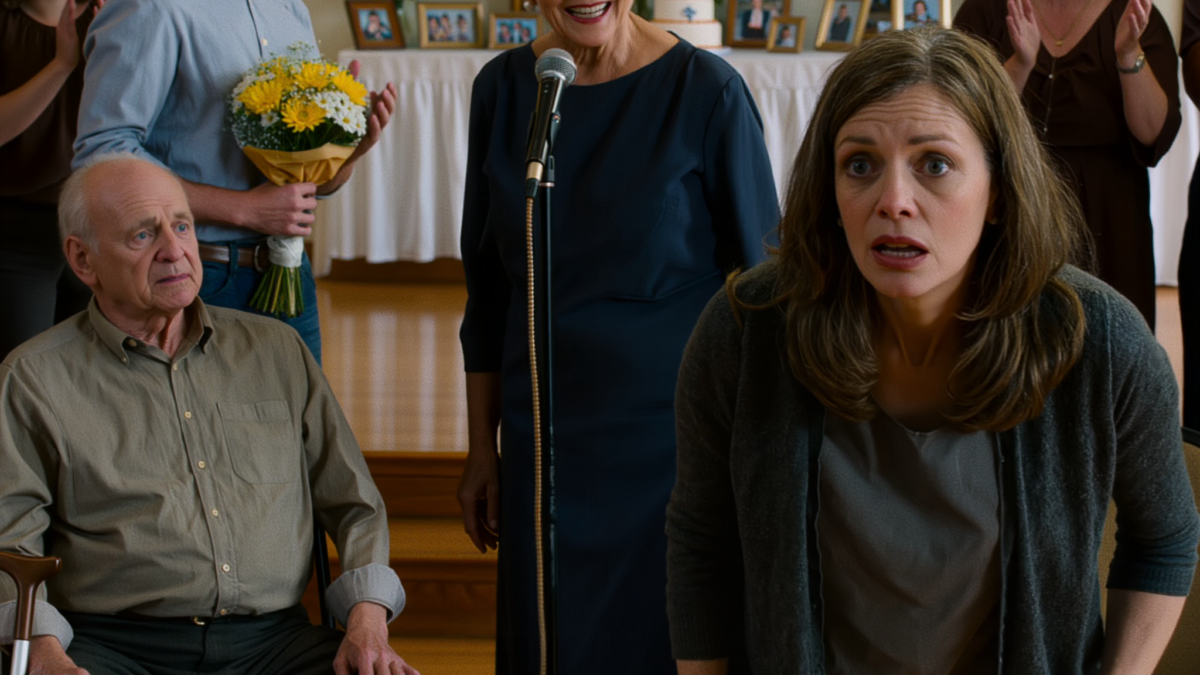
She did it at my parents’ 50th wedding anniversary, standing behind a microphone in a church fellowship hall filled with relatives, old friends, and people who had known our family for decades.
“And the best part,” Mom said brightly, “is that Ruth has agreed to take Walter in while I finally get some time to travel. Isn’t that wonderful?”
People applauded.
My younger brother, Brian, stood beside her holding the bouquet he’d brought for the occasion. Mom had already thanked him three times for the flowers and the vacation he’d arranged for her.
I was sitting near the back, still wearing the charcoal cardigan I’d thrown on after spending most of the morning carrying folding chairs and helping set up the food tables.
I hadn’t agreed to anything.
In fact, nobody had even asked me.
Mom spotted me and lifted her glass.
“Ruth has always been our dependable one. I don’t know what we’d do without her.”
More applause.
I looked across the room at my father, Walter Mason, who was sitting in a padded chair near the front.
He was 77, recovering from knee surgery, and still using a cane when he walked longer distances.
He wasn’t smiling.
That should have told me something.
Instead, I did what I’d spent most of my adult life doing.
I tried to figure out how to make the situation less uncomfortable for everybody else.
My name is Ruth Mason. I’m 50 years old, divorced, and a shift supervisor at a grocery distribution center outside a small town in Ohio.
I live in a rented two-bedroom townhouse about half an hour from my parents.
My place isn’t fancy. The upstairs bathroom has a faucet that drips unless you turn it a certain way, and my second bedroom holds a desk, an old exercise bike, and more books than any reasonable person needs.
But it’s home.
I pay the rent. I work long shifts. I decide when the lights go off at night and whether I want to spend Sunday morning drinking coffee in my pajamas.
After years of feeling responsible for everyone else’s comfort, that small amount of freedom means more to me than I can explain.
Apparently, my mother had mistaken it for availability.
To understand what happened at that anniversary party, you need to know a little about my family.
My mother, Elaine, is 74. She’s the kind of woman who sends handwritten thank-you cards, remembers everybody’s birthday, and can organize a church fundraiser with three phone calls.
People adore her.
And I understand why.
She’s warm and thoughtful when she wants to be. She can make a stranger feel welcome in five minutes.
But she has one habit that has followed me my entire life.
She decides what I can handle without ever asking what I want.
My brother Brian is four years younger than I am. He works in sales and lives about three hours away.
He’s a decent man. We get along. He remembers Christmas, calls on birthdays, and usually sends Dad something thoughtful for Father’s Day.
But Brian’s involvement in our parents’ lives has always been measured differently from mine.
When he drives down for a weekend, Mom calls everyone to tell them how wonderful it was to see her son.
When I stop by after work to take Dad to an appointment, she asks if I can pick up milk on the way.
When Brian sends flowers, she takes pictures.
When I spend a Saturday cleaning out the garage, she points out the boxes I missed.
I used to think she simply had different ways of expressing appreciation.
By 50, I should have known better.
Three months before the anniversary party, Dad had knee surgery.
The operation went as expected, but recovery was slower than he’d hoped. He could move around the house, prepare simple meals, and manage most personal tasks, but stairs were difficult, and he still needed rides to appointments.
Mom was exhausted.
I knew that.
I also knew she’d spent months worrying about Dad, managing the household, and trying to make sure he didn’t overdo things.
So I started coming over twice a week.
Then three times.
I picked up prescriptions, drove Dad to physical therapy, changed lightbulbs, took the trash cans to the curb, and made sure there was enough food in the refrigerator.
Some weeks I adjusted my work schedule to help.
I didn’t mind helping my father.
Dad had always been a gentle man, though he had a terrible habit of staying quiet whenever Mom made decisions for the whole family.
He taught me to check my tire pressure, fix a loose cabinet hinge, and never start a job I wasn’t willing to finish.
When I visited after his surgery, he’d apologize if I had to help him up from his chair.
“Dad, you don’t have to apologize every time your knee hurts.”
“I know,” he’d say. “I just don’t like being trouble.”
I understood that feeling better than he probably realized.
The anniversary party had been planned for months.
Brian offered to pay for flowers and arrange a trip for Mom. She’d spent years saying she wanted to see more of the country while she was still healthy enough to enjoy it.
He found a winter travel package and offered to accompany her for part of the trip.
Dad wasn’t ready for that kind of travel, but he encouraged her to go once they had worked out a sensible arrangement for his recovery.
I thought it was a lovely idea.
Mom had done plenty for Dad. She deserved a break.
What I didn’t know was that she had already decided what that break would cost me.
The week before the anniversary, she called while I was heating leftovers after a ten-hour shift.
“Your father is doing better,” she said. “But he’ll still need help this winter.”
“I know. His therapist said he’s making progress.”
“And that second bedroom of yours is still empty, isn’t it?”
I looked down the hallway.
“It’s not exactly empty.”
“Well, you know what I mean.”
There was a pause.
Then she began talking about the party decorations.
I didn’t think much of it at the time. Mom had a way of asking questions that sounded like harmless conversation.
Looking back, I can see she wasn’t asking.
She was checking.
On the morning of the party, I arrived at the church before nine.
The caterer was late. Two tables were in the wrong place. The projector wouldn’t recognize Brian’s laptop.
Mom was flustered.
“Thank goodness you’re here,” she said, pressing a clipboard into my hands. “I knew you’d figure everything out.”
So I did.
I moved tables, found extension cords, and helped arrange the photographs documenting my parents’ marriage, from their wedding day to family vacations and birthday celebrations.
One picture stopped me.
It showed my brother and me standing on either side of Dad in our childhood backyard.
Brian was holding a baseball trophy.
I was holding his jacket.
I remembered that afternoon.
Mom had taken a dozen pictures of Brian’s trophy and asked me to keep his things together so they wouldn’t get lost.
Nothing terrible had happened.
There hadn’t been a fight.
It was just one of those moments that had seemed too small to complain about.
There had been hundreds of them.
By noon, the hall looked beautiful.
White tablecloths, yellow flowers, framed photographs, and a cake decorated with a small gold number 50.
Mom came in wearing a navy dress and pearl earrings.
“Oh, Ruth. Everything looks wonderful.”
“Thanks.”
“Would you mind checking whether the coffee is ready?”
I went to check.
By the time the guests arrived, my feet hurt.
Brian came through the doors carrying his flowers.
Mom hurried over, kissed him on both cheeks, and announced, “Everybody, look who’s here! My wonderful boy!”
I watched her lead him around the room, introducing him to people he’d known for years.
She told them about his career, his generous gift, and the trip he had planned.
I wasn’t jealous of the flowers.
I wasn’t even jealous of the attention.
I was tired.
And I was starting to wonder how many more years I’d spend being useful at celebrations without feeling like a member of the family.
After lunch, Brian played the slideshow.
There were pictures of Mom and Dad when they were young, our first house, Brian’s graduation, my wedding, and family Christmases.
I was surprised to see my wedding photograph.
My marriage had ended six years earlier, and Mom rarely mentioned it without adding that at least Brian had been fortunate enough to build a stable life.
Still, seeing that photograph made me remember that my life had been more than work and errands.
I had been somebody with plans.
Some of them hadn’t worked out.
That didn’t mean the rest belonged to my family.
Then Mom stood for her speech.
She thanked the church volunteers, the caterer, and several friends who had traveled from out of town.
She thanked Brian for the beautiful flowers.
She thanked him for the wonderful trip.
She described how much his gift meant after such an exhausting year.
Then she turned toward me.
“And of course, there’s our Ruth.”
I straightened slightly.
“She’s always been the responsible child. Never needed much attention. Just quietly does what needs doing.”
I heard a few approving murmurs.
“That’s why I’m so grateful she’s agreed to help us through the winter.”
My stomach tightened.
Mom continued.
“Walter will be staying with Ruth while I take some time away. She has plenty of room, and she doesn’t have a husband or children to work around. It really is the perfect arrangement.”
She laughed.
Several guests laughed with her.
“And it’s nice to know we raised a daughter who understands family comes first.”
The applause started before I had time to process what she’d said.
Someone leaned across the table and told me I was a wonderful daughter.
Another woman said, “Your mother must be so proud.”
I looked at Brian.
He was still standing near Mom, one hand in his pocket.
He gave me an awkward little smile.
I recognized it immediately.
He knew.
Maybe he hadn’t understood that I’d never agreed, but he knew Mom had been planning to send Dad to my house.
I waited for him to say something.
He didn’t.
And the more I thought about Mom’s announcement, the less sense it made.
She was planning a trip during the winter, but she’d just committed my spare bedroom for the entire season.
Nobody had discussed how long Dad would actually need help, what his recovery would look like, or whether having another person stay in my rented townhouse for months would even work.
Mom had skipped all those questions.
She’d gone straight to telling everybody the decision was made.
Then she lifted the microphone again.
“Ruth, sweetheart, why don’t you stand up so everyone can thank you?”
And that was when something changed.
Not dramatically.
I didn’t suddenly become fearless.
I was embarrassed, and my heart was pounding.
But I was also angry in a way that felt different from the usual irritation I swallowed whenever Mom volunteered me for something.
She had just told a room full of people that I would rearrange my home, my work, and my entire winter around a decision I hadn’t made.
And she expected me to smile.
I stood.
“Mom,” I said, “I think there’s been a misunderstanding.”
Her expression barely changed.
“Oh, honey, don’t be modest.”
“I’m not being modest.”
A few people turned toward us.
“I haven’t agreed to have Dad move in with me.”
Mom lowered the microphone slightly.
“We talked about this.”
“You asked whether my spare bedroom was empty.”
“Well, yes.”
“That wasn’t the same thing.”
Her eyes narrowed.
I knew that expression.
It was the look she gave me when I corrected her in front of company.
“Ruth, this isn’t the place.”
I looked around the hall.
“You’re the one who announced it here.”
A couple of people looked down at their plates.
Brian shifted his weight.
Mom gave a strained laugh.
“Your father needs help, sweetheart. Surely we don’t have to argue about taking care of family.”
“I want Dad to get the help he needs.”
“Then what’s the problem?”
“The problem is that nobody asked me.”
Mom sighed into the microphone.
It made a soft sound through the speakers.
“Honestly, Ruth. Sometimes you make things harder than they need to be.”
I almost sat down.
That was the part I still remember clearly.
Not the embarrassment or the stares.
The fact that even at 50 years old, I wanted to sit down and let my mother have the last word.
I looked toward Dad.
He was watching me with an expression I couldn’t quite read.
So I asked him the question nobody had bothered to ask.
“Dad, do you want to move into my house for the winter?”
He adjusted himself in his chair.
“No,” he said.
Mom turned toward him.
“Walter—”
“No, Elaine. She asked me.”
He looked at me again.
“Ruth, I never asked to move in with you.”
For a moment, I couldn’t speak.
He continued.
“I love spending time with you. But I have my own home. I’d like to stay there while I recover, if we can make that work.”
Mom reached for the microphone as if she could somehow correct the direction the conversation had taken.
“Walter, we discussed this.”
“We discussed you going away,” Dad said. “That’s not the same thing.”
The people closest to the front were listening carefully now.
Dad rested both hands on his cane.
“There’s something else we discussed, Elaine. And I think Ruth deserves to know about it.”
Mom stopped moving.
I saw her glance toward Brian, then back at Dad.
“Walter,” she said quietly, “please don’t.”
But Dad had already made up his mind.
He took his time getting to his feet.
I moved toward him automatically, but he waved me off.
“I’m all right, honey.”
He stood beside his chair, leaning on his cane.
A few guests shifted to give him room.
He looked uncomfortable, not because he was speaking to a crowd, but because he was about to disagree with his wife in front of people who had spent fifty years knowing them as a couple.
“I’ve been looking into getting some help at home,” he said.
Mom stared at him.
“Walter, that’s private.”
“Then we shouldn’t have made Ruth’s living arrangements public.”
Nobody laughed.
Dad turned toward me.
“A couple of weeks ago, I called around about having someone come in a few mornings a week. Somebody who could help with the things your mother has been doing while I’m getting back on my feet.”
I blinked.
“You did?”
He nodded.
“I asked about the services, how scheduling works, and what it might cost. I even started figuring out what we could afford.”
I had no idea.
Dad had always been the one who avoided making decisions when Mom was involved. Hearing him describe taking those steps on his own surprised me more than the fact that help might be available.
“I told your mother I wanted us to look at the options together,” he continued. “We could use some of our savings for a little while. I’m not saying it’s cheap. I’m saying we should find out what’s possible before asking anybody to change their life.”
I looked at Mom.
She was gripping the microphone with both hands.
“You told me there wasn’t another option,” I said.
Mom shook her head.
“I said I didn’t think those services were necessary.”
“That’s not what you told me.”
“Well, I don’t want strangers coming into our house, and I certainly don’t want us wasting our savings if family can help.”
Dad’s expression tightened.
“Elaine, I told you I didn’t think Ruth should have to do everything.”
“She wouldn’t be doing everything,” Mom said. “She’d just be looking after you.”
There it was.
Just.
The word that had followed me through adulthood.
Could I just drive Dad to the doctor?
Could I just pick up groceries?
Could I just take off work on Friday?
Could I just let him stay with me for the winter?
Each request sounded small when Mom said it.
But she never seemed to notice what happened when all those small requests landed on the same person.
Dad looked toward me.
“Your mother said you wouldn’t mind,” he admitted. “I should’ve asked you myself. I didn’t.”
“Dad—”
“No. Let me finish.”
He glanced around the hall.
“I know everybody means well. And I know Ruth has been a good daughter. But being a good daughter shouldn’t mean we get to make her decisions for her.”
Mom looked as though she couldn’t believe what she was hearing.
“After fifty years of marriage, you’re going to embarrass me in front of our friends?”
Dad lowered his eyes briefly.
Then he said, “I think we’ve already embarrassed our daughter.”
That was the moment Brian finally moved.
He stepped away from the table and approached the microphone.
“Mom, I didn’t know Ruth hadn’t agreed.”
Mom turned toward him.
“Oh, don’t you start.”
“I knew you wanted Dad to stay with her. I thought you’d talked to her.”
“You heard me ask her about the bedroom.”
“Yes, but—”
“And nobody had any objections until she decided to make a scene.”
I stared at my brother.
“Brian, you knew she was planning this?”
He looked miserable.
“I knew she wanted to go on the trip. She mentioned that Dad might stay with you.”
“And you didn’t call me?”
“I figured you two would work it out.”
I let out a short, humorless laugh.
“That’s what everyone figures.”
Brian frowned.
“What does that mean?”
“It means whenever Mom has a problem, everybody assumes I’ll fix it. You don’t have to check whether I’m available because somehow I’m always supposed to be.”
“That isn’t fair.”
“No,” I said. “It isn’t.”
He opened his mouth, then closed it.
I wasn’t proud of how sharp my voice had become.
Brian hadn’t created the entire situation. He’d simply done what he’d always done: accepted Mom’s version of things because questioning it would require him to get involved.
But I was tired of pretending that wasn’t part of the problem.
Mom set the microphone down on the table.
“This was supposed to be a happy occasion.”
“I wanted it to be,” I said.
“Then why couldn’t we talk about this later?”
“Because later you would have told everyone I changed my mind. You would have said I’d promised and then let you down.”
She looked away.
I knew I was right.
More importantly, she knew it.
Dad was still standing, and I could tell his knee was bothering him.
I brought his chair closer.
He thanked me and sat down.
Mom watched the exchange.
“See?” she said, softer now. “You always take care of him. That’s all I was asking.”
I turned toward her.
“No, Mom. You weren’t asking.”
She folded her arms.
“What’s the difference?”
I took a moment before answering.
“When you ask me for help, I can tell you what I can do. We can work something out. But when you announce my answer before I give it, you’re not asking for help. You’re deciding that my time belongs to you.”
Her face hardened.
“You don’t understand what it’s been like taking care of your father.”
That stopped me.
Because there was something true beneath her anger.
I looked at Dad, then back at her.
“I know you’re tired.”
Her eyes filled unexpectedly.
“Do you?”
“Yes. I know you’ve spent months worrying about him. I know you’re scared he’ll fall when you’re not there. And I know you haven’t had a proper break since his surgery.”
She pressed her lips together.
“But I’m tired, too,” I said. “I’ve changed shifts, given up weekends, and spent nights worrying about him. I’m not saying we shouldn’t help. I’m saying we need a plan that doesn’t depend on one person giving up everything.”
Mom looked down.
For a moment, I thought she might understand.
Then she said, “It’s different for you. You live alone.”
I felt the familiar sting.
There were many things my mother had said to me over the years that sounded reasonable if you didn’t think about them too long.
That one had always hurt the most.
I lived alone.
Therefore, my time was less valuable.
I didn’t have children at home.
Therefore, I didn’t need weekends.
I was divorced.
Therefore, nobody was waiting for me.
I steadied myself against the back of a chair.
“Mom, I live alone because that’s how my life worked out. It doesn’t mean I don’t have a life.”
She looked at me.
I continued.
“Sometimes I come home from work and sit on my couch for an hour because I don’t have anything left to give. Sometimes I spend a Saturday reading a book. Sometimes I meet a friend for lunch. Those things might not look important to you, but they’re mine.”
I glanced at Brian.
“And I shouldn’t have to explain why I deserve them.”
He nodded slowly.
Mom had nothing to say.
A church volunteer approached the front table and quietly asked Brian whether they should serve the cake.
Brian looked around, clearly grateful for something practical to do.
“Yeah,” he said. “Let’s do that.”
The anniversary party didn’t end with a dramatic exit.
Nobody stormed out.
Nobody threw a glass.
The cake was cut, coffee was poured, and conversations slowly returned to normal.
But the mood had changed.
For the first time I could remember, the people around me seemed to understand that being the dependable daughter had come with a price.
I wasn’t sure whether that made me feel better.
Mostly, I felt exposed.
I helped Dad back into his chair after dessert and gathered the photographs I’d brought from home.
Brian found me near the coat rack.
“Can we talk?”
I kept folding the tissue paper around a framed photograph.
“Sure.”
He stood beside me for a moment.
“I really didn’t know she’d sprung that on you.”
“I believe you.”
“Then why are you so angry with me?”
I looked at him.
“Because you never thought to ask.”
He studied the floor.
“I guess I figured you were handling it.”
“That’s the problem, Brian.”
He nodded.
“I know.”
I wasn’t expecting much from that conversation.
My brother was good at saying the right thing when he felt bad. I needed to see whether he’d do something afterward.
Then he surprised me.
“What if I help Dad find somebody?” he asked. “I can make calls during the week. See what services are available.”
“That would be a start.”
“And I’ll talk to Mom about the trip. We can move it if we need to.”
I looked at him carefully.
“You paid for it?”
“Most of it. There’s still some flexibility with the dates.”
“Then don’t let her make you feel like you wasted your money if she has to postpone.”
He gave me a tired smile.
“Look at you. Still trying to make sure everybody’s okay.”
I hadn’t realized I was doing it.
Neither of us said anything for a moment.
Then he added, “You don’t have to manage me, Ruth. I can make the calls.”
It was a small promise.
But it was the first time he’d offered to take responsibility without asking me to explain what needed to be done.
Dad asked me to walk him to the car after the party.
Mom had gone to thank the kitchen volunteers, leaving us a few minutes alone.
We moved slowly across the parking lot.
The afternoon air was cool, and Dad stopped once to adjust his grip on the cane.
“Are you all right?” I asked.
He looked at me.
“I should be asking you that.”
“I’m okay.”
He gave me a familiar look.
“You’ve been saying that since you were little.”
I didn’t answer.
We reached the car, and he rested one hand on the door.
“I need to apologize for something.”
“Dad, you don’t have to—”
“Yes, I do.”
He waited until I looked at him.
“I knew your mother expected too much from you. I’ve known for a long time.”
My throat tightened.
“Then why didn’t you say anything?”
He looked toward the church.
“Because every time she asked you to do something, you did it. And I let myself believe that meant it was all right.”
He rubbed his thumb along the handle of his cane.
“I thought staying out of it was keeping the peace.”
“It wasn’t peaceful for me.”
“I know that now.”
I looked away, blinking hard.
He continued.
“When I called about getting help at home, I wasn’t just thinking about your mother. I was thinking about you. I kept picturing you driving over after working all day, looking exhausted and telling me you were fine.”
“Dad—”
“I should have spoken up sooner.”
There was nothing dramatic about the apology.
He didn’t try to explain away decades of silence.
He simply stood beside the car, leaning on his cane, and admitted he’d been wrong.
That mattered more than I expected.
I helped him into the passenger seat.
Before I closed the door, he reached for my hand.
“I want you to come visit because you want to, honey. Not because you think I’m another job you have to finish.”
I squeezed his fingers.
“I’d like that.”
Mom didn’t speak to me for four days.
On Wednesday evening, Brian called.
He’d contacted several home-care agencies, and Dad had helped him describe what he actually needed. They were comparing availability, services, and prices instead of assuming one arrangement would solve everything.
Nothing had been scheduled yet.
That was fine.
At least someone was finally doing the work of finding out.
Brian had also spoken to Mom about postponing her trip.
“She wasn’t happy,” he admitted.
“I didn’t expect her to be.”
“She says you humiliated her.”
I closed my eyes.
“Does she understand why I was upset?”
There was a pause.
“I don’t think she wants to.”
That answer hurt, but I appreciated that he didn’t pretend otherwise.
Over the next two weeks, Brian followed through.
He made calls, compared the information he’d gathered, and discussed options with Dad.
They found a provider with some availability and arranged an initial visit to talk through what support would be appropriate. A few mornings of help looked possible, depending on scheduling and what Dad actually needed.
Mom resisted at first.
She worried about the cost.
She worried about having strangers in the house.
She worried that people would think she wasn’t capable of caring for her husband.
Brian finally told her something I wished he’d said years earlier.
“Mom, needing help doesn’t mean you’ve failed. But making Ruth do everything isn’t a plan.”
She didn’t answer him.
Still, she agreed to sit down with Dad and discuss the options.
The vacation was postponed.
Not canceled forever.
Just delayed until they had a workable arrangement that Dad was comfortable with.
I kept visiting, but I stopped organizing my entire week around whatever Mom might need.
I told Dad I could take him to one regular appointment each week when my work schedule allowed. I could help with groceries on certain Saturdays.
For anything beyond that, we would talk first.
The first time I told Mom I couldn’t come over on a Sunday, she was clearly annoyed.
“But what are you doing?”
“I’m staying home.”
She waited.
I could almost hear her expecting a better explanation.
Finally, she said, “Well, I suppose you need your rest.”
I knew she meant it as criticism.
I decided not to treat it like one.
“I do,” I said.
And I stayed home.
About a month after the anniversary, Mom called me on a Tuesday night.
I was sitting at my kitchen table eating soup from a bowl that didn’t match the plate under it.
“Hello, Mom.”
“Hello, Ruth.”
She asked about work.
Then she told me Dad had been enjoying his visits with the home-care worker they’d arranged for a trial schedule.
“He likes having somebody to talk to in the mornings,” she admitted.
“That’s good.”
There was a pause.
“I suppose the arrangement is working better than I expected.”
I stirred my soup.
“I’m glad.”
Another pause.
Then she said, “I still think you could have handled the anniversary differently.”
My shoulders tightened.
I looked at the clock above the stove.
I could have argued.
I could have reminded her that she’d made the announcement in front of everybody.
I could have listed the years of favors, the missed weekends, and the times she’d spoken about my life as though it were a resource she could borrow.
Instead, I said, “Maybe I could have. But I needed you to hear me, Mom.”
“I heard you.”
“Did you?”
The question hung between us.
Finally, she said, “I didn’t realize you felt that way about helping us.”
“I don’t feel bad about helping you. I feel bad when helping stops being my choice.”
She was quiet for a long time.
Then she said, “I guess I never thought of it that way.”
It wasn’t an apology.
I wasn’t going to pretend it was.
But it was the first time she had acknowledged that there might be another way to see things.
We talked for a few more minutes.
Before hanging up, she said, “Your father would like to see you this weekend.”
“I’ll call him tomorrow and make a plan.”
Normally, Mom would have given me a time.
That night, she simply said, “All right.”
The following Saturday, I went to see Dad.
He was sitting on the back patio with a blanket across his knees, watching birds at the feeder.
Mom was inside folding laundry.
I brought two cups of coffee and sat beside him.
For a while, we talked about ordinary things.
Work.
The weather.
Brian’s latest phone call.
Then Dad asked, “Are you happy living on your own, Ruth?”
I thought about my little townhouse.
The dripping faucet.
The books.
The freedom to leave the dishes until morning without anyone commenting on it.
“Yes,” I said. “I am.”
He nodded.
“Good.”
He took another sip of coffee.
“Your mother and I got married young. We spent most of our lives making decisions together, or at least trying to. Somewhere along the way, I think she started believing that being family meant everybody should want the same things.”
I looked at him.
“Maybe.”
He turned toward me.
“But you get to want your own things.”
I didn’t answer right away.
I’d spent so many years defending my choices that I almost didn’t know what to do when somebody simply accepted them.
Dad reached over and patted my hand.
“I’m proud of you.”
The words caught me off guard.
Not because I’d never heard them before, but because this time they weren’t attached to something I’d accomplished for somebody else.
He wasn’t proud because I’d driven him to the doctor.
Or helped organize a party.
Or taken care of a problem that wasn’t mine.
He was proud because I’d stood up for myself.
When I left that afternoon, Mom walked me to the front door.
She asked whether I wanted to take home some leftover casserole.
I thanked her but declined.
She didn’t insist.
At the bottom of the porch steps, she called my name.
“Ruth?”
I turned.
“I’m going to call your brother about Thanksgiving,” she said. “I want to make sure everybody has a chance to say what works before we decide anything.”
I looked at her for a moment.
“That’s a good idea, Mom.”
She nodded, then went back inside.
I drove home through the quiet streets of the neighborhood where I’d grown up.
I thought about the anniversary party, the flowers Brian had brought, and the way Mom had smiled as she asked everyone to thank me for a sacrifice I hadn’t offered to make.
For years, I’d accepted those moments because correcting her seemed more exhausting than simply doing what she wanted.
But that afternoon had shown me what happened when I finally spoke.
Dad had been able to say what he wanted.
Brian had taken on work he’d previously left to me.
And Mom, though she still struggled to understand, had begun asking instead of announcing.
None of it had happened overnight.
We still had uncomfortable conversations. Mom still sounded disappointed sometimes when I said no. And I still had to remind myself that I was allowed to make plans without first checking whether my family needed me.
But Dad was receiving help at home, and I could visit him as his daughter rather than arrive with another list of errands.
When I got back to my townhouse, I put my keys on the kitchen counter and opened the door to my second bedroom.
The desk was cluttered, the exercise bike needed dusting, and a stack of books sat beside the window.
I had been meaning to make a reading corner in there for months.
Every time I started, something else seemed more urgent.
That evening, I finally moved the boxes away from the window, pulled a chair into the cleared space, and set a small lamp beside it.
I was arranging my books when Dad called.
He wanted to know whether I was free to have lunch with him the following weekend.
“Just lunch?” I asked.
“Just lunch,” he said. “No errands. No appointments. Your choice of restaurant.”
I looked at the chair by the window.
“I’d like that, Dad.”
After we hung up, I made myself a cup of tea and carried it upstairs.
The chair was comfortable. Through the window, I could see the trees behind the townhouse moving in the evening breeze.
I opened a book I’d been trying to finish for weeks.
Halfway through the first page, my phone buzzed.
For an instant, I reached toward it automatically.
Then I saw it was only a routine notification.
I turned the phone over, settled back into my chair, and kept reading.
For the first time in a long while, I didn’t feel that I was neglecting someone by enjoying my own home.