My Sister Tried to Exclude My Adopted Daughter From Mom’s 75th Birthday Portrait
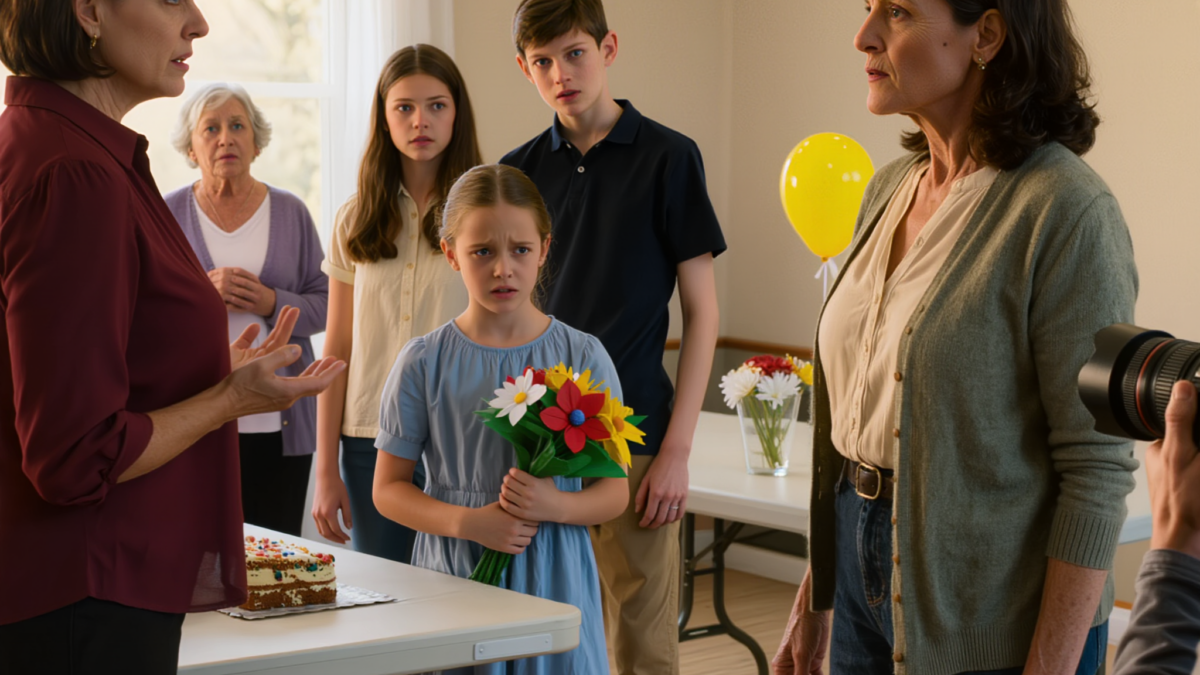
“Sadie, honey, why don’t you step aside for this one?”
My sister said it with a pleasant smile, as though she were asking my thirteen-year-old daughter to move away from a window.
We were at our mother’s 75th birthday party. The photographer had just arranged the grandchildren for a picture, and Sadie was standing between her cousins, holding the paper flowers she’d spent three evenings making for Grandma.
She looked at my sister, then at me.
“Where should I go?”
My sister Denise gestured toward the side of the room.
“We’re doing the biological grandchildren first. Then we can take one with everybody.”
Sadie’s fingers tightened around the green paper stems.
Her cousin Erin slowly lowered the arm she’d draped around Sadie’s shoulders.
And I felt something inside me sink.
There were relatives watching. My mother was standing beside the photographer, and Denise was already turning back toward the camera, expecting everyone to follow her instructions.
For a moment, I couldn’t speak.
Not because I didn’t know what was wrong.
Because I knew exactly how much those few words would hurt my daughter.
My name is Laura Bennett. I’m forty-eight years old, I work in the administrative office of a public school in Dayton, Ohio, and I’ve been Sadie’s mother for four years.
But apparently, after four years of birthday parties, Christmas mornings, family dinners, and school celebrations, my sister still believed there was a kind of family photograph my daughter didn’t belong in.
And she’d chosen my mother’s birthday to make that clear.
Three evenings before the party, Sadie had taken over our kitchen table with construction paper, scissors, glue, and a pile of colored markers.
She was making flowers for Grandma Rose.
Not ordinary paper flowers, either.
Each rose had several layers of carefully curled petals. Each daisy had a yellow center and a stem wrapped in green paper. She’d watched tutorials, tried different techniques, and started over whenever something didn’t look right.
At one point, I found her holding a slightly crooked daisy at arm’s length.
“Do you think Grandma will think these are too childish?”
I looked up from the dishes.
“She still has the birthday card you made when you were ten.”
“That was different.”
“How?”
“I was ten, Mom.”
I laughed.
She gave me the patient look teenagers reserve for adults who clearly don’t understand anything.
“Fair point,” I admitted.
She went back to shaping the petals.
My mother had always loved flowers. She had a small garden behind her house and knew which plants could survive an Ohio winter and which ones needed to be brought inside.
Sadie wanted to give her something that would last.
“Real flowers die,” she explained. “These won’t.”
I watched her bend over the kitchen table, concentrating so hard that a loose strand of hair kept falling across her face.
Four years earlier, I never would have imagined seeing her so completely at home.
When Sadie first came into my life, she was nine years old and painfully careful about everything.
She asked permission before getting a glass of water.
She apologized for leaving a book on the couch.
For months, she kept most of her belongings neatly arranged inside one dresser drawer, even though she had an entire bedroom.
I never forced her to explain those habits.
I just kept showing her that she belonged.
Our adoption was finalized four years ago. By then, I’d already learned that becoming a mother wasn’t one big moment of understanding. It happened through hundreds of ordinary things.
Packing lunches. Remembering favorite meals. Helping with homework. Sitting outside her bedroom when she was upset but didn’t want to talk.
And making sure that when she woke up the next morning, I was still there.
My mother understood that.
Rose Bennett was seventy-five now, and she’d accepted Sadie into her life without making the child earn a place.
At first, Sadie called her Mrs. Bennett.
Then she tried Rose.
One afternoon, while Mom was teaching her how to make biscuits, Sadie accidentally called her Grandma.
She immediately went red.
“I’m sorry. I didn’t mean—”
Mom simply asked whether she wanted another biscuit.
Sadie nodded.
And after that, Grandma was Grandma.
There was no discussion about bloodlines.
No explanation required.
Just a little girl finding a name that felt right, and an older woman letting her keep it.
My sister, unfortunately, saw things differently.
Denise is four years older than I am.
She’s fifty-two, married, and the mother of two teenagers: Erin, seventeen, and Caleb, fifteen.
Growing up, Denise was always the organized one.
She decided where we should sit during family dinners. She made lists before vacations and insisted everyone follow them. She remembered birthdays, coordinated holiday meals, and could organize a gathering before anyone else realized one was being planned.
Sometimes that was helpful.
Our mother certainly appreciated it, especially as she got older.
But Denise had a habit of confusing organizing the family with deciding what the family should be.
If she arranged Thanksgiving, she controlled the seating.
If she planned Christmas, she decided when everyone should arrive.
And if somebody disagreed, Denise acted as though they’d personally attacked her.
I’d spent most of my life trying not to argue with her.
It was easier to let her choose the restaurant than to spend an evening listening to why my suggestion was impractical.
I told myself those little compromises didn’t matter.
But after Sadie joined our family, Denise began making distinctions that mattered very much.
She would introduce Erin and Caleb as Mom’s grandchildren, then refer to Sadie as “Laura’s girl.”
At Christmas one year, she called my daughter “a wonderful addition.”
I pulled her aside afterward.
“Denise, Sadie isn’t an addition to a recipe.”
My sister rolled her eyes.
“You know what I meant.”
“Then say what you mean.”
“I was being nice, Laura.”
That was usually how our disagreements ended.
Denise insisted she’d meant nothing hurtful, and I eventually stopped talking because I didn’t want another family gathering to turn into an argument.
I used to think I was keeping the peace.
Looking back, I was mostly keeping Denise comfortable.
Fortunately, her children had never adopted her attitude.
Erin took Sadie shopping for her first middle-school dance.
Caleb taught her a card game they played whenever the family got together.
The three of them had their own jokes, complained about school, and treated one another like cousins who’d known each other forever.
Sadie adored them.
And I trusted that affection.
That’s why I wasn’t worried when we arrived at Mom’s birthday party.
Denise had rented a community room in Dayton for the celebration.
It wasn’t an expensive affair.
There were folding tables covered with white plastic tablecloths, balloons tied to chairs, casseroles brought by relatives, and a large grocery-store birthday cake.
My mother loved every bit of it.
She’d spent the previous month insisting she didn’t want anyone making a fuss.
Of course, that meant she wanted everyone together. She just didn’t want anybody spending too much money.
Sadie wore the light blue dress she’d chosen for the occasion.
She carried her handmade flowers in both hands, wrapped loosely in tissue paper so the petals wouldn’t bend during the drive.
When we walked into the room, Mom was standing near the birthday cake.
She spotted Sadie immediately.
“There’s my girl!”
Sadie hurried over and wrapped her arms around her grandmother.
“Happy birthday, Grandma.”
She held out the flowers.
Mom examined them carefully.
“Oh, sweetheart. Look at these.”
“They’re paper,” Sadie said quickly. “I thought maybe they’d last longer.”
“Well, they’re beautiful.”
Mom picked up a glass vase from the counter, arranged the flowers inside it, and placed them on the table where everyone could see.
Sadie watched the entire process.
The smile on her face was worth every scrap of construction paper we’d had to clean off our kitchen floor.
Erin came over to admire the flowers.
“Okay, you’re making me some for graduation.”
“You haven’t graduated yet,” Sadie pointed out.
“Exactly. You have time.”
Caleb appeared behind his sister and wanted to know whether Sadie had brought their usual card game.
Within minutes, all three were laughing together near the refreshments.
For the first hour, everything was wonderful.
Mom talked with relatives.
People ate cake before the main food.
Denise moved between tables making sure everything ran according to her schedule.
I even caught myself thinking that maybe I’d been too hard on my sister.
Then the photographer arrived.
Denise had arranged for a professional photographer to take pictures for Mom’s milestone birthday.
She wanted one photograph with all the relatives, then smaller pictures of different family groups.
It sounded like a thoughtful gift.
Mom had been saying for years that nobody printed photographs anymore. Everything stayed on phones, and she wanted something she could put in a frame.
The photographer set up near a large window where the afternoon light was soft.
Denise began directing everyone.
“Mom in the middle. Laura, stand on her left. I’ll be on the right.”
We did as she asked.
Several relatives gathered behind us.
The photographer took a few pictures, checked his camera, and nodded.
“Those look great.”
Denise clapped her hands.
“All right, now let’s do Mom with the grandchildren.”
Erin and Caleb stepped forward.
Sadie followed naturally.
Erin put an arm around her shoulders, and Caleb joked about being forced to stand in front because he wasn’t tall enough to hide behind everyone.
Sadie laughed.
The photographer lifted his camera.
That’s when Denise interrupted.
“Sadie, honey, why don’t you step aside for this one?”
Sadie’s smile disappeared.
She looked at Denise, confused.
“Where should I go?”
Denise gestured toward the side of the room.
“We’re doing the biological grandchildren first. Then we can take one with everybody.”
I stared at her.
“Denise, what are you talking about?”
She looked surprised that I was questioning her.
“I want one picture of Mom with her biological grandchildren.”
“Why?”
“Because I do, Laura. It’s a family tradition.”
Sadie had already taken a small step backward.
She was holding the paper flowers she’d picked up from Grandma’s vase because she’d wanted them included in the photograph.
Now she pressed them against her blue dress.
I recognized the look on her face.
I’d seen it years earlier, when she was still learning the rules of our home and thought making a mistake might mean she’d done something terribly wrong.
My stomach tightened.
“Denise,” I said, trying to keep my voice steady, “what exactly are you asking my daughter to do?”
My sister sighed.
“Please don’t start.”
“I’m asking a question.”
“It’s one picture.”
“One picture of what?”
“Of the biological grandchildren. I’ve already explained.”
The photographer lowered his camera slightly.
Mom looked between us, clearly trying to understand the disagreement.
Denise continued.
“There’s nothing wrong with wanting a traditional family photograph.”
“Sadie is family.”
“Nobody said she wasn’t.”
“You just told her to stand outside the family picture.”
Denise glanced at the photographer as though I were embarrassing her.
“Could we please not make this a production?”
I looked at my daughter.
Her eyes were fixed on the floor.
And suddenly, I wasn’t thinking about whether Denise would be angry with me afterward.
I was thinking about what Sadie would remember.
Would she remember standing with her cousins, excited to be photographed beside Grandma?
Or would she remember being told to move because the family had decided she belonged in a different category?
I turned toward the photographer.
“Would you mind lowering your camera for a minute?”
He lowered it immediately.
Denise’s face tightened.
“Laura.”
“No,” I said. “We’re not taking that picture.”
“Excuse me?”
“If my daughter isn’t included, neither am I.”
Denise gave an incredulous laugh.
“You don’t have to be in it. I want Mom and the grandchildren.”
“Sadie is one of Mom’s grandchildren.”
“I understand that she’s your daughter.”
The way she emphasized your made my chest ache.
“My daughter,” I repeated. “Yes. That’s exactly what she is.”
Denise folded her arms.
“You’re making this sound ugly when it isn’t.”
“Then explain why Sadie has to step out.”
“Because I wanted one picture showing the family line. Our family has been taking those photographs for generations.”
I looked around the rented community room.
At the balloons.
At the partly eaten birthday cake.
At my thirteen-year-old daughter holding paper flowers she’d made with her own hands.
“Denise, this isn’t a historical archive. It’s Mom’s birthday party.”
“Exactly,” she replied. “So stop turning it into an argument.”
For a moment, I felt the old pressure to give in.
There were relatives watching.
Denise had organized the entire celebration.
My mother was seventy-five, and the last thing I wanted was for her birthday to become an argument between her daughters.
A few years earlier, I probably would have suggested taking both photographs and discussing my feelings privately with Denise afterward.
But Sadie was standing right beside me.
And she was listening to every word.
“Mom?”
Sadie touched my elbow.
I turned toward her.
Her voice was so quiet I had to lean closer.
“It’s okay. We can just leave.”
I felt my heart sink.
“Do you want to leave, sweetheart?”
She glanced toward Grandma, then back at the flowers in her hands.
“I don’t want to ruin her birthday.”
There are moments when being a mother means finding the right words.
And there are moments when you realize you’ve waited too long to say them.
I crouched slightly so we were closer to eye level.
“Sadie, you’re not ruining anything.”
“But everybody’s upset.”
“That’s not because of you.”
She looked past me toward Denise.
“Maybe we could just take the other picture.”
I knew exactly what she was offering.
She was willing to step aside, smile afterward, and pretend nothing had happened.
She’d probably even manage to convince everyone she was fine.
Sadie had spent years learning how to make adults comfortable, even when she wasn’t.
I hated that she thought she needed to do it again.
I took her hand.
“You don’t have to agree to something that makes you feel smaller just so everyone else can have a nice afternoon.”
Her eyes filled with tears.
I hadn’t intended to make her cry.
Part of me wanted to gather her things, take her home, and spend the rest of the afternoon somewhere she wouldn’t have to worry about whether she belonged.
But another part of me knew that leaving without challenging Denise would allow my sister to tell the story however she pleased.
Laura overreacted.
Laura made a scene.
Laura wouldn’t let us take a simple family photograph.
And Sadie would remember that she’d walked away while everyone else stayed.
So I stood beside her.
Denise had been speaking quietly with the photographer while I comforted my daughter.
Now she raised her voice.
“Can we please finish? Mom’s getting tired.”
She looked toward Erin and Caleb.
“Kids, come on. Stand beside Grandma.”
Neither moved immediately.
Erin glanced toward Sadie.
Caleb looked at his mother.
Denise motioned with her hand.
“Come on, you two. Let’s get this picture taken.”
For one awful moment, I wondered whether I’d made things even harder for my daughter.
Erin and Caleb were Denise’s children.
They loved Sadie, but they were teenagers standing in front of a room full of relatives.
Their mother was telling them what to do.
I couldn’t expect them to challenge her.
And I certainly didn’t want Sadie to watch her cousins choose a photograph over her.
The photographer waited.
Denise stood beside Mom, tapping her fingers against her arm.
Then Erin stepped forward.
But she didn’t walk toward Grandma.
She walked straight to Sadie.
“Are you okay?” she asked.
Sadie shrugged.
Erin took her hand.
Caleb followed, stopping on Sadie’s other side.
Denise blinked.
“What are you doing?”
Erin looked directly at her mother.
“We’re standing with Sadie.”
“I asked you to get in the picture.”
“We know.”
Caleb spoke next.
“Then put Sadie in it.”
Denise stared at him.
“Caleb, this is not your decision.”
He shifted his weight, looking uncomfortable.
For a second, I thought he might back down.
Instead, he said, “It’s a picture of the grandkids. She’s our cousin.”
Denise turned to Erin.
“Are you seriously going to make a scene over this?”
Erin’s cheeks flushed.
I could see how difficult it was for her.
She was seventeen, contradicting her mother in front of relatives, and Denise wasn’t someone who handled public disagreement well.
But Erin didn’t move.
“Mom, you’ve spent the whole afternoon telling everyone we’re making family memories.”
Denise frowned.
“So?”
Erin looked at Sadie.
“What do you think she’s going to remember about this?”
My sister opened her mouth.
Nothing came out.
“She’s thirteen,” Erin continued, her voice quieter now. “She heard you.”
Caleb reached over and gently took the paper flowers from Sadie’s arms so she could wipe her eyes.
Then he handed them back.
“Besides,” he said, “we’re not doing two versions of Grandma’s grandkids.”
I had to look away for a moment.
I’d spent the last several minutes trying to explain why my daughter deserved to stand in a family photograph.
Two teenagers had just made the same point without a speech.
They simply refused to leave her behind.
And for the first time that afternoon, I saw something change in Sadie’s face.
She was still upset.
But she wasn’t standing alone anymore.
Mom had been watching from beside the window.
She wasn’t a woman who enjoyed confrontation.
At seventy-five, she preferred quiet conversations, familiar routines, and family gatherings where everyone went home with leftovers.
But she was also perfectly capable of making herself heard.
“Denise.”
My sister turned.
“Mom, I’m sorry about all this. I was just trying to arrange a nice photograph for you.”
Mom looked at Sadie.
Then at Erin and Caleb standing beside her.
“Did you ask Sadie to leave the picture?”
Denise hesitated.
“Only the first one.”
“Why?”
“Because I thought you’d appreciate having a photograph of your grandchildren by blood.”
Mom studied her for a moment.
“Did I ask you for that?”
“No, but—”
“Did I ever say I wanted it?”
Denise’s shoulders dropped slightly.
“No.”
Mom reached for the back of a folding chair.
I started toward her, thinking she wanted to sit down.
She waved me off.
“I’m fine, Laura.”
Then she looked at Denise again.
“I know you worked hard on this party. And I appreciate everything you’ve done.”
Denise nodded.
“But I don’t understand why you thought I’d want to celebrate my birthday by sending one of my grandchildren away.”
“Mom, that’s not what I was doing.”
“Then what were you doing?”
Denise glanced around the room.
For once, she didn’t have an immediate answer.
Finally, she said, “I just think there’s value in remembering where a family comes from.”
Mom nodded slowly.
“There is.”
I saw a flicker of relief cross Denise’s face.
Then Mom continued.
“And I know exactly where Sadie comes from. She came into Laura’s life four years ago, and she’s been part of mine ever since.”
Sadie made a small sound beside me.
Mom held out her hand.
“Come here, sweetheart.”
Sadie looked at me.
I nodded.
She walked toward Grandma, still holding the flowers.
Mom gently moved the stems aside and pulled her into a hug.
“Those flowers you made for me,” she said, “do you know why I like them so much?”
Sadie shook her head.
“Because you sat there and made each one with me in mind. You didn’t have to do that.”
Mom looked toward Denise.
“Family isn’t something I want photographed correctly. It’s people showing up for one another.”
She turned back to Sadie.
“And I want a picture with all three of my grandchildren.”
Nobody applauded.
There wasn’t a dramatic speech from the relatives or a sudden chorus of apologies.
The photographer simply asked whether everyone was ready.
And somehow, that ordinary question made the moment feel even more important.
Mom stood in front of the window with Sadie beside her.
Erin moved to Grandma’s other side.
Caleb took his place behind them, bending slightly so the photographer could see everyone’s faces.
Mom insisted that Sadie’s flowers be included.
“Those are part of my birthday,” she told the photographer.
Sadie finally smiled.
It was a small smile at first.
Then Caleb joked that he always looked like he was blinking in family pictures.
Erin told him that was because he never stopped talking.
Sadie laughed.
The photographer lifted his camera.
“Everybody look here.”
The camera clicked.
Then Mom called me over.
“Laura, get in the next one.”
I hesitated.
Denise was standing near the refreshments table, looking down at her hands.
Part of me wanted to leave her there.
I wanted her to understand what it felt like to be standing outside a family moment, wondering whether anyone would make room.
But the feeling passed almost as quickly as it came.
I wasn’t trying to punish Denise.
I was trying to protect Sadie.
Those were different things.
I joined Mom and the children.
Several relatives stepped into position.
Eventually, Denise joined the larger group photograph, too.
Nobody told her she couldn’t.
I didn’t want my daughter to learn that belonging required making somebody else an outsider.
The photographer took several more pictures.
Afterward, the party slowly returned to normal.
People collected leftovers.
Someone started stacking chairs.
The photographer packed away his equipment.
But things weren’t exactly the same.
Denise barely looked at me.
And Sadie stayed close to Erin and Caleb for the rest of the afternoon.
When we got home, Sadie went upstairs to change.
I put our leftover cake in the refrigerator and started washing the serving spoon we’d brought back.
A few minutes later, she appeared in the kitchen wearing sweatpants and an old school T-shirt.
“Mom?”
“Yeah?”
“Can I ask you something?”
“Always.”
She leaned against the counter.
“Was Aunt Denise always like that?”
I dried my hands.
It would have been easy to say yes.
After everything that had happened, I was angry enough to make my sister sound like a villain who’d never done a kind thing in her life.
But that wasn’t true.
Denise had helped me move apartments.
She’d brought groceries when I had the flu.
She’d organized celebrations for Mom and spent countless hours making sure family gatherings happened.
She wasn’t incapable of kindness.
She was capable of being kind to some people while treating others unfairly.
And I didn’t want to teach Sadie that the good things someone had done meant we had to excuse the hurtful ones.
“Your aunt has always liked deciding how things should be,” I told her. “Sometimes she has trouble accepting that other people see things differently.”
Sadie considered that.
“Does she not like me?”
There it was.
The question I’d been dreading since the photographer lowered his camera.
I pulled out a chair.
“Come sit with me.”
She sat across from me.
“I don’t know exactly what Denise feels,” I said. “But I know she treated you unfairly today.”
Sadie looked at her hands.
“Maybe she thinks I’m different from Erin and Caleb.”
“You are different from them in lots of ways. Erin likes theater, Caleb likes basketball, and you like art. None of that changes the fact that you’re cousins.”
She gave me a tired look.
“You know what I mean.”
“I do.”
I reached across the table.
“You became my daughter through adoption. That’s part of our story, and I’m never going to pretend it isn’t. But it doesn’t make you less my daughter.”
She was quiet for a while.
Then she asked, “Did you get mad because she embarrassed you?”
“No.”
“Then why?”
“Because she hurt you.”
Sadie looked up.
“And because I should have spoken up sooner.”
Her eyebrows drew together.
“What do you mean?”
I thought about every uncomfortable comment I’d dismissed.
Every time Denise referred to Sadie differently from the other children.
Every time I’d told myself she probably meant well.
“I’ve let your aunt say things before that I didn’t like,” I admitted. “I thought talking to her privately was enough. Today made me realize I haven’t always handled it well.”
Sadie looked surprised.
Children spend so much time listening to adults explain what they should do that they don’t always expect us to admit when we’ve done something wrong.
“You’re usually the one telling me I can say when something bothers me,” she said.
“I know.”
“And you didn’t?”
“Not as clearly as I should have.”
She thought about that.
Then she leaned forward and hugged me.
“I’m glad you did today.”
I wrapped my arms around her.
I couldn’t promise that nobody would ever make her feel unwanted again.
But I could promise that she wouldn’t have to face those moments without me.
Denise didn’t call that evening.
She didn’t call on Sunday, either.
Mom called Monday afternoon.
She told me she’d enjoyed her birthday and that the photographer had already sent a few preview photographs.
“I want the one with the three kids,” she said.
“I figured you would.”
There was a pause.
“And Laura?”
“Yeah?”
“I’m sorry I didn’t understand what was happening sooner.”
“You didn’t cause it, Mom.”
“I know. But I was standing right there.”
I understood what she meant.
She’d seen Sadie’s face.
She knew that even though the photograph had turned out beautifully, the afternoon had left something behind.
“Sadie loves you, Mom.”
“I love her.”
“I know.”
Mom told me she’d put the paper flowers on her kitchen table.
“I keep thinking about how long she must have worked on them.”
“Three evenings.”
“Well, tell her they’re the prettiest flowers in Dayton.”
I laughed.
“She’ll like that.”
After we hung up, I found Sadie doing homework at the dining room table.
I passed along Grandma’s message.
She tried not to smile too widely.
It didn’t work.
Denise finally sent me a message three days after the party.
It was longer than anything she’d written to me in years.
She said she’d been thinking about what happened.
She claimed she’d wanted a photograph that reflected the family she’d grown up with and hadn’t realized how hurtful her request would sound.
Then she admitted something I hadn’t expected.
Since Sadie joined the family, Denise had felt that Mom’s attention had shifted.
Rose often talked about Sadie’s school projects, displayed her handmade gifts, and told stories about the afternoon Sadie first called her Grandma.
Denise worried that Erin and Caleb were somehow becoming less important.
I read that part twice.
It didn’t make her behavior acceptable.
But it helped me understand what she’d been afraid of.
Denise seemed to believe that if Mom loved Sadie more openly, there would somehow be less love available for her own children.
It was an ugly way to think about family.
And the saddest part was that Erin and Caleb clearly didn’t share it.
I replied that Mom had enough love for all three grandchildren.
Then I told Denise that she’d hurt Sadie by treating love like something that had to be divided into categories.
I also told her that if she wanted to make things right, she needed to apologize directly to Sadie.
Not to me.
Not to Mom.
To the child she’d embarrassed.
Denise asked whether she could call.
I didn’t answer for Sadie.
I asked my daughter what she wanted.
“You don’t have to talk to her,” I explained. “And you don’t have to decide right now.”
Sadie thought about it through dinner.
Eventually, she said she wanted to hear what Aunt Denise had to say, as long as I stayed with her.
So we called together.
Denise sounded different from the confident woman who’d stood beside the photographer.
She sounded nervous.
“Sadie,” she began, “I’m sorry I asked you to step out of the picture.”
Sadie held the phone on speaker between us.
Denise continued.
“I made you feel like you didn’t belong, and that was wrong. You shouldn’t have had to hear me say those things.”
There was a pause.
Then Sadie asked, “Why did you do it?”
I could hear Denise take a breath.
“I was thinking about what I wanted the picture to look like. I wasn’t thinking enough about how it would make you feel.”
“But you know I’m Mom’s daughter.”
“Yes.”
“And Grandma’s granddaughter.”
“Yes, Sadie.”
“Then I don’t understand.”
Denise didn’t answer immediately.
Finally, she said, “I don’t have a good answer. I was wrong.”
I watched Sadie’s face.
She looked disappointed, but she was listening.
“I’m sorry,” Denise repeated.
Sadie stared at the phone.
Then she said, “Okay.”
Denise sounded hopeful.
“Does that mean we’re all right?”
Sadie looked at me.
I shook my head slightly, reminding her that she didn’t have to give an answer just to make her aunt feel better.
“I don’t know yet,” Sadie said.
Denise was quiet.
Then she answered, “That’s fair.”
The call ended a few minutes later.
Sadie put the phone down.
“Was that rude?” she asked.
“No.”
“I didn’t say I forgive her.”
“You don’t have to say something you don’t feel.”
She nodded.
Then she went upstairs to finish her homework.
I sat at the kitchen table for a long time afterward.
My thirteen-year-old had just handled a difficult conversation with more honesty than I’d managed in many disagreements with Denise.
She’d listened.
She’d asked a fair question.
And she’d refused to make a promise she wasn’t ready to keep.
I was proud of her.
The following weekend, Denise and I spoke privately.
I told her I wasn’t cutting her out of our lives.
But I also wasn’t going to bring Sadie to gatherings where her place in the family was open for discussion.
Denise listened without interrupting.
Then she asked whether I’d really keep my daughter away from family events over one photograph.
I almost laughed.
Even now, she wanted to make it about the picture.
“Denise,” I said, “the camera wasn’t the problem.”
She looked down.
“The problem was that you knew exactly who Sadie was, and you still asked her to leave.”
“I wasn’t trying to make her feel unwanted.”
“But she did feel unwanted.”
Denise rubbed her forehead.
“I don’t know how to fix this.”
“You don’t fix it by making everyone pretend it didn’t happen.”
“Then what am I supposed to do?”
I thought about the birthday party.
About Erin stepping toward Sadie.
About Caleb refusing to leave his cousin behind.
About Mom standing beside all three grandchildren.
Those things hadn’t happened because someone forced the family to apologize.
They’d happened because people made choices.
“Be different the next time you have a choice,” I said.
Denise looked at me for a while.
We’d spent years playing the same roles.
She made the decisions.
I adjusted.
She insisted.
I eventually gave in.
For the first time, I could see how uncomfortable she was when I stopped doing that.
But I wasn’t angry enough to pretend she’d never mattered to me.
She was still my sister.
We still shared childhood memories, family responsibilities, and a mother we both loved.
I wasn’t asking her to disappear.
I was asking her to stop making my daughter feel as though she had to.
Finally, Denise nodded.
We didn’t hug.
We didn’t make plans for another family dinner.
But I believed she’d heard me.
For now, that was enough.
A couple of weeks later, Mom received the finished birthday photographs.
She invited Sadie and me over to help her choose one to frame.
Erin and Caleb were there, too.
We sat around Rose’s kitchen table while she looked through the pictures on her laptop.
There were photographs of the cake, the decorations, and relatives laughing with their mouths full.
One picture caught Caleb blinking so badly that Erin nearly fell out of her chair laughing.
Caleb insisted the photographer had done it on purpose.
Then we reached the photograph of Mom with all three grandchildren.
Rose stood in the middle.
Erin had one arm around her grandmother.
Caleb stood behind them with his familiar crooked grin.
Sadie was beside Rose, holding the paper flowers against her blue dress.
She looked happy.
Not perfectly posed.
Not unusually confident.
Just like a thirteen-year-old girl standing with people who loved her.
“That’s the one,” Mom said.
Caleb leaned closer.
“Wait. I actually look normal in that one.”
Erin laughed.
“That’s a first.”
Sadie pointed at the flowers.
“I think one of the petals was bent.”
Mom adjusted her glasses.
“I can’t tell.”
“It’s right there.”
“Well, I think it looks lovely.”
She enlarged the photograph.
Then she turned toward Sadie.
“Sweetheart, would you help me pick a frame?”
Sadie nodded.
Mom looked at all three children.
“I want this one where I can see it every day.”
Nobody mentioned the argument at the birthday party.
They didn’t need to.
Erin and Caleb stayed beside Sadie while Mom compared frames, occasionally arguing about which color looked best.
They were simply three cousins helping their grandmother.
Exactly what they should have been doing in the first place.
I used to believe that being the reasonable person in a family meant knowing when to let things go.
Sometimes it does.
There are disagreements about holiday schedules, seating arrangements, and who forgot to bring the potato salad that aren’t worth carrying around for years.
But I’d confused those ordinary disagreements with something much more important.
I’d spent so long trying not to upset Denise that I hadn’t always noticed the price other people were paying for my silence.
Sadie had noticed.
She just hadn’t known how to tell me.
And I couldn’t stop thinking about Erin and Caleb.
They could have followed their mother’s instructions.
Nobody would have blamed them for doing what they were told.
Instead, they chose to stand beside Sadie.
They didn’t yell at Denise.
They didn’t try to humiliate her.
They simply refused to participate in something they knew was unfair.
That mattered more than any argument I could have won.
Denise and I still have work to do.
We speak, but our relationship isn’t what it was before.
I no longer agree to things simply because she insists they’re best for everyone.
And she no longer gets to decide which family gatherings Sadie should attend or what kind of family member my daughter is allowed to be.
As for Sadie, she hasn’t forgotten what happened.
I wouldn’t expect her to.
But she hasn’t forgotten what her cousins did, either.
And I think that distinction matters.
One afternoon, while we were looking through photographs on my phone, Sadie stopped at the birthday portrait.
She studied it for a moment.
Then she said something I hadn’t expected.
“Mom, I think Grandma looks really happy in this one.”
I looked at the picture.
Rose was smiling, with Erin, Caleb, and Sadie gathered around her.
“She does,” I agreed.
Sadie looked at it a little longer.
“I’m glad we stayed.”
“So am I, sweetheart.”
Later that evening, Mom sent me a photograph.
She’d finally placed the birthday portrait in a simple wooden frame on the shelf in her living room.
It stood beside the family photographs she’d kept for years.
Underneath it sat the little vase of paper flowers.
One yellow daisy leaned slightly to the left, just as it had when Sadie first made it at our kitchen table.
I showed her the picture.
She looked at it for a long moment.
“She really kept all the flowers?”
“Every single one.”
Sadie smiled.
Then she took my phone and enlarged the picture of Grandma’s shelf.
“Look,” she said softly. “She put our picture right beside all the old ones.”
“She did.”
Sadie studied the frame again.
Then she handed the phone back to me.
“That’s where I wanted to be.”
I pulled her close.
And when I looked at the picture again, I realized that was what had mattered all along.
Not the camera.
Not the photographer.
Not even the argument with Denise.
It was the simple fact that my daughter had wanted to stand beside her grandmother and her cousins, just like any other child in the family.
Now there was a photograph of exactly that, sitting on a shelf in Grandma’s living room.
And underneath it were the flowers Sadie had made for someone she loved.








