My Son Called Me the Babysitter at My Grandson’s Graduation Dinner
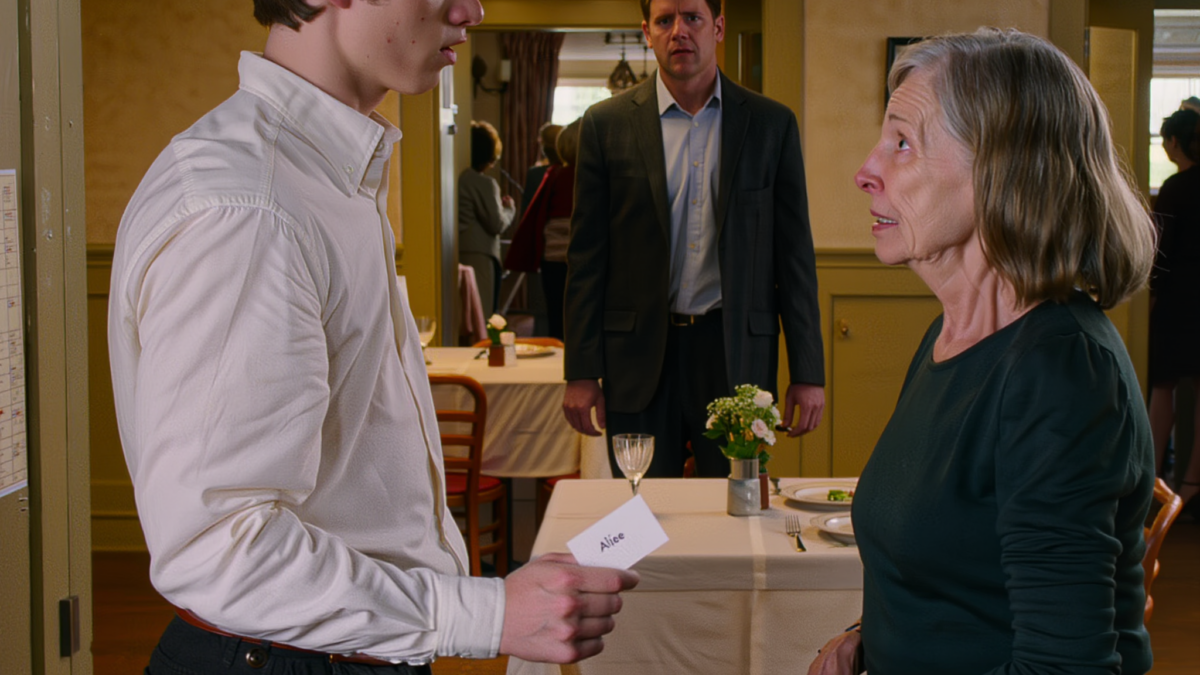
My name was printed on a little white place card at the table closest to the kitchen doors.
Not beside my son. Not beside my grandchildren. Not even at the table where the rest of the family was sitting.
For a moment, I thought the restaurant had made a mistake.
I was sixty-two years old, and I’d spent the last twelve years helping raise my son’s children. I’d picked them up from school, made their dinners, helped with homework, and attended more Little League games and school concerts than I could count.
But at my grandson’s graduation dinner, my son had apparently decided I belonged with distant relatives and family acquaintances, close enough to hear the kitchen staff calling out orders.
I was still trying to understand it when my daughter-in-law came through the restaurant’s front entrance.
“Alice! You’re here already.”
Lauren looked lovely in a navy dress. She was carrying a gift bag while her nine-year-old daughter, Sophie, tugged at her elbow.
“Of course I’m here,” I said. “Wouldn’t miss Owen’s graduation for anything.”
She kissed my cheek.
“You’re a lifesaver, as always. Would you mind watching Sophie for a minute? Evan’s outside helping my parents park.”
Before I could answer, she handed me the gift bag and hurried away.
Sophie took my hand.
“Grandma, did you see my new shoes?”
I looked down at her shiny silver flats.
“They’re beautiful, sweetheart.”
She beamed.
And just like that, I was doing what I’d always done.
Helping.
It wasn’t until later that evening, when my son stood in front of twenty-four dinner guests and introduced me as “the woman who helped with the kids,” that I understood how little that word had come to mean.
But the humiliation didn’t begin at that restaurant.
It had been building quietly for twelve years.
My name is Alice Mercer. I live in a modest two-bedroom house outside Dayton, Ohio.
My husband passed away several years ago, and after I retired from managing a public school cafeteria, the house became quieter than I’d ever imagined it could be.
I’m not wealthy. My retirement income covers my bills, the occasional lunch with friends, and the little extras I enjoy buying for my grandchildren.
I’ve always been comfortable with that.
When my grandson Owen started first grade, my son Evan and his wife were both working full-time. Their jobs didn’t fit neatly around school schedules, and childcare was expensive.
One afternoon, Evan called.
“Mom, could you pick Owen up today? We’re both stuck at work.”
“Of course,” I said.
The next week, he asked again.
Eventually, it became three afternoons a week. Then four. Some weeks, all five.
I didn’t mind.
At the time, I was still working at the school cafeteria, and my shift usually ended before Owen’s school day did.
I’d collect him, bring him home, and make him a snack while he told me about recess or whatever had happened in his classroom.
He liked peanut butter crackers and apples cut into thin slices.
He hated reading aloud until I started taking turns with him, one page each.
By third grade, he was bringing his spelling lists straight to my kitchen table.
When Sophie was born, I helped with her, too.
I remember rocking her through an entire afternoon when she was teething and Lauren hadn’t slept properly in days.
I remember Evan standing in my kitchen doorway, looking exhausted.
“Don’t know what we’d do without you, Mom.”
I believed him.
More than that, I liked believing him.
After losing my husband, having people to care for gave my days a sense of purpose.
There were afternoons when Owen would come running toward me outside school, waving a drawing he’d made.
There were evenings when Sophie fell asleep against my shoulder while I read her a story.
Those moments mattered to me.
I wasn’t keeping score.
But somewhere along the way, my son’s gratitude began turning into expectation.
He stopped asking whether I was available.
Instead, he’d text me a schedule.
Owen has practice Tuesday. Sophie needs to be picked up Thursday. We’ll be late Friday.
If I mentioned a dentist appointment or plans with a friend, he’d sound surprised.
“Oh. Well, can you move it?”
Usually, I did.
It was easier than making anyone uncomfortable.
And I suppose I taught him, little by little, that my time was something he could count on without asking.
Evan is forty now.
He’s a good-looking man, with his father’s dark hair and a habit of speaking with confidence even when he’s uncertain.
He works hard. Lauren works hard, too.
They have a nice house, two cars, and two wonderful children.
From the outside, they look like the kind of family that has everything figured out.
And I think maintaining that appearance matters a great deal to Evan.
He doesn’t like accepting help in front of other people.
At Thanksgiving, if Lauren’s parents complimented the children, Evan talked about how much effort he and Lauren put into parenting.
He never mentioned the afternoons Owen spent doing homework at my kitchen table.
Once, when an old neighbor told him he was lucky to have me helping so much, Evan laughed.
“Mom just likes staying busy.”
I remember feeling a little sting.
I did like staying busy.
But there was a difference between having something to do and being responsible for two children whenever their parents couldn’t be there.
Still, I let it pass.
I was proud of my son.
I wanted him to feel proud of himself.
Then Owen graduated from high school.
He’d been accepted into a state university and planned to study engineering. He was thoughtful, a little shy, and much more observant than people gave him credit for.
The week before graduation, he stopped by my house to return a casserole dish.
“You’re coming to dinner Friday, right, Grandma?”
“Wouldn’t miss it.”
“Good.”
He stood in my kitchen for a moment, turning the dish in his hands.
“Remember when you made me practice spelling words on the fridge?”
I laughed.
“You used to pretend you couldn’t hear me.”
“I remember.”
Then he smiled.
“Thanks for that stuff.”
I reached up and straightened his collar, something I’d done since he was little.
“You’re welcome, sweetheart.”
He hugged me before leaving.
That hug meant more to me than he probably realized.
The graduation ceremony was on a warm Friday afternoon in late May.
I sat with Sophie while Lauren and Evan took pictures of Owen in his cap and gown.
Afterward, everyone headed to the restaurant.
Evan had reserved a private dining room at a family-owned Italian place they’d visited for birthdays over the years.
There were three long tables, cream-colored tablecloths, small flower arrangements, and place cards written in dark blue ink.
I arrived early because I wanted to help.
Old habits don’t disappear just because you retire.
I found my card at the table nearest the swinging kitchen doors.
Alice Mercer.
Beside my name were cards for a couple of distant relatives and two longtime family acquaintances.
I looked toward the center table.
Evan and Lauren were seated there, along with Owen, Sophie, and Lauren’s parents.
There was no place for me.
I studied the arrangement twice, wondering whether somebody had accidentally moved a card.
When Evan came inside, I caught his attention.
“Honey, I think there might be a mistake with the seating.”
He glanced toward the table.
“What mistake?”
“I’m over by the kitchen.”
“Yeah. I thought that’d be easier.”
“Easier?”
“Less crowded. You know how loud these things get.”
I looked at him.
“I don’t mind noise, Evan.”
He adjusted his jacket.
“Mom, please don’t make a thing out of it. I spent forever working out where everyone goes.”
There were guests coming through the door behind us. I could hear Lauren greeting someone.
I didn’t want an argument.
“All right,” I said.
He gave my shoulder a quick squeeze.
“Thanks, Mom.”
Then he walked away.
For several seconds, I stood beside the seating chart, feeling foolish for having asked.
It was just a chair, I told myself.
A chair wasn’t worth ruining my grandson’s evening.
So I went to my assigned table.
Dinner began pleasantly enough.
The food was good, and the couple beside me asked about my old job at the school. I enjoyed talking with them.
But every time I looked toward the center table, I could see Owen laughing with his parents and grandparents.
His other grandparents.
I was happy they were there. Truly.
They were kind people who loved him.
I just couldn’t understand why their place in the family was so visible while mine seemed to need explaining.
At one point, Sophie came running over.
“Grandma, can you cut my chicken? Dad’s talking.”
She’d carried her plate halfway across the room.
I cut the chicken into smaller pieces while she told me about a girl at school who had gotten a new puppy.
When she returned to her seat, I noticed Evan looking in our direction.
He raised his glass slightly, as if thanking me.
I raised mine back.
I could see that he appreciated the help.
I wondered whether he had any idea how it felt to be thanked from across the room by the person who’d decided I shouldn’t sit with the family.
Then the waiter brought dessert, and Evan stood to make his speech.
He thanked the restaurant staff and the guests.
He spoke proudly about Owen’s accomplishments, his discipline, and his future.
I listened with tears in my eyes.
My little grandson was eighteen.
Somehow, the boy who’d once needed help tying his shoes was getting ready to leave for college.
Evan thanked Lauren for being such a devoted mother.
He thanked her parents for their encouragement and for setting a wonderful example of family commitment.
Then his eyes found me.
“And of course, we’ve got Mom over there,” he said, smiling. “Our unofficial babysitter. The woman who helped with the kids all these years.”
A few guests chuckled.
“Seriously, though, Mom, thanks for pitching in when we needed it.”
Then he turned back toward Owen.
“And now, let’s give our graduate a hand.”
Applause filled the room.
I clapped, too.
But my hands felt strangely heavy.
The woman who helped with the kids.
Our unofficial babysitter.
Twelve years of afternoons, sick days, summer vacations, appointments, homework, and meals.
I’d never expected a public thank-you for any of it.
But hearing my own son describe me that way, while I sat away from the family, made me wish he’d simply left me out of his speech.
After dessert, I went to the restroom.
I washed my hands longer than necessary, watching the water run into the sink.
My face in the mirror looked tired.
I suddenly remembered something my husband used to say.
“Alice, you’re allowed to need things, too.”
He’d said it when the children were young and I was trying to manage work, household bills, school events, and everyone else’s needs.
I’d laughed him off at the time.
Now, standing in a restaurant restroom at sixty-two, I wished I’d listened.
When I returned, people were moving around the room, taking photographs and saying their goodbyes.
I picked up my purse.
There was no reason to stay and risk getting emotional.
I’d tell Owen I loved him, congratulate him one more time, and go home.
I was near the entrance when I heard his voice.
“Grandma?”
He was standing beside the seating chart.
“Are you leaving?”
“I thought I’d head home, sweetheart. It’s been a long day.”
He frowned.
“Already?”
“It’s your night, Owen. You should enjoy it.”
He glanced down at the place cards, then back at the room.
“Wait. Where were you sitting?”
I pointed toward the table near the kitchen.
“Over there.”
He looked at the card with my name on it.
Then he looked at the center table.
I could see him working something out.
“Dad?”
Evan was talking with Lauren’s father.
He turned.
“What is it, buddy?”
Owen held up my place card.
“Why wasn’t Grandma sitting at our table?”
Evan looked confused.
“What?”
“Grandma. Why did she sit by the kitchen?”
I touched Owen’s arm.
“It’s all right, honey.”
But he wasn’t looking at me.
Evan glanced at the other guests.
“That’s just how the seating worked out.”
Owen studied the center table.
“Couldn’t we have made room?”
“It wasn’t that big a deal.”
“Then why didn’t we?”
I felt heat rising in my face.
“Owen, sweetheart, let’s not do this.”
He turned to me, and his expression softened.
“Grandma, I didn’t even know you were sitting over there. I thought you were with Aunt and Uncle.”
Then he looked back at Evan.
“She should’ve been up here.”
The nearby conversations had slowed. A few people were watching.
Evan gave an uncomfortable laugh.
“All right, everybody, we’re not going to rearrange the whole restaurant.”
“We don’t have to.”
Owen walked toward the center table and spoke to a waiter who was collecting dessert plates.
“Could we get one more chair here, please?”
The waiter looked toward the tables, then nodded.
“Sure. Give me a second.”
Evan started to object, but Lauren touched his wrist.
“Let him.”
A moment later, the waiter brought a chair.
Owen moved his own slightly to make room and pulled the new chair beside it.
“Come sit here, Grandma.”
I hesitated.
“Oh, honey, there’s really no need.”
“Yes, there is.”
His voice wasn’t loud. He wasn’t trying to embarrass anyone.
He simply sounded certain.
Then he said something I still remember.
“You were there for pretty much every important thing when I was little. You should be sitting with me now.”
I couldn’t speak.
He held the chair for me.
I sat down.
Owen took his place beside me.
“Sorry I didn’t notice sooner,” he whispered.
I shook my head.
“You’re eighteen, sweetheart. You’re supposed to be thinking about yourself tonight.”
He smiled a little.
“Well, you always told me to pay attention.”
I laughed through the tears gathering in my eyes.
“Yes, I did.”
For the next twenty minutes, we talked about his college plans.
He told me about the classes he hoped to take and asked whether I’d help him learn to cook a few meals before he left home.
I said yes.
We had a perfectly ordinary conversation.
And after an evening of feeling out of place, ordinary was exactly what I needed.
I thought that might be the end of the evening.
I was wrong.
Most guests had left when Evan approached me near the coat rack.
“Mom, can we talk?”
Lauren stood a few feet behind him.
I nodded.
“Of course.”
He glanced toward the private dining room.
“Did you really have to let Owen make a whole scene about the seating?”
I stared at him.
“Excuse me?”
“You know what I mean. People were looking at us.”
“Evan, I didn’t ask him to do anything.”
“You could’ve told him to leave it alone.”
“I tried.”
He exhaled sharply.
“Well, now Lauren’s parents probably think I deliberately stuck my own mother by the kitchen.”
Something in his wording made me pause.
“Didn’t you?”
He looked away.
“That’s not what I meant.”
Lauren stepped closer.
“Wait a minute.”
Her voice was different now.
“Evan, I thought Alice wanted that table.”
Nobody spoke.
I looked at her.
“What?”
Lauren frowned.
“When we were doing the seating chart, I wanted to put you next to Owen. I thought that was the obvious place.”
She turned toward her husband.
“You told me your mother didn’t want to sit in the middle of everything. You said she preferred someplace quieter.”
I felt my stomach tighten.
“Evan?”
He rubbed the back of his neck.
“Can we not do this here?”
Lauren shook her head.
“No. I want to understand. Alice never asked for that?”
I answered before he could.
“No, Lauren. I didn’t.”
Her face changed.
She looked genuinely upset.
“I wouldn’t have put you there if I’d known.”
Evan closed his eyes for a moment.
Then he said, “I just thought it would be better.”
“Better for whom?” I asked.
He didn’t answer.
“Because you told me the seating was already arranged,” I continued. “You made it sound like the restaurant had no other choice.”
“It wasn’t the restaurant.”
“I know that now.”
His jaw tightened.
“You don’t understand how this looks from my side.”
I waited.
For once, I wasn’t going to help him finish the sentence.
Evan lowered his voice.
“Everybody acts like Lauren and I couldn’t raise our own kids without you.”
I blinked.
“What?”
“People make comments, Mom. They say how lucky we are that you’re always there. They make it sound like you did everything.”
“Did somebody say that tonight?”
“Not tonight.”
“Then who?”
He looked toward Lauren.
“It doesn’t matter who.”
Lauren crossed her arms.
“Actually, I think it does.”
He gave a frustrated sigh.
“It’s just embarrassing sometimes. I’m forty years old. I have a career and a family. I don’t want people thinking my mother is the reason our household functions.”
I stood there, absorbing his words.
For twelve years, I’d thought I was helping him carry a responsibility.
I hadn’t realized he’d come to resent anyone noticing.
“So you put me at another table,” I said, “because you didn’t want people to know how much I helped?”
He said nothing.
“And when you thanked me, you called me a babysitter.”
“I was joking.”
“About what?”
His eyes met mine.
I continued, keeping my voice steady.
“Was the joke that I spent twelve years helping you? Or that you don’t want anyone to know?”
“Mom, you’re making this bigger than it is.”
I almost apologized.
The words rose automatically.
I’m sorry. I know you’re stressed. I didn’t mean to upset you.
I’d said variations of those things my entire life.
Instead, I took a breath.
“I never asked you to announce what I did for your family,” I said. “But I didn’t expect you to be ashamed of it.”
His expression shifted.
“I’m not ashamed of you.”
“Then why did you move my chair?”
He looked down.
Lauren quietly said, “Evan, this wasn’t fair.”
He snapped, “I wasn’t trying to hurt anybody.”
“Maybe not,” I said. “But you did.”
For a moment, none of us spoke.
Through the doorway, I could hear restaurant employees cleaning the tables.
I thought about all the afternoons I’d rearranged my life because Evan needed me.
The cancelled appointments.
The lunches with friends I’d declined.
The times I’d rushed through grocery shopping because Sophie needed to be somewhere.
And I thought about how quickly I’d agreed whenever he asked.
I had loved helping my family. That part was real.
But so was the resentment I was beginning to feel.
Neither of us could continue pretending the arrangement was working.
“I’m going to stop doing the regular pickups,” I said.
Evan looked startled.
“What?”
“The school pickups. Summer camp. The afternoons you expect me to be available.”
“Mom, come on.”
“I’ll give you six weeks to make other arrangements.”
Lauren stared at me.
“Are you sure?”
“Yes.”
Evan let out an incredulous laugh.
“So now we’re being punished?”
“No.”
“Then what do you call this?”
I thought carefully before answering.
“A decision I should have made a long time ago.”
He shook his head.
“We both work, Mom. You know that.”
“I do.”
“Summer camp closes before Lauren can get off work.”
“I know.”
“And Sophie can’t just stay home alone.”
“Of course she can’t.”
He spread his hands.
“So what exactly are we supposed to do?”
I looked at my son.
He was forty years old, and for years I’d stepped in before he had to ask that question for himself.
“I think,” I said gently, “you and Lauren will have to work that out together.”
Lauren nodded slowly.
“We will.”
Evan turned toward her.
“Seriously?”
She looked exhausted.
“She’s giving us six weeks, Evan. That’s reasonable.”
He looked back at me.
“And what about the kids?”
My chest tightened.
“The children aren’t losing their grandmother.”
I paused.
“But being their grandmother is not the same thing as being available every afternoon.”
Lauren reached for my hand.
“I understand.”
And I believed that she did.
The drive home took twenty minutes.
I kept the radio off.
There were moments when I wanted to turn around, find Evan, and tell him I’d changed my mind.
I worried about Sophie.
I worried about whether Lauren could adjust her work schedule.
I worried that Owen might think I’d made his graduation into something ugly.
By the time I pulled into my driveway, I’d nearly convinced myself that six weeks wasn’t enough.
Then I remembered Evan asking what they were supposed to do.
Not whether I was tired.
Not whether I wanted more time for myself.
Just what they were supposed to do without me.
I sat in the car for several minutes.
And finally I went inside without sending another message.
The next morning, my phone rang.
It was Owen.
“Hey, Grandma.”
“Good morning, sweetheart.”
“Did you get home okay?”
“I did.”
There was a pause.
“Dad’s upset.”
I closed my eyes.
“I’m sorry about that.”
“Don’t be.”
I could hear something moving in the background.
Then he said, “I didn’t know about the seating. Mom told me what happened.”
“I know you didn’t.”
“Why didn’t you say anything?”
I thought about it.
“Because it was your graduation dinner. I didn’t want to spoil it.”
He was quiet for a moment.
“You didn’t spoil it.”
I swallowed.
“Thank you.”
“I mean it. I’m glad you ended up at my table.”
I sat down at the kitchen table where he’d once done his homework.
“So am I.”
Then he asked whether he could come over Sunday to learn how to make my chicken-and-rice casserole.
“Sunday sounds wonderful,” I told him.
The next six weeks weren’t easy.
I kept my word.
I picked Sophie up from day camp on the afternoons we’d already agreed upon, helped with the transition, and made sure she understood that nothing about our relationship was changing.
She was too young to understand the tension between adults.
One afternoon, while coloring at my kitchen table, she asked, “Grandma, are you not coming to get me anymore?”
“Not every day, sweetheart.”
“Why?”
“Because your mom and dad are going to make a new schedule.”
She thought about that.
“Can I still sleep over?”
I smiled.
“Of course.”
“Can we still make pancakes?”
“Absolutely.”
She seemed satisfied.
“Okay. Can I have the purple marker?”
I passed it to her.
She went back to her picture, apparently reassured that our pancake mornings weren’t going anywhere.
Evan, on the other hand, struggled.
For the first two weeks, he sent messages about the inconvenience.
He told me after-school programs were expensive.
He said Lauren had to speak with her supervisor about adjusting her hours.
He complained that one local childcare option had a waiting list.
I listened.
But I didn’t offer to take everything back.
Eventually, the complaints stopped.
Lauren found an after-school program for Sophie for the coming school year, and she and Evan rearranged their work schedules to handle the remaining summer weeks.
It wasn’t seamless.
Some days were stressful.
But they managed.
And a surprising thing happened to me.
I began making plans without checking their calendar first.
I started attending a Tuesday morning walking group at a local community center.
I went to lunch with a former coworker.
I signed up for a pottery class I’d been thinking about for years.
The first time I spent an entire Thursday afternoon reading on my porch without watching the clock, I caught myself wondering whether I’d forgotten something.
I checked my phone.
There were no missed calls.
No messages asking me to drive across town.
I went back to my book.
Lauren called one Saturday morning in July.
“Do you have a minute?”
“Of course.”
She sounded nervous.
“I wanted to apologize.”
I waited.
“Not just for the dinner. For everything, really.”
“Lauren, you don’t have to—”
“Yes, I do.”
Her voice was firm.
“I knew you were helping a lot. But I didn’t realize how often we were assuming you’d say yes. And when Evan told me you wanted the quiet table, I should have asked you myself.”
I sat on the couch, looking out at the backyard.
“I appreciated helping with the children,” I said. “I still do.”
“I know. But appreciation doesn’t mean much if we forget you’re a person with your own life.”
Her words stayed with me.
Then she told me something that surprised me.
Owen had spoken to his father after graduation.
Not angrily.
He’d asked whether Evan realized how many important moments of his childhood involved me.
The first time he rode a bicycle without training wheels.
The afternoon he’d failed a math test and cried because he thought his father would be disappointed.
The day he’d gotten his driver’s permit.
Evan had been present for some of those moments, too.
But Owen remembered that I had been there.
And he’d noticed that his father seemed embarrassed by it.
“That conversation really bothered Evan,” Lauren said.
“Did it?”
“Yes. He’s been thinking about it.”
I didn’t know what to say.
Part of me wanted to believe that a single conversation could repair everything.
Another part knew better.
So I said, “I’m glad they’re talking.”
Lauren hesitated.
“He’s going to have to work some things out, Alice.”
“I know.”
“And I hope you know the kids love you.”
I looked at the little collection of drawings Sophie had left on my refrigerator.
“I’ve never doubted that.”
Evan didn’t apologize right away.
For nearly a month, our conversations were short and awkward.
He asked about my health.
I asked about work.
Sometimes he sounded as if he wanted to say something more, but he never quite managed it.
I didn’t push him.
Then, one Sunday afternoon in August, he came to my house alone.
I was outside trimming a rosebush when his car pulled into the driveway.
“Hey, Mom.”
“Hello, Evan.”
He stood beside the porch steps.
“Got a minute?”
I set down the garden shears.
“Sure.”
We sat on the porch.
For a while, he talked about Sophie starting school and Owen getting ready to move into his college dorm.
Then he stopped.
“I owe you an apology.”
I looked at him.
He took a breath.
“At the graduation dinner, I was embarrassed.”
“I know.”
“No. I mean, I was embarrassed because I thought people would judge me if they knew how much help we needed.”
He rubbed his palms together.
“I’ve spent years trying to look like I’ve got everything under control. And when people talked about what you did for the kids, I took it like they were saying I wasn’t doing enough.”
I listened.
“I know that doesn’t make sense,” he continued.
“It makes some sense,” I said. “But it doesn’t excuse what you did.”
He nodded.
“You’re right.”
Then he looked directly at me.
“I shouldn’t have changed your seat. I shouldn’t have lied to Lauren. And I shouldn’t have made that joke in my speech.”
Those were the words I’d needed.
Not a general apology about hurt feelings.
An acknowledgment of what he’d actually done.
“I’m sorry, Mom,” he said.
I could see how uncomfortable he was.
My son had always preferred fixing practical problems to discussing painful things.
“I appreciate you saying that,” I told him.
He glanced toward the street.
“Are you still serious about not doing pickups?”
“Yes.”
He nodded slowly.
“Okay.”
There was no argument this time.
After a moment, he asked, “Could we have dinner together sometime? Just you and me?”
I thought about the question.
For years, I’d gone to his house mainly because something needed doing.
Dinner without an assignment sounded unfamiliar.
“I’d like that,” I said.
He smiled.
“Good.”
Then he added, “I’ll call and ask what day works for you.”
I looked at him for a moment.
“That would be nice, Evan.”
Owen left for college at the end of August.
Before he went, he came over to my house carrying a bag of groceries.
“I need that casserole lesson,” he announced.
We spent the afternoon in my kitchen.
He burned the first batch of onions, forgot to preheat the oven, and asked me three times how much salt to use.
By the end, the casserole looked a little uneven but smelled wonderful.
We sat down to eat.
“This is actually pretty good,” he said.
“Try not to sound so surprised.”
He grinned.
Then he grew serious.
“Grandma, can I ask you something?”
“Anything.”
“Are you and Dad okay now?”
I considered giving him the easy answer.
But he was eighteen, and I’d spent his whole childhood teaching him that honesty mattered.
“We’re getting better,” I said.
He nodded.
“Good.”
I reached across the table and touched his hand.
“I love your dad, Owen. That hasn’t changed. But sometimes loving somebody means being honest about what you can and can’t keep doing.”
He thought about that.
“Yeah. I think I get it.”
Then he took another bite.
“Can I take the leftovers?”
I laughed.
“Now that sounds like the Owen I know.”
By September, my life had settled into a different rhythm.
I still saw Sophie regularly.
Some Saturdays, she’d come over to bake or help me in the garden. Other times, we’d visit the library or go out for ice cream.
Owen called from college, usually when he was walking between classes or trying to figure out how to cook something.
Lauren occasionally invited me for Sunday dinner.
And Evan was making an effort.
He called before asking for help.
He listened when I said I had other plans.
Once, when I arrived for dinner, he took my coat and told me to sit down while he finished cooking.
The meal wasn’t especially good.
His potatoes were undercooked.
I ate them anyway.
He noticed me looking at them and laughed.
“Not quite how you would’ve made them, huh?”
“Not quite,” I admitted.
He shook his head.
“I’ll do better next time.”
I didn’t offer to take over the cooking.
And he didn’t ask.
That was enough for one evening.
One Sunday, Lauren invited me over for lunch.
When I arrived, Sophie opened the door and grabbed my hand.
“Grandma! Come see!”
She led me toward the dining room.
There were six places set around the table.
Evan was carrying a bowl of salad.
Lauren was pouring drinks.
And Sophie had made little place cards from construction paper.
She pointed proudly to the chair beside hers.
It had my name written across it in purple marker.
“That’s yours.”
I looked at the card.
“Did you make this?”
“Yep.”
“All by yourself?”
She nodded.
“I wanted you next to me.”
For a moment, I remembered another place card, printed in dark blue ink, sitting beside the kitchen doors of a restaurant.
I remembered how I’d picked it up and wondered whether somebody had made a mistake.
Evan looked up from the table.
“Mom, sit wherever you’re comfortable.”
I glanced at him.
He was still learning.
So was I.
But he’d set the salad on the table and was waiting for me to choose a seat.
I pulled out the chair beside Sophie.
“Thank you, sweetheart.”
She climbed into her seat and leaned against my arm.
“Grandma?”
“Yes?”
“Can you pass the rolls?”
I laughed and reached for the basket.
Then Sophie began telling me about something that had happened at school, and Evan sat down across from us to listen.
For the first time in a long while, I wasn’t thinking about when I needed to leave, what I had to pick up, or who might need me next.
I was having Sunday lunch with my family.
And when I looked at the little purple place card beside my plate, I knew exactly why I was there.
My granddaughter had saved me a seat because she wanted me beside her.
I didn’t have to do anything to earn it.