My Mother Humiliated Me at Her 65th Birthday—Then My Daughter’s Tablet Played What She Said About Us

My mother was standing at the head of the table with a champagne flute in her hand when she decided to remind everyone exactly where I ranked in our family.
Nearly thirty relatives had gathered under the rented tent in my parents’ backyard for her sixty-fifth birthday. Warm string lights hung overhead. Caterers moved quietly along the edges. My older sister, Deline, sat near the center of everything, exactly where she had always belonged in my mother’s world.
Mom lifted her glass.
“To the daughter who actually loves this family.”
She turned toward Deline.
People smiled and raised their glasses.
Then Mom looked all the way down the table at me.
“And Callie,” she said, with that pleasant little smile she used whenever she wanted an insult to sound harmless, “you’re lucky we let you come at all.”
A few people laughed.
Softly.
Politely.
The kind of laughter people give when they know something is cruel but don’t want to be the person who challenges the hostess.
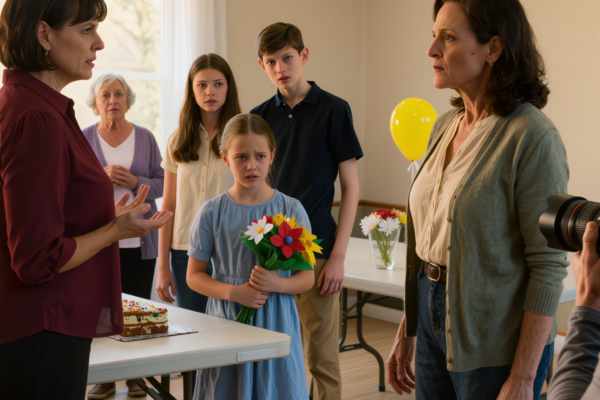
My eight-year-old daughter, Ren, was sitting beside me on a folding chair.
I had driven four hours to be there.
I had made a cake.
I had paid for the flowers sitting in the centerpieces.
And after thirty-four years of being treated like the extra daughter, I was still expected to smile when my mother reminded everyone that I should be grateful just to have a seat.
Usually, I would have.
That was what I did.
I kept my head down.
I made things easy.
I turned insults into jokes before anyone had to feel uncomfortable.
But that night was different.
Because an hour earlier, Ren’s tablet had accidentally recorded what my mother said when she thought I couldn’t hear her.
I lowered my glass.
Then I took out my phone and placed it face-up on the table.
“Before everyone sits down,” I said, “I have something I’d like you all to hear.”
My mother’s smile disappeared.
To understand why I finally pressed play, you have to understand what happened before dinner.
Really, you have to understand what had been happening for most of my life.
Deline was four years older than me.
She was planned.
I wasn’t.
My mother never needed to announce that difference when we were children. She showed us.
Deline’s artwork went on the refrigerator.
Mine disappeared into drawers.
Our grandmother made Deline a quilt.
I got a store-bought blanket.
When I turned eight, Mom forgot to order my birthday cake. She stopped at a gas station, bought cupcakes, and later told everyone I had specifically asked for them.
I hadn’t.
You learn things in a family like that.
You learn not to ask for too much.
You learn that disappointment hurts less if you pretend you never wanted anything.
And eventually, you learn that if you can’t be loved the way someone else is loved, maybe you can at least be useful.
So that became my role.
I helped.
I drove.
I fixed things.
I showed up.
The worst example happened when I was seventeen.
I won a four-year scholarship to a private college three states away.
It should have been my way out.
The acceptance letter came to my parents’ house.
I never saw it.
By the time the school called, the deadline had already passed.
I happened to hear my mother on the phone telling them I had decided to remain closer to home.
I hadn’t decided anything.
I didn’t even know I had been accepted.
When I confronted her, she didn’t deny what she had done.
She told me I would have been miserable.
She said she knew me better than I knew myself.
Then she reminded me that Deline would need support while she was applying to schools too.
So I stayed nearby.
I attended community college at night and worked during the day.
Deline went where she wanted.
I left home at nineteen anyway, but I had already learned the real lesson.
My mother didn’t just prefer my sister.
If necessary, she would interfere with my life to keep the family arranged the way she wanted it.
Years passed.
I built a small bookkeeping practice.
I became a mother.
I moved four hours away.
But I still came when the family called.
Which was why, on June 13, Ren and I were driving back toward my parents’ house in the hills outside Asheville for Mom’s birthday.
She had been planning the party for months.
There were rented chairs on the lawn, a tent in case it rained, caterers moving through the kitchen, and family members arriving all morning.
Deline lived twelve minutes away and had handled much of the planning.
She was thirty-eight now.
She had the polished house, the successful husband, the life my mother liked to present as evidence that one daughter had turned out correctly.
Her husband, Greer, worked in commercial real estate.
I had never been especially close to him.
When Ren and I arrived, my father met us at the door.
He gave me a quick hug.
Then he lowered his voice.
“Your mother’s in a mood.”
I almost smiled.
“She’s stressed,” he continued. “Just keep your head down.”
I had been keeping my head down in that house for thirty-four years.
Inside, Deline was arranging place cards.
She glanced up.
“Oh, good. You made it.”
“I told Mom I was coming.”
“She wasn’t sure.”
I had been there less than two minutes and somehow I was already causing tension simply by existing.
Then Mom came down the hall in her birthday dress.
Ren’s whole face brightened.
During the drive, she had made her grandmother a card.
There was glitter on it, a crooked heart, and HAPPY BIRTHDAY, GRANDMA written carefully across the front.
She stepped forward.
“Grandma.”
Mom glanced at it.
She didn’t take it.
“Oh,” she said. “Put it with the others, sweetheart.”
Then she walked past Ren.
Deline’s children had just entered the room.
Mom opened her arms.
“There are my babies!”
Ren stood still, holding the card.
I crossed the room.
“Let me see it.”
She handed it to me.
“It’s beautiful,” I said.
I put it carefully in my bag.
Mom had been treating me like an afterthought for decades.
Watching that same instinct reach toward my daughter felt different.
I carried the cake I had made into the kitchen.
Mom was there with Deline, my aunt Marian, and our longtime neighbor Patrice.
“Where do you want this?” I asked.
Mom looked at the box.
“You made it yourself?”
“Yes.”
“We already have the bakery cake for the actual celebration. Put yours in the garage refrigerator.”
I didn’t argue.
Ren had followed me inside carrying her tablet.
She had been recording a little video tour of Grandma’s house to show one of her friends later.
She set the tablet on the counter near a fruit bowl and wandered toward the desserts.
I carried my cake into the garage.
I was gone for only a few minutes.
When I returned, the room felt different.
Marian wouldn’t look at me.
Patrice had suddenly become very interested in the wineglasses.
Deline had a faint smile on her face.
“What?” I asked.
Mom barely looked up.
“Nothing. We were talking about the seating.”
I let it go.
That was still my reflex then.
A little later, I found Ren sitting alone on the back steps with her tablet in her lap.
Something about her expression stopped me.
“Mom?”
“What is it?”
“Is Grandma mad at us?”
“No, baby. She’s probably just busy.”
Ren looked down at the tablet.
“I left this recording in the kitchen.”
I almost told her it didn’t matter.
Then she pressed the screen.
The video showed mostly the fruit bowl and part of the ceiling.
But the audio was clear.
My mother was talking.
She said she didn’t know why I kept coming to family events.
She said she hadn’t exactly invited me to the birthday party. She just hadn’t figured out how to keep me away without creating a bigger problem.
Then I heard her say:
“Deline is my daughter. Callie is just somebody who happened to me.”
I couldn’t move.
Marian’s voice came next.
She sounded uncomfortable.
Then Mom started talking about Ren.
She said she had spent money on Deline’s children, but she wasn’t going to do the same for mine.
Why invest in a child, she asked, who would probably grow up exactly like her mother?
Patrice tried to change the subject.
She mentioned the flowers.
Mom dismissed that too.
According to her, paying for centerpieces didn’t erase a lifetime of being a disappointment.
Then she talked about what would happen when she died.
The house.
The accounts.
My grandmother’s ring.
She said it would all go to Deline.
The daughter who actually loved the family.
I stopped the recording.
For several seconds, Ren said nothing.
Then she looked at me.
“Did I do something wrong?”
That question did what thirty-four years of insults had never managed to do.
It made silence impossible.
I could tolerate being the lesser daughter.
I had practiced.
But Ren was eight.
She was the same age I had been when I started learning how to make myself smaller around my mother.
I put my arm around her.
“No.”
“Then why did Grandma say that?”
“You didn’t do anything wrong.”
I went back inside.
My father was hiding in the den.
“Dad, I need you to tell me the truth.”
He immediately looked nervous.
“Did Mom really change the will?”
His face gave me the answer before his mouth did.
“There’s a trust,” he finally said.
“When?”
“Two years ago.”
“And everything goes to Deline?”
He nodded.
“The house. The investment accounts.”
“What about Grandma’s ring?”
Another pause.
“That too.”
“You knew?”
“Yes.”
“She made you sign?”
“Yes.”
I stared at him.
“You thought it was wrong?”
“I told her that.”
“But you signed.”
He looked down.
“I always sign anyway.”
There it was.
My father wasn’t like my mother.
He didn’t enjoy hurting me.
But for decades, he had made the same choice over and over.
Peace with her over fairness to me.
I made three copies of the tablet recording.
One went to my email.
One went to cloud storage.
One went to a separate account I used for work.
I was a bookkeeper.
One copy of anything important had never felt like enough.
Then I went back outside.
I helped pour drinks.
I moved things.
I smiled.
But I started watching people instead of watching my own feet.
Marian avoided my eyes.
Patrice kept glancing at me.
Deline looked relaxed.
Happy, even.
Why wouldn’t she?
The system had always worked for her.
Then I noticed Ren’s chair.
Her place card was near mine at the far end of the table.
Almost everyone else had a regular chair.
Ren had been given a folding chair.
She noticed.
Of course she did.
Children notice these things.
She didn’t complain.
She just sat very straight.
I knew that posture.
Don’t react.
Don’t let anyone see that it matters.
Pretend the chair doesn’t say anything about you.
I had learned exactly the same thing when I was eight.
That was when I understood what would happen if I kept handling my mother the way I always had.
The pattern wouldn’t die with me.
It was already reaching for Ren.
I decided I was going to play the recording at dinner.
But even then, I almost lost my nerve.
I found Aunt Marian near the drinks table.
“I heard what Mom said in the kitchen.”
Marian went pale.
“I have it recorded.”
“Callie…”
“I’m not pretending it didn’t happen.”
Her expression tightened.
“Please don’t do this tonight.”
“You heard what she said about Ren.”
“I know.”
“I need you to tell people that.”
Marian set down her glass.
“You know what your mother is like when she gets cornered.”
“Yes.”
“No, I mean really cornered.”
She lowered her voice.
“She’ll say you edited it. She’ll say you’ve always been jealous of Deline. She’ll tell everyone you’re unstable and that you ruined her birthday because you couldn’t stand seeing your sister celebrated.”
Marian looked toward the tent.
“And people will believe her because that’s easier than admitting how long they’ve laughed along.”
“Will you tell the truth?”
Her eyes filled.
“I can’t stand up there against her.”
I walked to my car.
For about ten minutes, I seriously considered leaving.
I could put Ren in the back seat and drive four hours home.
It would be easier.
It was always easier.
Then someone knocked on the window.
Ren.
“Mom, Greer is looking for you.”
I found him near the garage.
He kept his voice low.
“Can I ask you something?”
“Okay.”
“Did your mother really hide a college scholarship from you when you were seventeen?”
I stared at him.
“How do you know that?”
“She told us.”
My stomach tightened.
“When?”
“Three weeks ago.”
He looked angry.
“She told the story over wine like it was funny. Like she had saved you from making a bad decision.”
I had barely told anyone what happened.
Greer raised his wrist slightly.
“I recorded it.”
I didn’t understand.
“You recorded my mother?”
“That one and some other things.”
“Why?”
He looked toward the tent, where Deline was talking with relatives.
“Because my wife has spent years telling me her mother is the kindest person she knows. And I started hearing things that didn’t fit that story.”
He paused.
“I needed to know I wasn’t imagining it.”
Greer had been recording some of Clare’s conversations for about two months.
He had the scholarship story.
He had her talking about the trust.
He had her describing me as a disappointment.
And that morning, before Ren and I arrived, he had captured part of a call between Mom and her estate attorney.
Everything to Deline.
Nothing to me.
Nothing to Ren.
“These are on your watch?” I asked.
“Yes.”
“So if she says I manufactured mine…”
“She can’t say you manufactured mine.”
“Why are you helping me?”
He looked toward Deline again.
“Because I love my wife.”
I waited.
“And I don’t think she’ll ever understand what her mother has done to both of you unless someone finally makes it impossible to ignore.”
We transferred the recordings.
Then I returned to Marian.
This time, I didn’t ask her to stand beside me.
“I’m playing it,” I told her.
She closed her eyes.
“When Mom says it’s fake, you don’t have to make a speech.”
Marian looked at me.
“Just don’t lie for her.”
I told Patrice the same thing.
Then I found Dad.
“There’s going to be a moment tonight when she looks at you and expects you to support her.”
He stared at the floor.
“I need to know what you’ll do.”
For a long time, he said nothing.
Then he stood.
“I’ve been signing anyway for forty years.”
He straightened his jacket.
“Not tonight.”
Dinner began.
Eventually Mom stood with her champagne flute.
She talked about loyalty.
Family.
Who showed up.
Then she praised Deline.
Everything she had built, she said, would be safe with the daughter who had earned it.
“The daughter who actually loves this family.”
People raised their glasses.
Then Mom turned toward me.
And delivered the joke.
I should consider myself lucky they let me come.
People laughed.
Ren was beside me.
So I took out my phone.
“Before everyone sits down,” I said, “I have something I’d like you all to hear.”
I pressed play.
My mother’s voice filled the tent.
She didn’t know why I came.
Deline was her daughter.
I was simply someone who happened to her.
Then came the words about Ren.
The laughter at the table vanished.
Mom moved toward me.
“Turn that off.”
I picked up the phone before she could grab it.
“That’s edited,” she said immediately.
She turned toward the family.
“She’s always been jealous of her sister.”
Exactly what Marian had predicted.
“She’s trying to humiliate me on my birthday.”
I let the recording continue.
Then I looked at Mom.
“You made almost the same joke about me five minutes ago in front of everyone. Which version did I edit?”
Nobody answered.
Mom spun toward Marian.
“You were in that kitchen.”
Marian looked terrified.
“Tell them,” Mom demanded. “Tell them this didn’t happen.”
Marian stood.
“I was there, Clare.”
My mother stopped.
Marian’s voice shook.
“You said it.”
Then Patrice spoke.
“I heard it too.”
She looked toward Ren.
“And I laughed because I was uncomfortable.”
Her eyes dropped.
“I’m ashamed of that.”
For the first time in my life, it wasn’t just my memory against my mother’s version of events.
She couldn’t simply tell the room who I was and expect everyone to accept it.
So she changed tactics.
She talked about everything she had supposedly done for me.
Food.
A home.
School.
Then she accused me of using Ren as a weapon.
That was the moment I lost the last bit of patience I had left.
“You can say whatever you want about me,” I said.
The table went quiet.
“I’ve had thirty-four years of practice.”
I looked toward Ren.
“But you don’t get to use my daughter.”
Mom stopped talking.
Then I said, “There’s more.”
I told the family about the scholarship.
Mom immediately shook her head.
“You chose to stay home.”
I played Greer’s recording.
Her own voice came through the phone.
She was laughing over wine, describing how she had told the college I changed my mind.
How she had saved me from myself.
How I never knew until it was too late.
Mom’s face changed.
She looked around the table.
Her eyes landed on Greer.
He stood.
“I recorded that.”
Deline turned toward him.
“You recorded Mom?”
“I’ve been recording some of the things she says for two months.”
Deline looked stunned.
Greer placed his watch on the table.
“There’s more.”
My sister looked from him to our mother.
“What does he mean?”
Mom started speaking.
Deline cut her off.
“What trust?”
That question changed the room again.
Mom stared at her.
“What trust?” Deline repeated.
I played the attorney call.
My mother’s voice was calm.
No wine.
No joking.
Everything to Deline.
Nothing to the other daughter.
Especially nothing to the child.
Deline looked at our mother.
“You told me it was going to be even.”
“Deline—”
“You looked me in the eye and told me you would never use money to divide us.”
Mom tried to soften her voice.
“You deserve what I’ve given you.”
Deline stared at her.
“Because I’m better than her?”
My mother answered too quickly.
“You are.”
Silence.
Mom seemed to hear the words only after they had already left her mouth.
Deline’s face changed.
“You used me.”
“No.”
“You spent my whole life telling me I had earned something you had already decided to give me.”
Then I mentioned my grandmother’s ring.
The ring Grandma had told me, when I was eleven, that she wanted me to have someday.
Greer had another recording.
Mom joking at a family meal that she had already given the ring to Deline.
I watched my sister look down at her own hand.
The ring was on her finger.
I had complimented it months earlier without recognizing it.
My great-uncle Harland finally spoke.
He was one of the last people alive who had known our grandmother well.
“Your grandmother meant that ring for Callie.”
Everyone turned toward him.
“She told me many times.”
Deline slowly pulled it from her finger.
Her hands were shaking.
She placed it on the table and pushed it toward me.
“It was never meant for me,” she said quietly.
I picked it up.
It fit.
After that, the birthday party seemed to collapse on its own.
People started gathering purses and keys.
The caterers packed quietly.
My father walked around the table.
He stopped behind my chair and placed a hand on my shoulder.
“The trust is real,” he said.
“I witnessed it.”
Mom looked at him.
“If it can be undone, I’ll help undo it.”
His voice was unsteady.
“I should have stopped this years ago.”
My mother looked around the tent.
No one moved toward her.
She went inside.
The screen door slammed behind her.
Nobody followed.
But the story didn’t end that night.
By Sunday, Mom had started making phone calls.
Not to me.
To everyone else.
She said I had problems with paranoia.
She claimed I had stolen from her years ago.
She told relatives that because I worked with numbers and computers, I could probably manipulate recordings.
She said Greer was trying to destroy his own marriage.
For a brief period, it worked.
Some relatives started questioning what they had heard.
That was when I remembered there was more on Greer’s recording of the attorney call.
Before discussing the trust, Mom had talked about me.
She told the attorney that the timing of everything was perfect.
After the birthday party, I would probably “make some scene.”
She had already begun telling people I wasn’t well.
That way, if I accused her of anything afterward, people would dismiss me.
She had planned the smear before the confrontation ever happened.
I sent thirty seconds of that recording to the family group chat.
No explanation.
No argument.
Just her own voice.
Then people started comparing dates.
She had told some relatives I was having a breakdown days before the birthday party.
Before I had confronted her.
Before I had played anything.
The rumor campaign collapsed.
Not because I argued better.
Because she had explained the strategy herself.
I didn’t get my parents’ house.
I didn’t get the investment accounts.
There was no dramatic transfer of wealth.
The ring came home with me because my grandmother had always meant it for me.
That was enough.
The night of the party, Ren and I got into the car to leave.
Deline came outside before I pulled away.
She stood beside my window.
“I didn’t know about the scholarship,” she said.
I looked at her.
“I want you to know that.”
“I believe you.”
She swallowed.
“I think I have a lot to figure out.”
“You do.”
That was all.
I didn’t forgive thirty-four years in a driveway.
Three weeks later, Deline drove the four hours to my house.
That mattered.
For most of our lives, I had been the one doing the driving.
She sat at my kitchen table with a cup in both hands.
“I keep waiting for someone to tell me I’m completely innocent in all of this,” she said.
I stayed quiet.
“People keep saying Mom used me too. And she did.”
Deline looked down.
“But I wasn’t the one in the folding chair.”
I felt something tighten in my chest.
“I got the good chair,” she continued. “Every time.”
She looked at me.
“And I took it without asking who was sitting at the other end.”
For once, she didn’t ask me to make her feel better.
“I didn’t know about the scholarship,” she said. “But I knew the shape of what was happening.”
I nodded.
“I liked being the favorite too much to look closely.”
That was the first apology from my sister that actually felt useful, even though she never used the word sorry.
I didn’t tell her everything was fine.
It wasn’t.
Instead I told her:
“The door isn’t locked. But I’m not doing all the driving anymore.”
She understood.
And she kept driving.
Not every week.
Not perfectly.
But she came back.
Greer moved out the following week.
He and Deline started counseling.
I don’t know what will happen to their marriage.
That part belongs to them.
My father changed too.
Slowly.
He started calling me without going through Mom.
Then he started visiting.
Once a month, he drives the four hours to my house.
He sits with Ren at the kitchen table doing puzzles while I cook.
On one of his first visits, he told me:
“I missed thirty-four years of you because I was afraid of conflict.”
He looked down at the puzzle pieces.
“I’d like to earn whatever is left.”
I told him earning it was the only way forward.
My mother sent one message several weeks later.
I hope you’re happy. You destroyed this family.
I read it twice.
Then I answered:
No, Mom. I stopped helping you hide what was destroying it.
Then I blocked her number.
Some relatives disappeared.
Others apologized.
Patrice mailed me a handwritten letter.
She admitted she had watched my mother treat me badly for years and stayed quiet because being comfortable was easier.
Uncle Harland started telling me stories about my grandmother that I had never heard.
Stories my mother had never bothered to preserve.
And Ren kept the birthday card Grandma refused to take.
One night, I found it in a box in her room.
“Why didn’t you throw this away?” I asked.
She shrugged.
“Because I made it nice.”
Then she looked at me.
“It doesn’t become bad just because Grandma didn’t want it.”
I was thirty-four years old.
My daughter was eight.
And somehow she already understood something I had spent most of my life trying to learn.
Someone refusing to value you does not reduce your value.
For years, I thought there was only one family table.
My mother owned it.
She decided who sat near her.
Who received the good chair.
Who was worth listening to.
Who should be grateful simply to be included.
Deline had the good seat.
I sat at the cold end.
Then I saw Ren in that folding chair and finally understood that I had been trying to win the wrong thing.
I didn’t need a better seat at my mother’s table.
I needed my own table.
Now Ren sits wherever she wants.
My father comes when he is willing to show up honestly.
My sister drives the four hours when she wants to be part of our lives.
And there is room for people who understand that love is not something one child earns by being worth more than another.
On the drive home from Asheville that night, Ren fell asleep before we reached the highway.
I looked at her in the rearview mirror.
I thought about the folding chair.
The tablet.
The ring.
The thirty-four years I had spent trying to prove I belonged.
And for the first time, I understood that my mother had never actually held the power I thought she did.
She could decide who sat at her table.
She could not decide who deserved a seat in my life.