At my wedding, Dad pulled his arm away and said, “I won’t give my daughter to a grease monkey.” Then he walked to the back row while 160 guests watched me start down the aisle alone. Halfway to the altar, an older mechanic with scarred hands stood and offered me his arm. Dad shot to his feet—and started explaining a 22-year-old steering failure no one had accused him of.
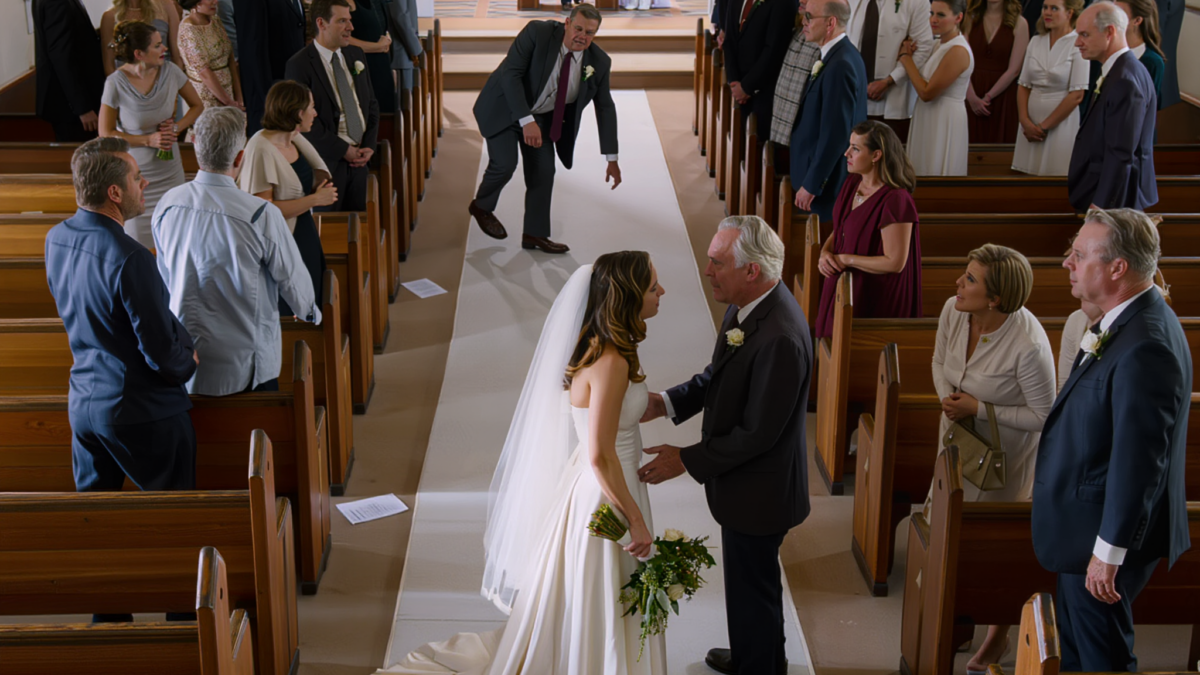
The processional was two chords in when my father slid his arm out of mine.
“No daughter of mine marries a grease monkey.”
He pitched it loudly enough for the front pews to hear. Then he turned his back on me, walked to the last row, and sat down among the guests.
One hundred sixty people watched me stand there alone in white.
So I lifted my bouquet and started down the aisle by myself.
Halfway to the altar, an older man rose from his seat. Silver hair. Grease-scarred knuckles. He stepped into the aisle and offered me his arm.
Behind me, my father shot to his feet so fast his wedding program hit the floor.
His face went gray.
Because the stranger now holding me up was the one man alive who could prove what my father had buried.
And for twenty-two years, my father had prayed I would never have to meet him.
My name is Aubrey Whitmore. I was thirty-one years old, and I had spent most of those years trying to earn a nod from the man who had just walked away from me at my own wedding.
That morning, hours before he let go of my arm, I still believed he might show up as my father.
I was wrong.
The bridal room smelled like hairspray and old radiators. I stood in front of a mirror that had probably watched a hundred brides before me and did the thing I always do before something important.
I made myself still.
I checked the seams of my dress. I breathed in for four counts and let it out slowly.
I am a reliability engineer. I spend my working life deciding how much load a thing can take before it fails, where the weak point is, and whether the warning signs arrive early enough to matter.
I had spent my whole life running the same calculations on myself.
My mother stood behind me with a strand of borrowed pearls, trying to fasten the clasp. Her fingers would not cooperate.
She had buttoned my dresses since I was four years old, and now her hands shook so hard that the little gold hook kept missing the loop.
“Mom,” I said. “It’s okay. Let me. I’ve got it.”
She didn’t.
I watched her in the mirror instead of turning around.
Diane Whitmore, sixty-one, dressed in dove gray. Her lipstick was perfect.
Her eyes were not.
She looked pale in a way that had nothing to do with the room.
I had seen my mother nervous before. This was thinner than nerves. This looked worn through.
For thirty-one years, I had studied exactly one face in our family: my father’s. I had learned to search it for the smallest sign that I had finally done enough.
I had never learned to read my mother’s face.
I suppose I had assumed there was nothing behind it worth reading.
“You look like my mother,” she said quietly. “On her wedding day.”
“Is that good?”
She didn’t answer.
She finally got the clasp fastened. Then her palm rested flat between my shoulder blades and stayed there one second too long.
The way you hold something you are afraid is about to leave.
“Aubrey.”
Her voice dropped.
“Your father wants to talk to you before it starts. He’s waiting in the vestry.”
I met her eyes in the mirror.
“He asked me to bring you alone.”
The vestry was a narrow room off the side of the sanctuary, dark wood and candle wax.
My father was already standing when I entered.
Gerald Whitmore, sixty-three, retired after thirty years certifying automotive components. People in town called him the safety man. He had spent three decades signing his name beneath the word approved, and the town treated that signature like scripture.
His suit was pressed.
His hands were folded in front of him.
As always, they were immaculate.
My father had the cleanest hands of any engineer I had ever met.
Not a callus.
Not a shadow of oil in the creases.
“Shut the door,” he said.
I did.
“There’s still time to do this properly.”
He didn’t sit.
“You call the coordinator. You tell her there’s been a change. People will understand.”
“There’s no change.”
“Aubrey.”
He said my name like a diagnosis.
“You are a Whitmore. You have a career, a mind, and you want to tie yourself to a man who fixes engines for a living.”
“He restores them. There’s a difference.”
“There is no difference.”
His jaw tightened.
“No daughter of mine marries a grease monkey.”
I had known it was coming. I had known the shape of the sentence for weeks.
It still landed somewhere under my ribs.
“If you go through with this,” he said, “I don’t walk you down that aisle. I don’t sign the check for this circus, and I do not ever call that man family.”
He let the silence sit between us.
“Choose.”
I kept my voice level because level was the only weapon I had ever been allowed at that man’s dinner table.
“Then don’t walk me,” I said. “I’ll walk myself.”
Something crossed his face.
Not anger.
For half a second, it looked like fear.
“You think this is about a man’s job,” he said, lowering his voice. “You have no idea what those people are.”
Those people.
He said it as if he were describing contamination.
I left the vestry with the phrase lodged sideways in my mind.
Not Eli.
Not that man.
Those people.
And it caught on something old.
There had always been a locked box in my parents’ storage room.
Steel. Heavy. Army green, with rust creeping into the corners.
Two initials had been stamped into the lid and worn almost smooth.
SV.
Forbidden.
The one time I touched the latch when I was around nine, my father grabbed my wrist hard enough to leave marks.
There had been an entire grammar of forbidden things in our house.
The garage he never let me help in.
The way he changed the television channel whenever the news showed a highway wreck.
The way he reacted when, as a child, I asked why we never fixed our own cars in our own garage.
I had always called it snobbery.
A tidy man.
A man who liked clean hands.
Standing outside the vestry in my wedding dress, that explanation suddenly felt too small.
Three weeks before the wedding, I had gone to Eli’s shop.
It sat at the end of a gravel lot in a long steel building that smelled of solvent, warm metal, and coffee that had been on the burner too long.
I loved that shop.
It was the only place I had ever been where nobody seemed to perform.
You were what your hands could do, and that was the whole test.
That afternoon, a third man was in the bay, bent over the open hood of a car older than I was.
When he straightened to shake my hand, I looked down out of professional habit.
His hands stopped me.
They were mapped with scars. One burn had gone silver along his thumb. His knuckles had been thickened by decades of turning steel that did not want to turn.
Working hands.
Honest in a way I did not yet have language for.
The exact opposite of my father’s.
“Aubrey,” Eli said, and there was something soft in his voice I had never heard before. “This is my teacher. This is Silas.”
“He exaggerates,” the older man said. “I just kept him from bleeding out on the equipment.”
We talked about engines.
Silas asked me real questions about load and fatigue, the kind my father used to ask before he decided I would never quite measure up.
He wanted to know how a joint tells you it is about to fail.
Whether it warns you, or whether it waits until the worst possible second and then quits.
“The honest ones warn you,” I said. “The dangerous ones look perfect right up until they don’t.”
“That’s people, too,” Silas said.
He wiped his hands on a rag that would never make them completely clean.
I remember thinking I had never met a man who said less and meant more.
I liked him immediately.
Later, after Silas stepped away to wash up, Eli stood beside me and stared at the doorway the older man had gone through.
His jaw worked before he spoke.
“He raised me more than anyone did.”
Eli kept looking toward the door.
“And he lost everything before I ever met him. A company man framed him for something he didn’t do. Blamed a repair. Killed his shop, his name, all of it.”
His voice went flat.
“And the coward never even put his own name to it. Signed the paper that ruined Silas and stayed clean.”
I looked toward the workbench.
Silas’s toolbox sat open there.
Two initials were stamped into the steel, worn almost smooth.
SV.
I drove home that night and did not go inside.
I sat in my car in my parents’ driveway, hands at ten and two, engine ticking as it cooled.
I thought about the locked green box in their storage room.
SV.
Two initials.
A coincidence, I told myself.
Common enough.
I work for a living by understanding the difference between a pattern and a coincidence.
I sat there for twenty minutes trying to build the case for coincidence.
It would not hold.
I remembered the television channel changing whenever a highway wreck appeared.
I remembered the garage door he kept shut to me.
I remembered his expression when I asked why we never repaired our own cars.
The kitchen lights were on.
My father’s silhouette moved across the window, unhurried, a glass in his hand, entirely comfortable in a life I was beginning to suspect he had purchased with someone else’s.
The next morning, while my mother was at church and my father was at his club, I went into the storage room.
The box was under a drop cloth where it had lived for as long as I could remember.
I got a flat bar from the garage.
It took twenty minutes, both hands, and a sound I hoped nobody heard.
Then the lid gave.
Tools.
Beautiful old tools wrapped in oiled rags. The kind a man buys once and keeps forever. Wrenches worn smooth at the jaws.
And beneath them, flat against the bottom, was a photograph.
The edges had gone soft and brown.
It showed a shop front. A younger dark-haired man stood there proudly with one boot resting on a bumper.
Above the bay door, painted by hand, were the words:
Vance and Son.
I do not know how long I knelt there.
Long enough that I did not hear the door.
“Put it back.”
My mother stood in the doorway in her church coat.
Every trace of color had left her face.
“Aubrey,” she whispered. “Put it back and lock it, and never, never tell your father you opened it.”
I stood slowly, holding the photograph.
“Whose tools are these, Mom?”
“They’re nobody’s.”
Her voice broke.
“They’re nothing.”
“There’s a name on this photo.”
She came toward me quickly and took it from my hands.
Gentle and desperate at the same time.
She pressed the photograph to her chest as though I had handed her an open wound.
“Your father did something,” she said. “A long time ago. To a mechanic. Something terrible.”
Her eyes were wet and fierce.
“And it’s finished. It’s done. There is nothing you can do that won’t make it worse for everyone. So I am begging you, let it lie.”
“What did he do?”
“Let it lie.”
She would not tell me anything else.
But I already knew one thing she did not realize I knew.
I had met the man in that photograph.
I had already shaken his ruined hands.
My mother slipped the photograph inside her coat.
Then her hand went to the purse she had left on a shelf beside the door.
She pulled it tight against her body with both arms, the way you protect something from bad weather.
I noticed.
I filed it away.
I did not understand it yet.
Three weeks later, at the church, the same purse was still close to her body.
And my family was still trying to decide who belonged where.
My aunt Vivien Whitmore Hail, my father’s older sister, had taken charge of the seating.
She had married a wealthy man forty years earlier and spent every year since then terrified that somebody might remember she had not been born into that world.
She wore that fear as taste.
Everything about her was correct and cold.
On my wedding day, she carried a clipboard.
“Aubrey, darling.”
She kissed the air beside my cheek.
“I made a few adjustments to the seating for flow.”
I looked past her.
Ushers were moving place cards.
Eli’s people, his shop crew, the men and women who worked beside him and whom he called family, were being pushed into the last three rows behind the columns.
“You put the shop crew in the back.”
“I put them where they’ll be comfortable.”
Vivien smiled.
“People like to be among their own kind, dear. It’s a kindness, really.”
The place cards were cream-colored, engraved and expensive.
Someone had separated them into two stacks by hand.
Us.
Them.
“Move them to the front.”
“Aubrey.”
“The people who love Eli sit where they can see Eli.”
I kept my voice quiet and precise.
“That’s the seating. Touch it again and you’ll spend the reception standing in the parking lot.”
For a second, her mask slipped.
Underneath it was not superiority.
It was fear.
The fear of a woman who had climbed away from where she came from and could not bear to be seen standing beside it again.
“You’ll thank me,” she said, “when you understand what you’ve married into.”
There was that word again.
Into.
As if I were walking into contamination.
I crossed the narthex and heard my father before I saw him.
He had positioned himself near the guest book with two men he had worked beside for decades. A glass of good sherry was already in his hand even though it was still morning.
He was doing what he did best.
Building a story.
“Came out of nowhere, honestly,” he was saying in that warm, confidential voice of his. “Bright girl, our Aubrey. Always was. And you know how it is when a certain kind of man finds a woman with prospects.”
He let the sentence finish itself in their minds.
“We did what we could. You can’t choose for them.”
A certain kind of man.
He was telling the room, before the ceremony had even started, that Eli was a hustler and I was a fool.
He was preparing the story in advance.
So that if the day went wrong, everyone would already know who to blame.
A woman I had known since childhood looked at me with soft pity.
“You’re so brave,” she said, in the voice people use with someone going into surgery.
Another man who had once bounced me on his knee at a company picnic would not quite meet my eyes.
My father had not raised his voice.
He did not need to.
He had simply planted the story and let it grow.
I could have corrected every person in the room.
I could have told them Eli had turned down more money that morning than most of them earned in a season.
I did not.
I had spent my career watching structures fail under load.
The hardest collapses usually came from structures built with the most confidence.
I let my father keep building.
Then I found Eli’s crew gathered at the sanctuary doors.
Six of them, scrubbed and pressed, standing close together the way people stand when they are not sure they are welcome.
An usher I did not recognize was explaining apologetically that the reception afterward was for immediate family and close friends.
The shop people, he said, would have a nice area set up on the side lawn.
A separate lawn.
My aunt had arranged a separate lawn.
“Whose instruction was that?” I asked.
The usher reddened.
“Mrs. Hail.”
“Mrs. Hail is a guest here, same as everyone else.”
I let my voice carry.
“There is no side lawn. There is one reception. These six sit at the head table with the groom. If anyone is confused about where they belong today, send them to me.”
Dell, Eli’s lead technician, ducked his head.
“You don’t have to do that.”
“I do, actually. You built the car I’m leaving in tonight. You’re not eating on a lawn.”
That earned a low laugh.
The tension loosened.
Then Vivien’s husband, Preston, walked past with his own glass of sherry and looked the six of them over the way somebody might inspect a used car.
“Very sporting of you, Aubrey,” he said. “Bringing the help up front. Democratic.”
He smiled at Dell.
“You’ll want to watch the salad forks, son. There’s a whole system.”
“We’ll manage,” Dell said pleasantly.
“I’m sure you’ll try.”
Preston moved on.
I watched him go without letting my face change.
Over Dell’s shoulder, I saw my mother standing alone near the coat room.
The purse was held tightly against her chest again.
She was looking at me the way you look at someone stepping onto ice you already know is thin.
A minute later, Eli found me near the flowers.
Everything in my chest loosened a little.
He looked wrong in his suit and right in his own skin, a thing only certain people manage.
He placed his hand over mine on the bouquet.
His thumb was warm.
A gray shadow of engine grease still lived in the creases no amount of scrubbing ever completely removed.
I loved that shadow more than anything spotless I had ever touched.
“Whatever your aunt just said,” he murmured, “let them sit where they want. I’ve got you.”
“They put your crew in the back.”
“My crew has been in the back their whole lives. They know how to have a good time from a bad seat.”
His mouth tilted.
“You should worry about me. I’ve never been to a wedding this fancy. I might use the wrong fork and start a war.”
I laughed.
It came out by accident, and it felt like setting something heavy down.
“You’ll be fine because Silas is here,” Eli said, glancing toward the sanctuary. “He wouldn’t miss it. Man hasn’t left that shop for anything in years, and he put on a tie for you.”
My laugh disappeared.
“Tell me about him,” I said. “The whole thing.”
So Eli told me quickly.
Silas Vance had once run the best restoration shop in three counties.
Then came a wreck.
A young woman died after a steering component failed.
Silas’s name appeared in the paper.
His repair work was blamed.
His shop collapsed.
His reputation went with it.
Years later, a furious teenager with nowhere to go walked into the one small bay Silas rented just to stay alive.
Silas handed him a wrench instead of calling anyone.
“He gave me a life over a lie that took his,” Eli said. “Never complained about it once.”
Standing there in my wedding dress, I finally saw the shape of the thing.
If the truth cleared Silas Vance, it could destroy the reputation my father had spent his entire adult life building.
Then Silas himself walked toward us.
Up close, his eyes were pale and steady.
He took my hand in both of his.
His scarred palms were warm.
“You’re the bride,” he said. “Eli talks about you like you invented the weekend.”
“He talks about you the same way.”
Silas smiled.
Then something in his eyes sharpened.
“I know whose daughter you are.”
I could not breathe.
“Mr. Vance, I…”
“You don’t have anything to be sorry for.”
His thumb moved once across the back of my hand.
“A child doesn’t sign the papers. I saw your name on the invitation weeks ago. I could have stayed home. Made this easy on myself.”
“Why didn’t you?”
He looked toward Eli.
His whole weathered face opened.
“Because I’m still glad my boy found you. That’s the truth.”
He looked back at me.
“Whatever your father did to me, it doesn’t touch that. I won’t let it touch this day.”
“You could ruin him today,” I whispered. “Everyone he cares about is in this room.”
“I know exactly where he is.”
His voice did not rise.
“I’ve known since I sat down.”
Then he let go of my hand.
“But this is your wedding, not my verdict. I’ve waited twenty-two years. I can get through one afternoon.”
He returned to his seat.
That was when I made my decision.
I would not expose my father publicly.
I would not turn my own wedding into a courtroom.
I would simply stop protecting him.
I would stop translating his cruelty into something respectable.
I would let him be exactly who he was and see what he chose to do when nobody cleaned the edges for him.
My father appeared beside me near the sanctuary doors.
Vivien joined him.
They flanked me the way they had flanked me at every family holiday of my childhood.
“We’re not trying to hurt you,” Vivien said. “We’re trying to save you from a mistake you’ll spend years regretting.”
“There’s nothing to save.”
“Postpone it,” my father said. “A season. Give it until spring. If the man is worth anything, he’ll wait.”
His voice was reasonable.
That was always when he was most dangerous.
“We’ll make it beautiful, Aubrey. The right venue. The right people. I’ll cover all of it gladly.”
“He is the right people.”
Vivien’s mouth tightened.
Then she opened her cream satin clutch and removed a folded check.
“We tried to do this kindly,” she said. “We offered your Eli a very generous sum to step aside gracefully before you were embarrassed in front of the whole town.”
I stared at the check.
My father’s handwriting was on it.
A number with too many zeros for a man’s dignity.
“He told me last night,” I said. “He gave it back to you folded exactly like that, didn’t he?”
Neither of them answered.
That was the answer.
They had tried to buy Eli out of my life.
When he refused, they brought the check to the church anyway.
I took it from Vivien.
For one second, my control broke.
My hand shook.
Barely.
A quick tremor.
I stopped myself the way I do before a load test.
Then I folded the check along the same crease Eli had made, placed it back inside Vivien’s clutch, and clicked the clasp shut.
“That’s yours,” I said. “It was always going to stay yours.”
My father’s face went cold.
“You’ll regret choosing them over your own blood.”
“We’ll see,” I said. “Which of us regrets today?”
The sanctuary doors stood open.
Beyond them sat my father’s entire reputation.
Engineers he had worked beside for thirty years.
Inspectors.
Members of the state licensing board.
People who believed Gerald Whitmore’s name meant a thing had been checked carefully and found safe.
They had come to watch the good father walk his daughter down the aisle.
What they did not know was what I had learned three weeks earlier at a microfilm reader in the county library basement.
I had gone looking for the crash.
The local newspaper from the spring of 2004 showed a car folded around itself on a rain-dark road.
The headline blamed a local shop owner for a fatal steering failure.
A twenty-six-year-old woman named Norah Kesler had died.
The article said the manufacturer’s certifying engineer testified that the component had left his hands sound and that the failure came from faulty repair work performed afterward.
The shop was Vance and Son.
Silas Vance was named.
His business did not survive.
The certifying engineer was not named.
But the firm was.
My father’s firm.
The one where he had worked in 2004.
The one where he had signed approvals.
Somewhere, once, there had been a certification tag attached to that component.
An inspection date.
A batch code.
A signature.
I did not have it.
I did not know whether it still existed.
But I knew whose handwriting I expected to see on it.
Norah Kesler would have been forty-eight by then.
Instead, she had become a name in an old newspaper.
Silas had become a disgraced mechanic.
And my father had become the safety man.
Then, before the ceremony, my father noticed Silas sitting near the front.
He did not recognize him immediately.
He only saw what he thought Silas was.
Plain jacket.
Scarred hands.
A mechanic occupying a good pew.
“Whoever seated that man up front made a mistake,” my father said loudly. “Move him back with the rest of the shop people. This is the second row.”
The sanctuary went quiet.
“Dad,” I said. “I won’t have it.”
“There are standards. Move him.”
Silas looked up.
For the first time that day, the two men truly looked at one another.
Silas did not glare.
He did not stand.
He simply held my father’s gaze.
Then he gave one small nod.
Not obedience.
Recognition.
Something changed behind my father’s eyes.
A snag of familiarity.
An old alarm he could not place.
Twenty-two years had blurred the face of the man whose life he had helped ruin.
But something about that nod reached him.
Eli moved beside Silas and placed a hand on his shoulder.
I started to step forward.
Silas caught my eye and shook his head very slightly.
Not yet.
My father turned away first.
He did not fully recognize him.
But the unease had started.
That was when I almost chose silence forever.
I looked at my mother clutching her purse.
At Silas choosing peace over the vengeance he had earned.
At Eli, who wanted a wife and a life, not a war.
At 160 people who had come to watch a wedding.
What if I simply got through the day?
What if the truth about 2004 died quietly with the people who carried it?
What if Norah Kesler remained a forgotten name in the basement of a library?
What if I married Eli and let my father keep the reputation he had built?
The cost of exposing him would fall on my mother too.
Silas had already chosen mercy.
Who was I to be less merciful than the man who had lost everything?
For a few minutes, burying it felt sensible.
Then my mother grabbed my arm.
Her fingers were stronger than they looked.
“Whatever happens today,” she whispered, “don’t hate me.”
“Mom, nothing’s going to happen. I’ve decided it’s fine. I’m going to let it.”
“Promise me, Aubrey.”
I looked at her.
For the first time, I understood.
She was not afraid of what my father might do.
She was afraid of what she might do.
“What are you carrying?”
Her arms tightened around the purse.
Her chin lifted.
“Something I should have burned twenty-two years ago,” she said. “And couldn’t.”
“Then tell me what it is.”
“If I tell you, you’ll make me use it.”
Her voice dropped.
“And once it’s used, there’s no putting your family back together.”
Before I could answer, the coordinator called for us to take our places.
My mother stepped back.
Both hands remained over the purse.
Later, I found her in the powder room, palms flat on the sink, staring at the drain.
“You always could handle them,” she said. “Even as a girl. Your father would say something to cut you, and you’d go still. Take it apart later, alone.”
Her mouth trembled.
“I used to think that was strength. Lately I’ve started to think I taught it to you by never once standing between you and him.”
“Whatever is in that purse, you don’t have to decide today.”
“That’s the part nobody tells you.”
She laughed without humor.
“You think the hard thing is choosing. It isn’t. The hard thing is that not choosing is also a choice. And I’ve made it every day for twenty-two years.”
Her hand moved toward the purse clasp.
Then laughter sounded through the wall.
Vivien’s laughter.
My mother’s face closed.
“Go get in your line,” she said. “You’ll be late for your own wedding.”
At the sanctuary door, a member of the state licensing board stopped me.
He told me my father was the gold standard.
He said he had spent his career trying to be half as careful as Gerald Whitmore.
“Tell him the standard he set still holds.”
I said I would.
Then I watched him return to the men whose signatures decided whether people like me could sign our own names beneath calculations that held weight over other people’s lives.
The standard didn’t hold.
That was the thought that stayed with me.
It had never held.
There were two minutes left before the ceremony when Vivien found Eli.
I did not hear the conversation.
He told me about it afterward.
She said our family would never accept him.
She told him that every Christmas for the rest of his life, he would sit at the far end of the table and know exactly what everyone thought.
She told him a decent man who truly loved a woman would spare her the humiliation of dragging her name down into a garage.
Then she looked deliberately at his hands.
Eli let her finish.
When he found me, anger lived at the corners of his eyes, but his voice stayed dry.
“Your aunt sends her love.”
“What did she say?”
“She gave me a chance to be a gentleman. Told me the decent thing was to leave you at the altar so you could marry up.”
He tilted his head.
“I told her I already married up. I just haven’t done the paperwork yet.”
I almost laughed and cried at the same time.
“I’m not walking without you.”
“I know.”
His thumb moved across my knuckles.
“Whatever your family throws at us today, we walk out those doors married. That’s the only outcome I’m interested in.”
The coordinator called for him.
Eli kissed my knuckles quickly.
“See you at the end of the aisle.”
Then he left.
My father took his place beside me.
He had rebuilt himself into the shape the town recognized.
Chin level.
Shoulders square.
Benevolent expression.
From ten feet away, he looked exactly like a loving father preparing to give his daughter away.
“Last chance,” he said without looking at me. “You walk through those doors on my arm and it’s the beginning of the rest of your life done right.”
Then he turned toward me.
“I’ve protected the Whitmore name my whole life. I won’t watch you spend it on a garage.”
I nearly told him everything.
I know what you protected it from.
I know about 2004.
I know Norah Kesler’s name.
But Silas had chosen the day.
My mother had chosen silence.
For one more minute, so did I.
“Walk me down the aisle, Dad,” I said. “Be my father for four minutes. That’s all I’m asking.”
Something moved behind his face.
The closest thing to feeling I had seen all day.
For one last foolish second, I hoped.
He offered his arm.
I slipped my hand through it.
His pulse hammered beneath my fingers.
The organ began.
The doors opened.
One hundred sixty faces turned toward us.
A white runner stretched toward the altar.
Eli stood at the far end.
All my father had to do was walk.
Instead, his arm slid out from beneath my hand.
Slowly.
Deliberately.
“I won’t do it.”
The organist stopped.
“I won’t give my daughter to a grease monkey.”
The last chord faded into the rafters.
One hundred sixty people held their breath.
My father turned and walked away from me.
Past colleagues.
Past friends.
Past people who had spent decades believing he was fundamentally decent.
He reached the last pew, sat down, folded his clean hands in his lap, and looked toward the front.
I stood alone at the head of the aisle.
The silence was worse than the words.
I became aware of tiny things.
The weight of my bouquet.
A bead of sweat beneath my veil.
The empty air beside my elbow where my father’s arm had been.
My hand was still curled as if holding something that had already left.
I made myself uncurl it one finger at a time.
My mother sat near the front, hands pressed against her chest, her purse in her lap.
Vivien sat beside her.
And three rows back, Silas watched me.
He did not look pleased.
He did not look hungry for revenge.
He looked at me like someone who had privately decided not to let me fall.
For four seconds, nobody moved.
Then I lifted my chin.
I looked toward Eli.
If nobody would walk me, I would walk myself.
I took the first step.
Then the second.
The whole town watched the safety man’s daughter walk alone through the church after being abandoned at her own wedding.
I kept moving.
When I reached the halfway point, Silas stood.
Slowly.
One hand on the pew for balance.
He stepped into the aisle.
He did not block me.
He turned toward the altar and lifted his arm.
“Let me walk you the rest of the way.”
That was when my eyes filled.
Not when my father left.
When a man my family had wronged offered me kindness anyway.
I placed my hand on Silas’s forearm.
Beneath my fingers were old scars from forty years of work.
Then, from the back of the church, a chair scraped hard against the stone.
Something wooden hit the floor.
I did not turn.
Everyone else did.
Then my father spoke.
“That linkage wasn’t the shop’s work.”
Silas’s arm went completely still beneath my hand.
My father was standing.
His wedding program lay on the floor beside him.
“That wasn’t Vance’s repair,” he said.
No one had accused him of anything.
No one had mentioned Silas’s shop.
No one had mentioned a steering linkage.
But my father kept talking.
“The steering linkage, it came certified. It came out of the batch certified. Nobody told me the batch was… I signed what they gave me to sign.”
Confusion moved through the sanctuary.
People looked at one another.
Certified what?
What batch?
What linkage?
Then, among the older engineers and inspectors, recognition began.
A recall.
A crash.
A young woman.
A shop that disappeared.
Silas did not say a word.
He simply stood beside me and let my father continue.
My father’s voice climbed.
“The certification tag had the batch code on it. 2004. I inspected against spec. Against spec. Do you hear me? The metallurgy failure was upstream. It was the supplier. If that girl’s car, if the Kesler…”
He stopped.
Too late.
Kesler.
He had said her name.
Vivien rose.
“He’s confused,” she announced. “Can’t you all see he’s unwell? Gerald, sit down.”
But the room had already heard him.
Batch code.
Certification.
Kesler.
Then my mother stood.
She smoothed the front of her gray dress with one hand.
The way she had always smoothed tablecloths, arguments, and truths.
Then she stepped into the aisle.
She did not come to me.
She did not go to my father.
She opened her purse.
Her fingers shook as she reached inside.
She removed a small rectangle of aged manila cardstock, the corners softened by twenty-two years of being handled and hidden.
Even from where I stood, I could see a signature box.
Blue ink, faded almost purple.
Gerald Whitmore.
The original certification tag.
The document my father had said was gone.
The tag showing that the component had passed his inspection before it reached Silas Vance’s shop.
The one piece of paper that could prove the failure had been certified before Silas ever touched the car.
“I kept it,” my mother said.
Her voice broke.
“Twenty-two years, I kept it.”
She looked at my father.
“I knew what you did. I watched you let that man take the blame for it. I pulled this out of your files the night before you burned the rest.”
Her breathing shook.
“I couldn’t burn it. I couldn’t say it. And I have carried it every single day.”
Then she turned toward Silas.
“And I am done carrying it.”
She walked to him and held out the tag.
Silas took it with two fingers.
Gently.
As if he had wanted it so long that he was afraid it might disappear if he held it too tightly.
He lifted it toward the tall south windows.
Light passed through the old cardstock and illuminated the faded blue signature.
A small piece of paper.
Twenty-two years of a ruined name inside it.
“Norah Kesler,” Silas said.
It was the first thing he had said since offering me his arm.
“Her name was Norah Kesler. She was twenty-six.”
His voice did not shake.
“And it was never my repair that killed her.”
The guests turned.
Not just their heads.
Their whole bodies.
The room’s attention swung toward my father.
He did not apologize.
He lunged two steps into the aisle, one clean hand reaching toward the tag.
“Give me that. That proves nothing. That’s a copy.”
Nobody moved to help him.
He turned on my mother.
“You had that in my house for twenty-two years?”
Then he turned toward Silas.
“You people ruined me. The company hung me out. They gave me that batch and told me to sign. And when it failed, they needed a name.”
His voice broke.
“And I gave them a name.”
The room heard it.
So did he.
I gave them a name.
That was the moment his reputation ended.
Not because anyone shouted.
Because people stopped standing beside it.
Men who had worked with him for thirty years looked away.
A retired inspector who had toasted my father at his retirement dinner sat down slowly and covered his mouth with one hand.
My father lived in the court of other people’s respect.
The judgment arrived in turned shoulders and averted eyes.
I thought of Silas’s toolbox.
Army green.
SV stamped into the lid.
My father had kept it all those years.
He could not return it.
Could not throw it away.
His guilt had weight.
It had been sitting in a locked box in the corner of his life.
Then I looked at his hands.
All my life, he had held up those spotless hands as evidence of what kind of man he was.
Silas’s hands were black in the creases and had nothing to hide.
My father’s were immaculate.
And they carried twenty-two years of silence.
I stepped toward him.
The entire church seemed to wait for me to scream.
I did not.
“You didn’t refuse to walk me,” I said quietly. “You ran.”
He opened his mouth.
“You’ve been running since 2004. You just never had to do it in front of everyone before.”
“Aubrey…”
“A grease monkey is holding me up right now in front of all your friends. The one you called worthless is the reason I’m still standing in this aisle.”
I let that sit.
Then I said the thing I had spent my whole life needing to understand.
“I’m not the one who should have been ashamed.”
For once, my father had no answer.
His hands hung at his sides.
For one moment, he looked exactly as old as he was.
Then anger covered the fear again.
He turned and walked out.
The heavy church doors boomed shut behind him.
One hundred sixty people seemed to exhale at once.
Vivien stood alone near the front.
She looked toward the doors.
Then around the room.
Nobody met her eyes.
She gathered her purse and followed him, chin high.
Her heels struck the stone too hard.
Everyone heard them.
The back pew where my father had been sitting was empty.
His wedding program lay face up on the floor.
My name and Eli’s printed together across the cream cardstock.
Silas handed the certification tag back to my mother.
Something passed between them that was older than I was and not mine to understand.
Then he took my hand and placed it back on his forearm.
“Well,” he said quietly.
The faintest smile touched the lines around his eyes.
“Shall we finish it? That boy up front has waited long enough.”
I looked toward the altar.
Eli had not moved.
Through all of it, he had stayed exactly where he promised he would be.
Silas walked me the rest of the way.
Slowly because of his knees.
I did not hurry him.
Halfway there, I heard a quiet sob from somewhere in the pews.
I knew it was my mother.
It did not sound like grief.
It sounded like something being set down after twenty-two years.
At the altar, Silas stopped.
He held my hand in both of his.
Then he looked at Eli.
“I’m still glad my boy found you.”
He placed my hand into Eli’s.
Grease to grease.
Then Silas stepped back and sat in the front pew that had been meant for family.
Because by then, he was.
Eli looked at me.
His eyes were wet.
“You okay?”
“I am now.”
The minister cleared his throat.
He had probably never seen anything like the previous ten minutes in all his years of weddings.
Then he found his place and began.
The ordinary words came.
The words spoken at weddings every day.
After everything that had happened, their ordinariness steadied the room.
We said our vows.
My voice stayed clear.
Eli’s shook when he said, “I do.”
I loved him more for that than I could put into words.
He slid the ring onto my finger.
I noticed the dark line of grease beneath his thumbnail.
The kind no amount of scrubbing completely removes.
The cleanest hands in that church had carried the most.
The hands putting a ring on my finger had honest dirt under the nails and nothing to hide.
Then we were married.
The rest happened slowly over the following weeks and months.
Silas Vance’s name came back to him one piece at a time.
My mother took the original certification tag to the state licensing board.
The courtroom door may have been effectively closed after twenty-two years, but the professional one was not.
The board opened an ethics review.
Retired engineers and inspectors suddenly had plenty to say.
A regional automotive trade paper that had once helped bury Silas’s reputation ran a new story.
This time, the photograph showed his hands.
People who had quietly stopped bringing cars to Silas years earlier began calling again.
Some sounded embarrassed.
He took their cars anyway.
That was who he was.
Norah Kesler’s mother was in her eighties by then.
For twenty-two years, she had believed a mechanic’s careless repair had taken her daughter.
She received a letter.
Then a visit.
Silas finally sat with her and explained what had really happened to Norah’s car.
I was told she cried.
Then thanked him.
Then asked him to stay for coffee.
They sat together for a long time.
Silas later said it was the coffee he had been waiting two decades to drink.
That spring, Eli repainted the sign over his shop.
It had said Mercer Restoration.
Now it said Vance and Son.
Underneath, in smaller letters, Mercer.
Silas began coming in three days a week.
He sat on a stool and told my husband everything he was still doing wrong.
Eli wrote it all down.
My mother left my father.
Quietly.
Completely.
She gave the licensing board the tag and her testimony with her own name signed beneath it.
It cost her the life she had arranged herself around.
She never once told me she regretted it.
We began having coffee on Sundays.
At sixty-one, she was learning how to be a person who told the truth.
It turned out she was braver than either of us had known.
My father lives alone now.
His name is no longer on the letterhead of the consulting firm that once traded on his reputation.
Vivien stopped speaking to my mother when the board opened its file.
My mother says that was the second-best thing to come out of everything.
My father has not apologized.
I stopped organizing my life around waiting for him to.
The door is not locked forever.
But it does not open until he stands in front of the people who once believed him and clears Silas Vance’s name with the same voice he used to bury it.
Until then, there is nothing to discuss.
I stopped measuring myself against my father’s approval on the floor of that church, in a bar of window light, with a stranger’s scarred arm holding me up.
For thirty-one years, I had treated my father’s contempt like a ruler and myself as the thing that kept measuring too short.
It was never a ruler.
It was a wall he had built between himself and the truth he could not bear to face.
I had lived in its shadow my entire life and mistaken the cold for my own smallness.
The man who finally gave me away had grease permanently worked into the creases of his hands and not one thing to hide.
That night, after everything was finally quiet, Eli reached across the table and took my hand.
I looked down at his thumb, at the dark line beneath the nail that would probably never come out, and at my new gold wedding band catching the light beside it.
And I did not let go.








