“She’s marrying beneath this family—stop the ceremony,” my mother announced from the front pew as 200 guests turned toward me. I stood at the altar in my grandmother’s veil while she called my fiancé’s electrician family “the help.” Then a woman three rows back rose, faced my parents, and said, “You don’t remember me, Vivien.” My mother went white.
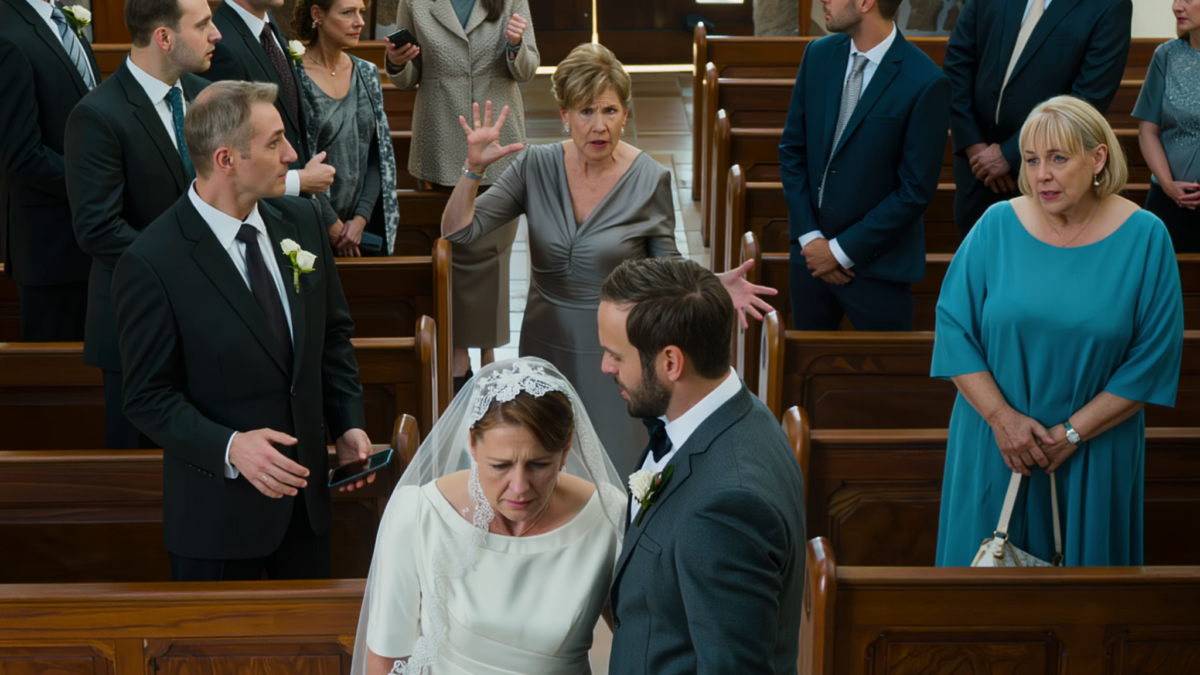
Forty minutes into my wedding, my mother rose from the front pew.
Two hundred guests were watching. My grandmother’s veil covered my face, and I was halfway through my vows when my mother’s voice cut through the church.
“Stop. She’s marrying beneath this family.”
The organ died in the middle of a note.
My father lunged for her arm. She pulled away from him. Then she turned toward the room and began talking about my groom’s family as if they were beneath everyone sitting there. She called them “the help.” She called my dress money wasted.
She smiled while she said it.
She said those things to my face, at the altar she had helped pay for, in front of every guest she had invited to watch me shine.
Instead, they watched me shrink.
Then a woman three rows back stood up.
I didn’t know her. I hadn’t invited her.
She turned her back on me and faced my parents.
And my mother, a woman who had never lost control of a room in her life, went white to the lips.
She had spent thirty-six years making sure that face never walked through a door.
My name is Stella. I was thirty-one years old, and I built things that were supposed to hold.
Bridges. Parking structures. Steel that didn’t care what your last name was.
I had spent my adult life proving that a beam could carry more than anyone expected.
It never occurred to me that I would have to prove the same thing about a marriage.
Eight months before that woman stood up in the church, none of this had happened yet.
There was only a kitchen, flour on the counter, and Dany on one knee.
He had been trying to make bread from his mother’s recipe and failing beautifully. There was dough on the counter and dough in his hair.
Then he knelt in the middle of the mess with a ring he had saved a year to buy.
I said yes before he finished asking.
We laughed until we could barely breathe.
That was the last uncomplicated hour I had for a long time.
My mother had been building toward the sentence she would eventually shout at my wedding from the moment Dany proposed.
I just couldn’t hear the foundation cracking yet.
You have to understand the house I grew up in.
My father’s family had made its money in real estate three generations earlier. We were old money in the way museums are old: polished, protected, and arranged so carefully that no one was supposed to touch anything.
The purpose of our family, as far as I could tell, was to look as though none of us had ever once needed to try.
My mother enforced that idea with her entire life.
She had a phrase for everything I did wrong.
“This family has standards.”
I heard it when I laughed too loudly.
I heard it when I wore a coat she thought was inappropriate.
I heard it when I said I wanted to become an engineer instead of choosing something she considered more suitable for a woman with my last name.
I became an engineer anyway.
I paid my own way through my degree because I wanted her to understand that she could not fund my obedience.
There was one thing about my mother I had never understood.
Every year, on one particular day in early spring, she locked herself inside my father’s study and stayed there until the windows went dark.
She never explained it.
“Migraine,” she would say the next morning.
Then she would look at you in a way that warned you not to ask again.
So I learned not to ask.
That spring, Dany came to dinner at my parents’ house for the first time.
Before we arrived, I had already dressed him in my head. I had chosen the jacket he should wear and rehearsed the questions my parents might ask.
I hated myself for doing it.
Dany ruined all my planning by showing up in a good coat with his own easy smile.
My mother greeted him with a handshake so brief that it somehow managed to look polite and insulting at the same time.
She poured the wine herself.
Then she asked him what his father did.
“He’s an electrician,” Dany said. “Ran his own crew until his back gave out.”
“The trades,” my mother repeated.
She let the words sit on her tongue.
“How useful.”
My father became deeply interested in his plate.
My brother Preston, twenty-eight and already resembling a younger version of my father, smirked into his glass.
Dany didn’t react.
He spoke about his father’s work with pride. Panel upgrades. Old houses that needed rewiring. Buildings where bad electrical systems could become dangerous if no one knew what they were doing.
I watched my mother’s face close.
She kept smiling.
That was what frightened me.
She was deciding something, and she was smiling while she did it.
As Dany and I were leaving, she caught me alone near the coats.
“He’s a lovely boy,” she said softly. “You can do so much better.”
“Better than kind?”
She said nothing.
“Better than honest?”
“Better than that name. Better than that world.”
Her hand closed around my sleeve.
“You have no idea what it costs to climb out of it.”
The sentence stayed with me.
Climb out of it.
She had said it like someone who knew exactly what climbing out cost.
So I asked her why class mattered so much to her. Why the fact that Dany’s father worked with his hands could drain the warmth from her face.
She let go of my sleeve.
“We don’t talk about before.”
“Before what?”
She didn’t answer.
She simply returned to her guests with her chin lifted, leaving me alone in the hall.
Dany’s family turned out to be the answer to a question I had never realized I was asking.
His mother, Sophia, opened the door and hugged me as if I already belonged there.
Their house was small, warm, and noisy. The radiators clanked. Something always seemed to be steaming in the kitchen.
Nobody measured me.
Nobody corrected my posture.
Nobody told me my laugh was too loud.
Sophia fed me until I could barely move and told me stories about Dany as a boy, including the time he rewired Christmas lights when he was nine and almost burned part of the porch.
I laughed until I cried.
No one told me to lower my voice.
Sitting at that crowded table, I felt something I didn’t yet know how to name.
It wasn’t that Dany’s family had less than mine.
It was that somehow, with less, they had built more.
On the drive home, Dany asked why I had gone quiet.
“I’m better than okay,” I told him.
I didn’t explain that the quiet was grief.
I was mourning all the years I had spent shrinking myself to fit inside a house that had never once felt the way Sophia’s kitchen felt.
Somewhere on that dark drive home, I decided I was going to marry into that warmth.
My mother could keep her cold.
She had other plans.
Within a week of our engagement, she appointed herself commander of the wedding.
She wanted the large church our family had used for generations. Marble, tradition, the same pews where generations of my relatives had displayed their respectability to everyone who mattered.
I wanted something smaller.
My mother heard “small” as “shameful.”
“You will be married somewhere respectable,” she told me, “or you will become an embarrassment I am forced to explain.”
She booked a florist I had not chosen.
She changed the guest list Dany and I had made and replaced half the names with people I barely knew.
“My people,” she said. “The people who matter.”
Every time I pushed back, she reframed control as generosity.
She was paying, after all.
She reminded me of that constantly.
I let her have the church.
I told myself it was one battle, not the war.
I had not yet learned that with my mother, there was no such thing as one battle.
There was only the campaign.
The first real crack appeared because of tablecloths.
My mother sent me into my father’s study to get heirloom linens from a low cabinet for a bridal luncheon she was planning.
It was the same study she locked herself inside every spring.
That day the door stood open.
I knelt at the cabinet and reached behind the folded cloth.
My fingers touched something stiff.
An envelope.
It was pale blue, faded with age, sealed and unopened.
Across the front was a name I didn’t recognize.
Vivien Voss.
It was not the name my mother used.
Stamped across the envelope in faded red ink were three words.
Return to sender.
I was still holding it when my mother appeared in the doorway.
“Give me that.”
It wasn’t a request.
She crossed the room faster than I had ever seen her move and took the envelope from my hand.
Her fingers were shaking.
My mother’s hands did not shake.
“This is not yours to touch.”
Her voice sounded different.
Then, almost under her breath, she said, “You have no idea what you’re holding.”
She was right.
I didn’t.
But when she pressed that pale blue envelope against her chest, I understood that I had found the edge of something she had spent years burying.
I went to my father first because he seemed like the safer version of the truth.
He was outside with coffee.
I said the name directly.
“Who is Vivien Voss?”
Something shifted in his shoulders.
“Where did you hear that name?”
“It’s Mom, isn’t it? Before this family.”
“That’s your mother’s business.”
“You married her.”
“Not yours. Not mine.”
“How is it not yours?”
He finally looked at me.
For one second, I saw something I had never expected to see on my father’s face.
Fear.
And beneath it, something close to grief.
“Some doors you leave shut, Stella,” he said. “You leave them shut for the good of everyone inside the house.”
Then he picked up his newspaper.
The conversation was over.
He knew something.
Worse, he had chosen for years not to know all of it.
The person who had been inside my parents’ house longest was Marta.
She had worked there for thirty years, since before I was born.
In the small ways that mattered, Marta had raised me more than my mother had.
She knew how I liked sandwiches cut. She had smoothed my hair when no one else was looking. She remembered things about me that my mother considered too ordinary to matter.
If anyone knew what my mother had brought into that house, it was Marta.
I found her polishing a tray in the kitchen.
“How long have you worked for us?”
“Since the spring your mother came. 1992.”
“What was she like?”
Marta’s cloth slowed.
“Thin.”
She kept polishing.
“Frightened underneath all that chin she carried. A woman running from something and dressed like she wasn’t.”
She glanced toward the door.
“She didn’t come with much. One good coat. One suitcase.”
Then she paused.
“And she didn’t come alone.”
A chill moved through me.
“What does that mean?”
Marta opened her mouth.
Then my mother’s heels sounded in the hallway.
Marta’s face changed immediately.
“Nothing,” she said loudly. “Old woman’s memory. Pay me no mind.”
My mother entered and asked what we were discussing.
“The weather,” Marta said.
But I had heard her.
She didn’t come alone.
A few days later, I caught Marta near her car.
I didn’t ask her for the entire story.
I asked for one place.
She hesitated for a long time.
Finally, she whispered, “Dolan’s.”
“What’s that?”
“Two hours north. That’s every last thing you’ll get from me. Don’t ever tell anyone I said it.”
She squeezed my hand once and went back inside.
I drove there on a Saturday.
I told Dany I had a site inspection.
That was a lie.
Dolan’s Auto stood at the end of a cracked Main Street.
The sign had faded until it looked like the ghost of a business. The bay doors were chained shut. Weeds rose through the lot.
I stood there wondering if I had driven two hours to stare at rust.
Then an older man on a nearby porch called out.
“Help you?”
“I’m looking for anyone who knew the Dolans.”
He studied me.
“Ray’s been gone a long time. Good mechanic. Bad luck his whole life.”
Something about my face made him look closer.
“You family?”
“I honestly don’t know. That’s what I’m trying to find out.”
He thought for a moment.
“There was a young wife way back. Real pretty. Real cold.”
He said the name.
“Vivien.”
Hearing my mother’s old name from a stranger while standing in front of a dead garage made the ground feel unstable beneath me.
“And a little girl,” he continued. “Baby, then toddler. Then one year, no wife, no baby, nothing. Ray came apart after that.”
He looked toward the abandoned shop.
“Drank the place right out from under himself. Been gone maybe fifteen years.”
Then he looked at me again.
“You favor her around the eyes.”
I drove home with my hands tight around the steering wheel.
My mother had been someone else before she became the woman I knew.
She had been connected to a mechanic named Ray.
There had been a baby girl.
And somehow, both of them had disappeared from the version of her life she had given us.
That night I told Dany where I had really gone.
He didn’t lecture me.
He put the kettle on.
That was how his family handled panic.
Then he sat with me while I said the worst part aloud.
“There was a baby. My mother has another daughter somewhere. Older than me.”
Dany stayed quiet.
Then he said, “You have a sister.”
I had not allowed myself to use the word until he did.
Sister.
It landed in my chest and stayed there.
My mother’s next move was money.
Money was the language she spoke most fluently.
She invited me to lunch at the club.
Just the two of us.
Over salad, she made an offer as calmly as if she were discussing flowers.
“I’ll pay for a different wedding.”
I stared at her.
“A better one. Give this some time. Take a year. See other people. I’ll cover every cent.”
“You’re offering to buy me out of my own engagement.”
“I’m offering you a way not to throw yourself away.”
I put down my fork.
“Dany isn’t a mistake I’m making. He’s the one good thing I ever chose without you.”
Her mouth tightened.
“Everything you have, you have because of this family.”
“No. Everything I have, I built.”
I left her sitting at the table.
My hands stayed steady all the way to my car.
Only after I shut the door did they start shaking.
The dress fitting was worse.
I was standing on the platform in a half-pinned gown while my mother spoke on the phone in the corner.
She believed I couldn’t hear her.
She was discussing the wedding seating.
“His whole family,” she said. “They’ll be seated with the help, essentially. I’ve done what I can, but there’s only so much one can do.”
The help.
Sophia, who had fed me as though I were already her daughter.
Dany’s father, whose back had been damaged after decades of electrical work.
The help.
I turned.
Dany was standing in the doorway with coffee.
His expression told me he had heard it too.
He did not storm out.
He set down the coffee, kissed my temple, and told my mother the gown looked beautiful on me.
He was gracious to a woman who had just reduced his parents to furniture.
I smiled at the seamstress and let her finish pinning the dress.
Inside, I made my mother a promise she could not hear.
Whatever you’re hiding, I thought, I’m going to find it.
A childhood memory came back to me.
I had been seven.
I wandered into my mother’s dressing room and found a photograph inside a book.
My mother was younger in the picture, wearing a cheap coat I had never seen before.
She was holding a baby.
The baby was not me.
I asked who it was.
My mother snatched the picture so quickly that the corner cut my finger.
“That’s no one,” she said.
“Put it out of your head.”
I had.
For twenty-four years.
Now I remembered her face.
That was the first time I had ever seen my mother afraid.
I stopped waiting for her to tell me the truth.
I started digging.
Quietly. Methodically.
I went through old family papers. I called my aunt, my father’s sister, who loved family history more than almost anything.
I guided the conversation toward my mother.
What I found was not a history.
It was an absence.
There was almost nothing before 1992.
No relatives from her side at my parents’ wedding.
No cousins.
No mother.
No childhood photographs.
“She told us they had all passed,” my aunt said. “So sad. She simply appeared, really. Gerald was completely smitten.”
People did not simply appear.
They came from somewhere.
I called the county records office during my lunch break and asked how someone could locate an old marriage or birth record under the name Voss.
The clerk typed for a while.
Then she paused.
“I’m showing sealed records under that name.”
“What kind?”
“I can’t tell you that. You would need a court order or you’d need to be a party to the record yourself.”
I hung up in the parking lot of a bridge job.
Behind me, steel climbed into the sky.
Sealed.
Not missing.
Sealed.
Someone had gone through a process to close part of my mother’s past.
I still did not know exactly what was inside those records.
But I knew they existed.
Preston chose a family dinner to make his next move.
Two aunts were there. A cousin. My parents. The good china.
He waited until the table went quiet.
“So, Dany,” he said, “when Stella’s up on some bridge in her little hard hat, what is it you actually do all day? Flip a few breakers?”
A soft laugh traveled around the table.
Dany put down his fork.
“Mostly I keep the lights on for people who’ve never had to wonder how they stay on.”
“Charming,” Preston said. “We just like people to know their place. Saves everyone embarrassment later.”
I looked at my brother.
“He knows his place, Preston. He earned it.”
The table went still.
“When was the last time you earned anything besides a haircut and a headache for the family accountant?”
My father stared at his wine.
My mother looked at me.
There was no anger in her expression.
There was calculation.
I had stopped reacting the way she wanted.
So she changed tactics.
She started calling relatives.
My aunt contacted me first.
“Your mother is beside herself. Are you certain? A girl with your name, your future, you could have anyone.”
“I don’t want anyone. I want him.”
There was a pause.
“Well,” she said, “don’t expect all of us to bless a mistake.”
Then she hung up.
Soon afterward, a younger cousin quietly forwarded me messages from a family group I had never been added to.
My mother’s name was at the top.
For Stella’s sake, we should present a united front.
Those who attend endorse this choice.
I would ask each of you to consider your absence a kindness to her.
Below those messages, relatives were beginning to say they would not attend my wedding.
Chair by chair, my mother was trying to empty the room.
Then my cousin sent one private message.
Not all of us.
Delete this before she sees you have it.
Some relatives were coming anyway.
The bridal luncheon became another performance.
About forty women sat around tables with good crystal and tiny sandwiches.
Someone asked how Dany and I had met.
My mother answered before I could.
“At a construction site, if you can believe it.”
A few women laughed.
“Our Stella has always had a soft spot for a project.”
I let the comment sit.
My mother lifted her glass.
“But you know how it is. She’s marrying beneath this family. We’re all going to have to be very brave about it.”
More polite laughter.
I lifted my water.
“To bravery.”
Then I drank.
My mother’s eyes narrowed.
She had wanted me to break in front of her friends.
I had not.
Not long after that, she invited Dany and me to dinner to “make peace.”
I knew better.
I went anyway.
She was gracious all evening. She asked Dany about his work without sneering. She poured the good wine herself.
Then, over dessert, she slid a folded page across the table.
“A family understanding.”
It asked us to postpone the wedding for a year.
In exchange, she would give us her blessing and continue paying.
Dany read it.
He set it down without saying a word and looked at me.
The entire dinner had been a stage.
The kindness had been part of the negotiation.
“You made a lovely dinner,” I told my mother as I stood. “Keep the paper.”
Dany and I left together.
A few nights later, I sat with Dany’s father on the back step of Sophia’s house.
He had spent four decades doing electrical work.
He knew exactly how my family saw him.
“They think a man’s worth whatever his hands earned by the hour,” he said, turning his coffee cup slowly. “Your mother’s not the first person to look at me like the help. Won’t be the last.”
There was no bitterness in his voice.
That was one of the things I admired most about Dany’s family.
They knew what they were worth.
They did not need my family to appraise them.
“You don’t marry a family, Stella,” he told me. “Whatever people tell you, you marry the one person. Everything else is weather.”
Then he went back inside.
I stayed on the step for a while.
Two days later, I returned to my father’s study.
My mother was out.
My father was gone.
I told myself I was returning the linens.
I knew I was lying.
This time I went to the desk.
The low drawer was locked.
I found the key taped underneath the drawer above it.
Inside was a bundle of pale blue envelopes.
Seven, maybe eight.
They were tied together with a ribbon that had gone gray from handling.
Every envelope was addressed to Vivien Voss.
Every one had been returned to sender.
The postmarks moved across the years.
More after that.
Nearly thirty years of someone writing to my mother.
Every envelope had the same initial in the corner.
R.
The oldest envelope had split along one seam.
Inside, beside a folded page I forced myself not to read, was a photograph and something small and hard.
A hospital bracelet.
The kind fastened around a newborn’s wrist.
One name was stamped into it.
Rachel.
I knelt on the floor.
For the first time, I had something solid.
Someone named Rachel had been trying to reach my mother for years.
And my mother had sent every letter back unopened.
That evening, I found her in the study.
I put one envelope on the desk between us.
“Who’s Rachel?”
The color drained from her face.
She reached across the desk slowly and pressed her palm over the envelope.
“We don’t talk about before.”
“You keep saying that. Before what? Before who?”
“Nothing that concerns you.”
“You went into my things,” she said. “You have no idea what you’ve disturbed.”
“Then tell me.”
She stood.
She gathered the entire bundle of letters against her chest.
“Leave it alone, Stella. I am warning you as your mother.”
Then she walked out and shut the door in my face.
My father found me in the hall.
He had heard at least part of the confrontation.
He put a hand on my shoulder.
“Your mother had a life before us,” he said. “A hard one. She built herself out of it with her own two hands. Leave it buried. For all our sakes. Especially hers.”
“You know what happened.”
“I know enough not to ask the rest.”
His hand fell away.
“That’s the kindest thing I ever did for her.”
“You think not asking was kindness?”
“Some love is knowing when to stop looking.”
He believed it.
That was the worst part.
He had taken deliberate ignorance and called it devotion for so long that he could no longer separate the two.
That night, Dany held me while I told him everything.
The sealed records.
The envelopes.
The bracelet.
“Maybe it’s better not to know,” he said carefully.
“If finding out costs me my whole family, it’s already costing me my family. Not knowing is just paying for the same thing more slowly.”
I thought about the childhood photograph.
“What kind of person looks at a child and says she’s no one?”
The question frightened me because I knew why it mattered.
I had spent my life afraid that love could be revoked.
That belonging was conditional.
That one morning, the people who loved you could decide you were no longer worth keeping.
Now I knew my mother may have made that decision about someone before me.
I needed Dany’s family after that.
I drove to Sophia’s house.
The kitchen was warm and steaming.
Dany was under the sink fixing something that had apparently been working well enough before he decided it needed attention.
Sophia put food in front of me before I had completely sat down.
For an hour, we talked about flowers and ordinary things.
For an hour, the wedding was only a wedding.
Dany came out from under the sink with grease on his knuckles, kissed my forehead, and left a dark smudge there.
Sophia laughed and wiped it away with her thumb.
For one hour, I felt held.
Then I went to the courthouse.
If the records were sealed, I wondered whether being my mother’s daughter gave me any right to request them.
The clerk read my form and shook her head.
“Sealed surrender and adoption records. Only a party to the record can petition. The birth parent or the child once she’s grown.”
“I’m the birth mother’s daughter. Her other daughter. Doesn’t that count for something?”
“No, hon. It doesn’t.”
She said it kindly.
“You’re not in the record. Two people can open that door. The mother or the child she gave up.”
I walked back into the parking lot.
The key to the truth had never been in my mother’s desk.
It was not in my father’s silence.
It belonged to two people.
My mother.
And the daughter inside the sealed record.
Meanwhile, my mother stopped limiting her cruelty to me.
Sophia received a phone call from someone connected to my family.
The caller suggested that Sophia might feel “more comfortable” not attending a wedding so far outside her world.
Sophia listened.
Then she thanked the caller for the concern and said she would not miss her only son’s wedding for anyone’s comfort but her own.
After she hung up, she cried at her kitchen table.
Dany found her there.
She made him promise not to tell me.
He told me anyway.
He was finished keeping my family’s cruelty secret just to protect my feelings.
That was when my anger changed.
It stopped being hot.
It became cold and steady.
Dany found me staring out a window.
He took my hand and pressed it against his chest.
“Whatever she does next,” he said, “she can’t buy this back once she’s spent it.”
My mother’s next move came through Preston.
He met Dany for coffee.
Then he slid an offer across the table.
Money for Dany to walk away.
No scene.
No hard feelings.
A quiet exit.
“For a man in your position,” Preston told him, “it’s a lot of money. Take it. Nobody has to know we spoke.”
Dany handed it back.
“My position is that I’m marrying the woman I love.”
He told me about the meeting that night.
His voice was calm.
His jaw wasn’t.
My family had tried to put a price on him.
I held his face in my hands and told him he was worth more than everything inside the church my mother cared so much about.
Then the parish office called.
The administrator sounded confused.
She wanted to confirm that we no longer needed our wedding date because the reservation had been canceled.
I had canceled nothing.
My mother had called and released the reservation.
Her name was on the account.
So suddenly we had no church.
Vendors had been booked around a ceremony location that no longer existed.
For ten minutes, sitting in my car outside a job site, I honestly did not know whether there would be a wedding.
Then I found another place.
A smaller stone church across town.
Plain.
Warmer.
I booked it that same day in my own name with my own card.
Then I called every vendor myself.
When my mother heard, she was colder than I had ever known her to be.
“You’ve made this small,” she said. “You’ve made us look like people who have to.”
“No,” I said. “I’ve made it mine. That’s the part you can’t stand.”
Then I hung up.
The sky did not fall.
I started to believe Dany’s father was right.
Everything else was weather.
Then Dany’s crew lost its biggest commercial client.
Months of work disappeared in a short phone call.
Dany did not accuse my family directly.
Neither did I.
We could not prove anything.
But the timing was impossible to ignore.
A company that relied heavily on business connected to my family’s real estate world had suddenly dropped a good electrical crew two weeks before our wedding.
Dany sat at his kitchen table working through numbers that had been simple a few days earlier.
“She wants me to know she can do it,” he said. “Not stop the wedding. Just make sure I keep paying for it.”
I confronted Preston at the club.
“The client. Did you make the call, or did you give her the number?”
He smiled.
“I have no idea what you mean.”
Then he took a drink.
“But if a man can’t hold on to his own business, maybe he was never really in business.”
I looked at my brother.
He had become so comfortable acting as my mother’s weapon that he seemed to have forgotten he was only the handle.
“You’ll be at the wedding, Preston.”
He raised an eyebrow.
“I want you there. I want you to watch me not need one single thing this family holds over my head.”
I left.
For the first time, his smirk looked like work.
That morning, my younger cousin sent another message.
Don’t reply. She checks my phone.
Some of us are coming anyway.
Some of us are tired of being told who counts and who’s furniture.
I’ll be there.
I read it twice.
For the first time in weeks, I felt the ground shift slightly beneath me.
Not my mother’s ground.
Mine.
What I did not know was that someone else had seen our names and wedding date printed in the local paper.
Someone whose name had appeared as one initial on nearly thirty years of returned letters.
I found Rachel the way people find almost anyone now.
I searched her name.
Rachel Voss.
The county.
Registry.
Eventually I found an old reunion registry post.
Searching for birth mother, initials V.
Child surrendered 1990.
Any information welcome.
I read it four times.
My parents had married in 1993.
The woman posting was looking for a birth mother with initials matching my mother’s old name.
It still wasn’t proof.
Voss was not a unique surname.
Initials were not fingerprints.
But there was the bracelet.
There were the letters signed R.
There were the sealed records.
There was my mother locking herself in a room one day every spring.
All the weight was beginning to point toward the same place.
The registry had a button that allowed me to contact the poster.
My cursor hovered over it.
If I clicked, I could not undo it.
I would be pulling a stranger into a family conflict that had already hurt everyone around it.
Rachel, whoever she was, had mailed letters into silence for years.
I refused to use her as a weapon against my mother.
So I closed the laptop.
Not that night.
Not that way.
Dany and I sat down with the actual wedding costs.
Deposits had been lost.
Last-minute changes had increased prices.
The small wedding I originally wanted had become more expensive because we were constantly replacing things my mother disrupted.
Dany looked at the numbers.
“We could go to the courthouse,” he said. “You and me. Skip all of it. Let her keep the room. We keep the marriage.”
For one honest second, I wanted to.
I wanted to leave the church empty and walk away with him.
Then I closed the notebook.
“No.”
He looked at me.
“She doesn’t get the church too. Some ground you hold because holding it is the whole point.”
He nodded.
My mother summoned me to the study one final time before the wedding.
She was no longer shaking.
She had moved past fear into something harder.
“You’ve been asking questions,” she said. “In my papers. In town. About names that died a long time ago.”
“Names don’t die, Mom. People stop saying them.”
She folded her hands.
“Listen carefully. If you marry that man, you are out.”
I stared at her.
“No inheritance. No trust. No name. I will personally make sure that not one person who matters attends. I’ll empty that little church and leave you with the help and your regret.”
She smiled.
“You’ll have your marriage. You’ll have nothing else.”
“You’d burn down my wedding to protect a secret you won’t even say out loud.”
Her expression did not change.
“I’ve burned down a great deal more than that to protect this family from itself.”
I believed her.
That was what made my mother frightening.
She rarely bluffed.
I stopped asking her for anything.
I mailed the wedding invitations myself.
Our wedding announcement appeared in the local paper because that was a family tradition.
Our two names.
The small stone church.
The date in July.
I did not think twice about it.
I had spent weeks deciding not to contact Rachel.
Without realizing it, I had just made it possible for Rachel to find us.
The night the invitations went out, I almost called my mother.
Her number glowed on my phone at midnight.
I wanted to tell her I missed her.
I wanted to ask her to come to the small wedding and simply sit in the front row without saying the cruel thing for once.
That was the difficult part about creating distance from someone who had hurt me.
The anger was not the hardest thing to carry.
It was the love that did not disappear when I wanted it to.
Part of me was still seven years old, still holding that photograph, still wanting my mother to choose me.
Then I thought about the woman who had been sending letters into the same silence for decades.
I put my phone face down.
My mother did not answer calls like that.
She never had.
The next morning, I felt lighter.
My mother came to my job site once.
Only once.
It was the one place where she could not control the room.
She arrived in gray silk at the base of a half-built overpass. Her heels sank slightly into the gravel.
My crew went quiet.
“This is your last chance to be reasonable,” she announced loudly enough for people nearby to hear.
“Marry him, and you are no one. No trust. No name. You’ll spend your whole life on gravel like this with people like this.”
People like this.
She looked directly at the crew.
I set down my clipboard.
“These people have built more real things by nine in the morning than our entire family has in three generations.”
I walked her toward her car.
“You don’t get to make a scene at the one place I built without you.”
Then I looked down.
“Go home, Mom. You’re standing in wet concrete.”
She looked down too.
Her expensive heels had sunk into a fresh pour.
She had to step out of them.
She drove away in her stocking feet, leaving the shoes behind as the concrete began to set.
My crew waited until she was gone before laughing.
I didn’t.
I looked at the shoe-shaped marks and understood something clearly.
My mother would never stop because I asked her to.
She would carry the fight to the one place where she still believed she could win.
A church full of people whose approval she had spent her life collecting.
The night before the rehearsal, my father came to see me alone.
He had been drinking a little.
He sat across from me and stared into his glass.
“Your mother left someone behind,” he said.
I waited.
“Before me. Before she became who she is now. I’ve known that a long time. I never asked how much of a life she left.”
He finally looked at me.
“I decided the name was worth not asking.”
“Dad.”
“Don’t make me learn it now, Stella. Please. Whatever you found, let it stay in the room she keeps it in. She’ll shatter.”
For a moment, I felt tenderness for him.
He was wrong, but he wasn’t speaking from cruelty.
“You could have helped her carry it,” I said, “instead of helping her hide it.”
“Hiding it was how I helped her carry it.”
That sentence explained my father better than anything else could have.
He had confused complicity with love.
He asked me again to leave the past alone.
I did not promise.
Three days before the wedding, I saw my mother burn a letter.
I had gone to the house with seating charts.
She stood at the kitchen sink holding another pale blue envelope.
This one was different.
It had been sent certified, with a green slip attached.
Someone had required a signature.
My mother had signed for it.
She could not simply mark it return to sender.
So she held it over the sink and burned it.
The flame climbed the pale blue paper.
She saw me in the doorway.
She did not stop until it was gone.
“It’s nothing,” she said.
Then she ran water over the ash.
But I understood.
Rachel had seen the wedding announcement.
She already knew the family name because she had been mailing letters to that house for years.
Now she also knew the date.
And the church.
My mother believed she had buried the past again.
She had no idea it already knew where we were going to be.
The rehearsal was small.
My mother refused to attend.
Preston came instead and spent part of the evening moving place cards when he thought no one was looking.
Afterward, Sophia found me sitting in a pew.
She took both my hands.
“You don’t need her blessing to be blessed,” she told me. “You’ve got mine. You’ve got his. That right there is a wedding.”
I needed those words later.
Because that night, doubt finally reached me.
I lay awake asking myself the question I had avoided for months.
Was I marrying Dany because I loved him?
Or had I become so consumed by fighting my mother that the wedding itself had turned into the fight?
Was love worth losing the only family and world I had ever known?
I had told everyone I would rather lose them than lose him.
Hours before the wedding, I had to know whether I actually meant it.
My mother made her final move that same night.
She went to Dany first.
She caught him outside Sophia’s house.
She spoke gently.
That was how he later knew she had planned every word.
She told him I was having doubts.
She said I had confessed that I would eventually resent him for the family I was giving up.
According to her, the kind and selfless thing would be for him to leave before I learned to hate him for staying.
Then she called me.
To me, she told a different story.
She said she had looked into Dany’s crew and suggested they were drowning financially.
She told me he had chosen a woman with my family name because I represented security.
She had an answer ready for every objection.
She struck both of us with the exact fear most likely to work.
He feared he would become a burden.
I feared I was being used.
For a few hours, in separate places, we each believed her a little.
I sat on my bathroom floor at midnight.
My wedding dress hung on the door behind me.
For the first time, I genuinely considered canceling everything.
Dany did not sleep either.
Later, he told me he sat in his truck outside his mother’s house until almost two in the morning, replaying my mother’s words.
Then he did the one thing that saved us.
He drove to me.
He knocked on my door in the middle of the night.
When I opened it, he looked exhausted.
“Your mother came to me tonight,” he said.
I stared at him.
“She told me you have doubts. I almost let it work.”
He swallowed.
“So I need you to tell me right now, to my face. Not what you’re supposed to say. The truth.”
He looked directly at me.
“Do you want this?”
The answer came without effort.
“Yes.”
He stayed still.
“I want you. I have never once not wanted you.”
“She got in my head,” he admitted.
“She’s good at it.”
I pulled him inside.
“Don’t listen to her. Listen to me. Marry me tomorrow.”
He held me in the hallway.
We stood there breathing until the fear felt smaller.
Morning came.
It was my wedding day.
I dressed in a room full of women who loved me.
Norah pinned my hair.
Sophia steamed the last wrinkle from the hem of my gown.
Then they brought me my grandmother’s veil.
The family veil.
Four generations of brides had worn the same yellowing lace.
My mother had insisted on it back when she still believed she would be standing beside me.
I looked at myself in the mirror.
The veil was beautiful.
It also represented everything about my family I had spent months questioning.
The name.
The bloodline.
The belief that belonging made one person more valuable than another.
For a moment, I considered taking it off.
Then I decided to wear it on my own terms.
I lowered it over my face myself.
“Okay,” I whispered to my reflection. “Let’s go get married.”
The church filled.
Two hundred people came.
To my surprise, many of my mother’s people came too.
Maybe curiosity brought them.
Maybe some were quietly defying her.
Maybe a family wedding still carried enough social gravity to pull them in.
Dany stood at the front in a suit that fit him perfectly.
His father stood beside him as best man despite his damaged back.
Sophia was already crying.
Then my mother arrived.
Late.
Precise.
Gray silk.
My father was on her arm.
She walked to the front pew and sat down as though she had never threatened to empty the church.
Her hands folded neatly in her lap.
She looked almost serene.
Now I understand why.
She believed she had won.
Three days earlier, she had burned Rachel’s latest letter.
She thought she had buried the past again.
She believed the worst thing that could happen that day was that I would marry a working man.
She could survive that.
She could spin it later.
She could control the story.
She did not know what was walking through the church behind her.
I almost missed the woman.
She entered through a side door while the prelude was playing.
Late thirties, maybe.
Plain gray coat.
She looked unlike almost everyone else in the room.
She took an aisle seat three rows behind my family.
I registered her as a stranger and immediately looked away.
A friend of someone.
A plus-one.
It did not occur to me to study her face.
If I had, I might have noticed the shape of my mother’s jaw softened on another woman.
The familiar angle of the shoulders.
But I had a wedding to get through.
The ceremony began.
The minister welcomed everyone.
Dany found my eyes through the lace.
For a few minutes, the previous eight months disappeared.
It was just us.
His hand was warm.
Mine was steady.
We reached the vows.
The church became so quiet I could hear the lace move against my shoulder.
I opened my mouth to promise Dany everything I had.
Then my mother stood.
“Stop.”
The word carried through the stone church.
The organ stopped.
Every head turned.
“She’s marrying beneath this family.”
Dany’s hand tightened around mine.
My father reached for my mother’s arm.
She pulled free.
She stepped into the aisle and faced the room as though it belonged to her.
“You all came here to watch my daughter throw herself away,” she said. “So watch.”
No one moved.
“His people are tradesmen. Electricians. The help, frankly, dressed up for a single day.”
A murmur moved through the pews.
Sophia’s face changed.
Dany’s father put one hand on his son’s shoulder.
My mother gestured toward me.
“That dress is money wasted. This entire affair is a lapse in judgment that I fully intend to see corrected.”
She smiled.
At me.
At the altar.
In front of everyone she had invited.
My father stood behind her, gray-faced.
Preston sat nearby with the beginning of a smirk.
I did not interrupt her.
I let her use every word she had brought.
Then the woman three rows back stood.
She did not look at me.
She turned toward my parents.
Her voice was calm when she spoke.
“You don’t remember me, Vivien.”
My mother’s face emptied of color.
The woman continued.
“But I remember every single letter you sent back.”
My mother reached for the pew beside her.
“I don’t know you.”
The confidence had disappeared from her voice.
The woman stepped into the aisle.
“You knew me for two years.”
The entire church was listening now.
“You held me. Then you decided I didn’t fit the life you wanted.”
My mother did not move.
“I’ve been writing to you since I was ten years old. Pale blue envelopes. You know the ones.”
My stomach dropped.
“You never opened a single one.”
The woman took another breath.
“You sent every one back.”
Recognition was written across my mother’s face.
She knew her.
She had known her from the moment she stood.
The woman reached into the pocket of her gray coat.
She removed a folded document.
“My hospital record,” she said. “Maternity ward, 1988. Mother’s name: Vivien Voss.”
She placed it on the edge of the pew.
Then she opened her other hand.
A small plastic hospital bracelet lay in her palm.
The kind used for a newborn.
Even from where I stood, I recognized the name.
Rachel.
I had seen the same name in my father’s locked drawer.
My mother stared at it.
Rachel looked at her.
“You kept a veil for four generations,” she said quietly. “I kept this.”
She lifted the bracelet slightly.
“It’s the only thing you ever left me.”
A sound moved through the church as people reacted all at once.
I looked toward Preston.
His smirk was gone.
Rachel turned enough for the room to see her face clearly.
Now the resemblance was impossible to miss.
Then she looked directly at my mother.
“You want to talk about who’s marrying beneath who?”
My mother said nothing.
“Then let’s talk about it.”
Rachel stepped farther into the aisle.
“You had a husband who fixed cars. You had a baby girl. And you gave up your own blood.”
The room stayed still.
“You surrendered me to strangers so you could marry up into this name.”
She let the last word hang there.
“You didn’t rise above anything, Vivien. You climbed over me to get here.”
My mother’s face twisted.
Rachel did not raise her voice.
“So don’t you ever stand in a church and tell your daughter she’s marrying beneath this family.”
For months, my mother had used that accusation against Dany and his parents.
Now the same idea had turned back toward her in front of everyone whose opinion she had spent her life protecting.
My mother snapped.
“You have no right,” she said.
Rachel remained still.
“You were a mistake. I fixed it.”
The words left my mother’s mouth before she seemed to understand what she had said.
Then she heard them.
So did all two hundred people.
Her hand flew to her mouth.
She had tried to deny Rachel.
Instead, she had confirmed her.
My mother turned toward my father.
“Gerald, do something!”
He was no longer standing.
He had sunk into the front pew with his face in his hands.
For thirty years, he had called his silence love.
Now the thing he had chosen not to know stood only a few feet away, holding a newborn bracelet.
He did not defend my mother.
He could not do so without admitting how much he had always suspected.
For once, my father’s silence did not protect anyone.
It only exposed him.
He looked at me once.
I watched him realize that I had known part of the truth before the wedding.
Then I looked back at Rachel.
People may have expected me to turn toward my mother and make her pay.
I didn’t.
My mother had used public humiliation as a weapon.
I did not want another version of the same weapon.
Rachel had already said what belonged to her to say.
The truth did not need my help becoming louder.
I stepped down from the altar.
I gathered my grandmother’s veil in one hand and walked into the aisle.
I passed my father.
I passed my mother.
She said my name once.
“Stella.”
She said it like a command.
For most of my life, I would have stopped.
I kept walking.
I stopped in front of Rachel.
My sister.
A woman I had never met and had somehow been searching for for months.
I held out my hand.
Rachel looked at it.
Then she looked at me.
For the first time since she stood up, her composure cracked.
She took my hand.
Her grip was strong.
“I’m sorry no one came for you,” I told her quietly.
Her eyes filled.
“I’m here now.”
Behind me, my mother’s voice rose.
She began telling people it was all lies.
The pews shifted.
Guests murmured.
Some reached for coats.
I did not turn around.
For the first time, I did not need to see my mother’s face to understand what she was losing.
I stood at the back of the church holding my sister’s hand.
Then I did the last thing my mother expected.
I did not leave.
I did not let her destroy the wedding.
I turned around with Rachel beside me.
We walked back toward the altar.
Dany was still there.
His eyes were wet, but he had not moved.
I brought Rachel to the front row.
I put her in the seat my mother had left when she stood to interrupt the wedding.
Then I went back to Dany.
I took his hands.
I looked at the minister.
“Please finish it.”
The minister looked once toward the confusion in the pews.
Then he smiled.
And he continued.
Dany and I said our vows while my mother gathered herself and left through the side aisle with my father.
Gray silk disappeared through the church door.
She got to keep the family name.
That was all.
Then Dany kissed me.
Sophia sobbed.
Norah cheered.
Dany’s father stood as straight as his back allowed and clapped.
The people who actually loved us made enough noise to fill the stone church.
Rachel stood in the front row.
My sister watched me marry the man our mother had spent eight months trying to convince me to abandon.
A few weeks later, the loud part was over.
The quiet part was harder.
I stopped speaking to my mother.
Not because I wanted revenge.
Mostly, I no longer did.
But because some doors really do need to stay closed.
She had taught me that phrase herself.
She had simply been talking about the wrong door.
She never apologized.
I don’t know whether she would know how.
She stayed in the large house with my father, the family name, and the veil.
I sometimes imagined her still locking herself inside that study one day every spring.
Only now, the family knew what that day meant.
My father called once.
He said he was sorry.
I believed he meant it as much as he knew how to mean anything.
I told him I would speak with him under certain conditions.
Not about my mother.
Not in that house.
And not until he could say my mother’s name and Rachel’s name in the same sentence.
He did not call back.
I kept the boundary anyway.
A boundary still counts even when you are the only person enforcing it.
Rachel became part of my life.
That was the unexpected gift buried beneath everything else.
I had a sister.
She started coming to Sunday dinners at Sophia’s.
She and Dany argued about baseball with the same intensity other families reserved for major decisions.
Piece by piece, she told me about the woman she had become without our mother.
She was kind.
Funny in a dry way I recognized immediately.
Strong in ways I was only beginning to understand.
We did not spend every conversation talking about Vivien.
We did not need to.
We talked about now.
And Dany was my husband.
Every ordinary morning with him became an answer to the woman who had tried to put a price on his worth.
I had married the trades.
I had married the warm kitchen.
I had married the person.
It took me thirty-one years and a wedding nearly torn apart in front of two hundred people to understand what my mother had taught me without ever saying it directly.
She had taught me that love was conditional.
That to be kept, you had to be worth keeping.
That your worth could disappear the moment you stopped fitting the life someone else wanted.
She had taught Rachel that lesson first.
Then she nearly convinced me to repeat it with Dany.
I chose not to.
I did not have to erase someone I loved in order to remain worthy of love myself.
The family name had never been the standard.
The veil eventually went into a box on a high shelf.
Rachel’s bracelet stayed where I could see it.
I knew which one felt like the real family heirloom.
A family was never just the people who shared my name.
It was the people who would never trade me for it.








