At our Fourth of July dinner, Dad tossed my sister the keys to a brand-new car and told me, “You’ve earned nothing. You never do.” Fifteen relatives clapped. I set my fork down and stayed quiet because I knew who was coming up the driveway. At 7:14, the doorbell rang, and a man in a gray suit stepped inside with a thick folder and asked which Kesler man was the biological father.
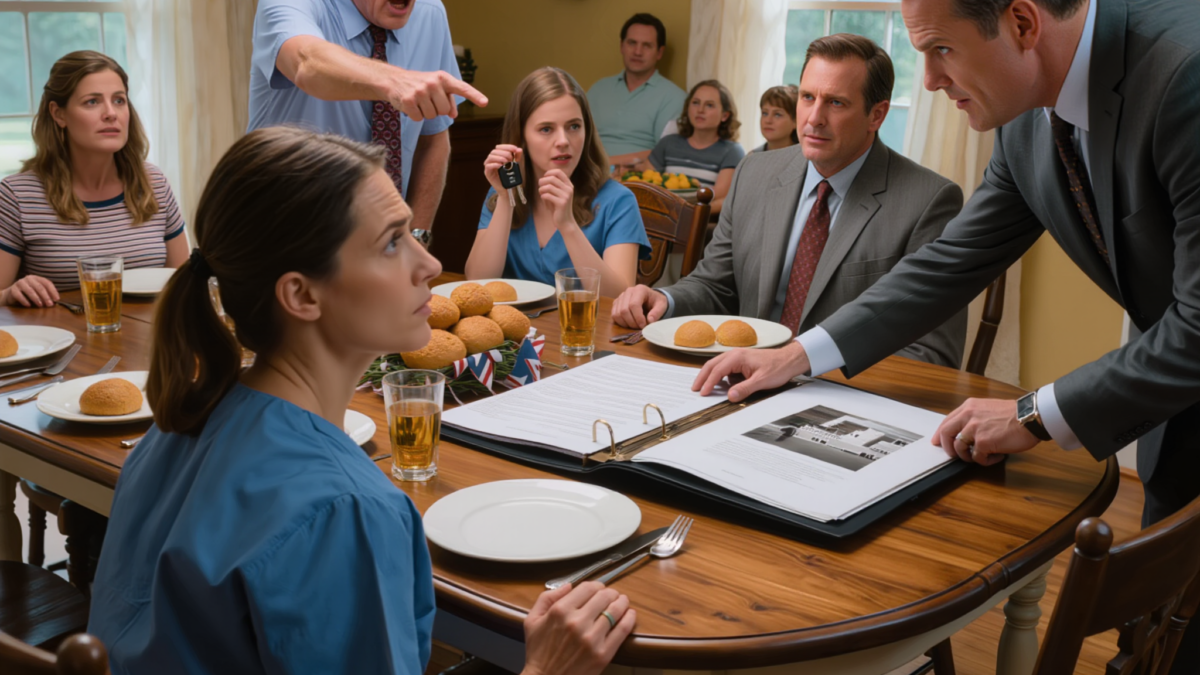
“You’ve earned nothing. You never do.”
My father said it to my face at his own table on the Fourth of July, seconds after he tossed my younger sister the keys to a brand-new car.
Fifteen relatives clapped.
My mother beamed like she had won something.
I set my fork down and waited, because I had seen what was coming up that driveway and they hadn’t.
At 7:14, the doorbell cut through the applause.
A man in a pressed gray suit stepped inside, laid a thick folder on the table, and looked around at every Kesler man in the room.
“I’m here about a paternity claim,” he said. “I need to know which one of you is the biological father.”
My father laughed and raised his hand.
He shouldn’t have.
My name is Bronwin Kesler. I was 34 years old, a pediatric nurse at Milbrook General in Ohio, and the man who called me nothing that night was my father, Denton.
The reason I didn’t flinch when he said it began eight months earlier with a cheap plastic DNA test and a question I had never expected to ask.
In my family, love worked like a payroll.
You earned it or you didn’t.
My father kept the books.
He had repeated some version of that idea for so long that it had stopped sounding cruel when I was a child. It simply became part of the weather in our house.
“Nobody hands you anything, Bronwin. You earn your place.”
He said it over dinner. He said it while standing at the kitchen sink. He said it over the hood of whatever truck he happened to be polishing that week.
My childhood felt like one long performance review in which I was always just short of the raise.
My younger sister, Cassidy, never seemed to have that problem.
She was five years younger than me, softer and prettier in the way my father valued, and she learned early that the easiest way to live with Denton Kesler was to smile, agree, and let him feel important.
She was very good at it.
I wasn’t.
I asked questions.
I remembered details.
I noticed when a story changed.
By 34, I had built a life my father couldn’t take credit for and wouldn’t respect anyway. I put myself through nursing school while working night shifts at a diner. I took no money from him. I worked on the pediatric floor at Milbrook General, where I learned how to speak calmly to frightened parents and hold still when everything in a room was falling apart.
Steady hands.
A calm voice.
A face that didn’t show every feeling moving beneath it.
That last skill, I would eventually learn, ran in my family.
I just didn’t yet know where I had learned it.
My father was proud of almost nothing more than the story of how he had made his money.
He told it at nearly every holiday.
“1991,” he would begin, and everyone would settle in.
He had been 23, broke, working two jobs. Then he made one smart move.
A lucky investment, he called it.
Timing and nerve.
That one decision, according to him, had changed everything.
The house on Larks Lane.
The boat.
The good schools for Cassidy.
The comfortable life everyone around him associated with discipline and success.
There was even a photograph in the hallway that served as a kind of shrine to the story.
My father at 23, grinning outside a low brick building with a duffel bag over his shoulder.
“The day my luck turned,” he called it.
He would tap the glass when he passed it.
“Right there. That’s where I stopped being nothing.”
I had walked past that picture thousands of times.
I had never really looked at the building behind him.
The money mattered because the money was his sermon.
Denton Kesler had climbed out of nothing with his own two hands. Anyone who failed to do the same had, in his mind, suffered some kind of moral failure.
He made sure I understood that he included me in that judgment.
I was 34 and still renting an apartment.
To him, that fact alone seemed to outweigh nursing school, night shifts, and every life I had built without his help.
My mother, Beverly, spent years smoothing things over.
She would catch my eye across a table with a look that meant, Don’t. Not tonight.
For most of my life, I interpreted that as a weak version of being on my side.
It took me 34 years to understand that my mother had not been protecting me from my father.
She had been protecting my father from me.
That was our family.
The saint.
The golden girl.
And me, the daughter who never quite earned it.
I had mostly made peace with that by adulthood. I stopped attending Sunday dinners. I built a small, good life 40 minutes away. I went home for the holidays I couldn’t skip without starting a war.
Then, the previous November, I ordered a DNA test.
There was nothing dramatic about the decision.
A four-year-old on my floor had been admitted with a rare clotting disorder. It was genetic, the kind of condition that could remain quiet in a family until suddenly it wasn’t quiet anymore.
His mother sat beside his bed and said something that stayed with me.
“We had no idea it was in us.”
I thought about that sentence for a week.
As a nurse, I knew my father’s medical history was basically a locked box. He rarely talked about his parents. He never volunteered information about illnesses. Whenever I tried to fill out a family medical questionnaire, he dismissed the questions.
“Keslers don’t get sick,” he liked to say. “We’re built right.”
So I spit into a tube.
I told myself it was practical.
Know your own risks.
I mailed it away and forgot about it.
Six weeks later, the results arrived.
The health section was mostly unremarkable. A few carrier flags. Nothing urgent.
That was not the part that stopped me.
Near the bottom of the screen was a tab labeled DNA relatives.
There was a number beside it.
I had matches.
A lot of matches.
And some of them were far closer than they had any reason to be.
I remember sitting on my kitchen floor with my laptop, staring at the list and assuming there had been an error at the lab.
The website said I had half siblings.
Not cousins.
Not distant relatives.
Half siblings.
People with whom I apparently shared one biological parent.
And there weren’t one or two.
The first time I loaded the page, there were 17.
I sat there doing the only math available to me.
My parents had been married for 36 years.
There were two children in the family.
Cassidy and me.
That was the whole story I had grown up with.
Seventeen half siblings meant one of my parents had an entire history I had never heard whispered about.
I closed the laptop.
I decided it was a database error.
I told myself I would email the company the next morning and someone would apologize.
For about nine hours, I almost believed that.
I slept badly, woke up, made coffee, and opened the laptop.
The number was 19.
By the end of the week, it was 22.
They were not glitches.
New profiles kept appearing.
Real people with real photographs.
Some messaged me through the site.
Hi, I think we might be related.
A few had been searching for years. Others, like me, had casually taken a consumer DNA test and walked directly into a family history they had never known existed.
What kept me awake was the pattern.
Twenty-two half siblings scattered across the country, most of them close to my age.
As far as I could tell, they had been born largely between 1991 and 1996.
That was exactly the period when my father had been in his twenties.
Exactly the period when, according to his own famous story, he had been broke until one mysterious stroke of luck changed his life.
I did not let myself finish that thought.
Not yet.
I had spent my whole life as the family scapegoat, but I was not foolish. I knew what would happen if I accused my father of something enormous without proof.
He would bury me under the version of me he had already spent decades creating.
Jealous.
Difficult.
Ungrateful.
So I did what I always did when a story stopped adding up.
I kept records.
I created a spreadsheet.
Names.
Ages.
Hometowns.
Birth years.
Whatever details each person knew.
I told nobody.
Not my mother.
Not Cassidy.
Not even the man I was seeing.
I went to work. I cared for my patients. I kept my face steady.
Every few days, I opened the site and watched the number rise.
By Christmas, there were 29.
I drove to my parents’ house for the holiday with a folder full of information about strangers in my bag and my father’s voice already filling the room.
He was telling the 1991 story again.
I watched him tap the framed photograph in the hallway.
“Right there. That’s where I stopped being nothing.”
For the first time in my life, I stopped in front of the frame and studied the building behind him.
Low brick.
Flat overhang.
A sign too blurry to read.
I took a photograph of the photograph.
Then I drove home.
For the entire 40-minute trip back to Milbrook, that brick building sat in my mind.
I had no idea yet that I had just found the thread that would unravel nearly everything my father had taught me about who earned what.
The message that changed everything arrived in January while I was charting at the nurses’ station.
It was from a woman named Simone Adler.
She was 35, a NICU nurse in Cleveland.
We did nearly the same kind of work about 90 miles apart and had never met.
Her message was brief.
She had noticed me on the relatives list.
She had been building her own spreadsheet for two years.
And she believed she had figured out something I hadn’t.
“We don’t share a mother,” she wrote. “I’ve ruled that out for almost all of us. We share a father. One man. And I think I know how.”
I called her during my break and stood in the stairwell with my heart hammering.
Simone had the calm, dry voice of someone accustomed to delivering difficult information gently.
She had already found around 30 of us.
She had done something I had been too afraid to do.
She put our birthdays and birthplaces on a map.
Almost everyone had been born within roughly 100 miles of Columbus.
“Between 1991 and 1996,” she said. “You too. 1992.”
“My parents lived outside Columbus,” I told her.
There was a pause.
I could hear her writing something.
“Bronwin, how much do you know about where you were conceived?”
I laughed because the question sounded absurd.
“Nothing. Normal, I assume. Why?”
“Because most of us weren’t,” she said. “Most of us were conceived at a fertility clinic. And I don’t think all our parents know that yet.”
I sat down on the concrete stair.
I still remember the cold railing and the fluorescent hum.
My first thought was simple.
Not me.
My parents had been married.
My father had raised me.
This had to belong to somebody else’s nightmare.
Simone kept talking.
Not every sibling’s story was identical, she explained. But enough of them had records connecting their conception to fertility treatment that a pattern was forming.
One donor could explain many of us.
Thirty people suggested something larger.
Possibly one clinic repeatedly using the same donor far beyond what anyone involved understood.
“Whoever he is,” she said, “he may have no idea there are this many of us.”
I asked the obvious question.
“What clinic?”
“We’re not completely sure yet,” she said. “But three people have paperwork. All three name the same place. Brightwater. It was in Columbus.”
I wrote Brightwater on the back of my hand.
That night, the name meant almost nothing.
Within days, it meant everything.
I searched for Brightwater from my kitchen table.
The clinic had closed years earlier, but its name was appearing in recent coverage because of a lawsuit. Donor-conceived adults had come forward alleging serious misconduct at the clinic under its founder, Dr. Wendell Fra.
The allegations involved donor records, repeated use of certain samples, and families who believed the information they had been given did not match what had actually happened.
I read one article.
Then another.
Then a third.
By the fourth, my coffee was cold.
That article included a photograph.
A low brick building.
A flat overhang above the entrance.
I stood so quickly my chair tipped backward.
I grabbed my phone and opened the photograph I had taken at Christmas.
My father at 23.
The duffel bag.
The grin.
I put the two pictures side by side.
Same brick.
Same overhang.
Same doorway.
The building in the background of my father’s favorite photograph was Brightwater Fertility Center.
I sat there for a long time.
The two images glowed beside each other on the kitchen table.
For the first time, I allowed myself to consider that the story I had heard my entire life might be a cover story.
But I also knew what a photograph could and could not prove.
My father having once stood outside Brightwater did not prove he was the biological father of dozens of strangers.
I was a nurse.
I knew the difference between a symptom and a diagnosis.
So I kept going.
I sent Simone the photographs.
She was quiet for a long time.
Then she suggested further DNA comparisons with her and two others.
The genetic details were complicated, but the result was not.
The other donor-conceived siblings matched me as half siblings.
The paternal pattern also pointed directly toward the same paternal line as the man who had raised me.
Denton Kesler was not simply a man who happened to be standing outside the clinic in an old photograph.
He was the donor we shared.
The father who had spent my childhood lecturing me about blood, discipline, family, and earning my place had biological children scattered across the country.
Dozens of them.
Children he had never raised.
Never fed.
Never taken to school.
Never judged across a holiday table.
And of all those children, he had raised two.
Cassidy and me.
The realization sat strangely in me.
He had kept me.
And somehow I was still the child he had spent my entire life telling was worth less.
Simone and I began talking almost every day.
Then I began meeting more of the others.
There was Reed, a high school football coach in Indiana who had my stubborn jaw.
Dana was a pharmacist who cried when she saw my photograph because she said I had the same eyes as several other people in the group.
Colton was quiet and had been looking for his biological father for 11 years.
In March, I met four of them at a diner roughly halfway between us.
I went in expecting grief.
Instead, something unexpected happened.
For the first time in my adult life, I sat at a family table where nobody was keeping score.
They laughed at similar things.
They interrupted one another in familiar ways.
Reed moved his hands exactly the way I did when he was nervous.
When I carefully told them that I believed I knew who the donor was and that I had actually been raised by him, nobody treated me like I was creating a problem.
Dana reached across the table and held my wrist.
“God,” she said. “He kept you and treated you like that.”
No one had ever said it so plainly.
One sentence from a woman I barely knew reached somewhere that decades of my mother’s careful looks had never reached.
I had spent my life assuming I was the defective one.
The difficult daughter.
The person for whom love had to be earned because something about me made it harder to give.
Then I sat in a diner with people who had my jaw, my eyes, my hands, and some of my mannerisms, and none of them acted as if I were difficult to love.
I carried that with me.
But there was another problem.
Simone was the one who put it on the table.
She slid a medical letter toward me.
It had been drafted by two physicians connected to the group.
Some of the siblings were being diagnosed with the same inherited cardiomyopathy.
A condition that could remain silent and then become dangerous in adulthood.
Three people had already been diagnosed.
Others had family histories involving unexplained heart problems.
Simone believed the pattern was coming through the donor’s biological line.
My father’s line.
Which meant all of us needed to be screened.
Including Cassidy.
Including me.
I read the letter for a long time.
Until then, the story had been about identity, deception, money, and the meaning of family.
That letter changed the stakes.
Now it was about whether people had information that could protect their health.
My father had spent my childhood declaring that Keslers were “built right.”
He dismissed medical questions as weakness.
He used health almost as proof that his blood was superior.
Now that same biological line appeared to be carrying something his children needed to know about.
I put the letter in my bag.
On the drive home, I realized I was no longer simply a daughter trying to understand a disturbing DNA result.
I had information people needed.
And there was one person at the center of all of it who had no idea what was approaching him.
Then, during the last week of March, the condition stopped being an abstract risk.
Her name was Naen.
She was 35, a schoolteacher in Missouri, and one of the siblings.
She had twin boys whose baseball photographs she posted regularly in the group thread.
One Wednesday, she collapsed at school.
She died before she could be helped.
The reported cause was the same cardiomyopathy that had already appeared elsewhere in the group.
The chat went quiet for two days.
Then people began posting Naen’s photographs.
The same pictures of her boys.
Again and again.
I sat on my kitchen floor and cried for a woman I had never met.
From that point forward, I could no longer treat any of this as an ugly family secret that might be easier to leave buried.
There were people who needed screening.
Children who might one day need information about their own risks.
That was also when Everett Doyle changed the way he discussed the case.
Everett was a Columbus attorney involved in the legal action connected to Brightwater.
Before Naen’s death, much of the discussion had focused on accountability.
The clinic.
The records.
The money.
Afterward, another phrase became more urgent.
Medical advisory.
Everett made it clear that a health warning could not simply disappear into paperwork.
Where identified biological connections existed, the warning needed to reach the relevant people in a way that could be documented.
Sooner or later, somebody was going to knock on my father’s door.
Not because I wanted revenge.
Because people needed information.
Meanwhile, the story of my father’s money had started bothering me more.
For decades, he had celebrated 1991 as the year one intelligent financial move lifted him out of poverty.
But whenever anyone asked what the investment had actually been, the details shifted.
Sometimes it was a piece of a business.
Sometimes it was “the market.”
Once, at Thanksgiving, he told my cousins he had simply “bet on himself.”
Everyone nodded as if that explained something.
Nobody asked how a 23-year-old working two jobs had suddenly acquired enough money to build a comfortable life.
I used to assume I simply didn’t understand finance.
Now I wondered whether finance had ever been involved at all.
By then, the sibling group had grown to 61 people.
Everett and the legal team were reviewing old Brightwater records that had surfaced through the case.
One afternoon in April, financial documents were circulated.
Ledgers.
Payment schedules.
Old records from the mid-1990s.
Most of us skimmed them.
Simone didn’t.
She called me that evening.
“There’s a line item you need to see.”
In 1996, when complaints involving Brightwater had begun surfacing, the clinic had made payments to several heavily used donors in connection with confidentiality agreements.
The records identified donors through codes.
But some codes had already been linked to people in the group.
One particular payment was connected, through the records available to the siblings, to the same biological donor tied to me.
The amount was close to the money my father had used around that same period to pay off the family home.
I sat on my kitchen floor again with the scanned ledger on my phone.
One row of numbers.
For years, my father had built his identity around the claim that he had earned everything through superior discipline and one brilliant decision.
Now there was a documented payment from Brightwater during the same period his financial life had changed.
The house.
Cassidy’s school.
The boat.
The comfortable life.
The later gifts.
Even the brand-new car that would eventually sit in the driveway with a bow on it.
Suddenly, the old story looked very different.
I could have driven straight to my parents’ house.
I imagined laying the ledger on the kitchen table and watching the legend collapse.
But I knew my family.
In our house, the messenger often became the criminal.
If I presented the information, my father would make the story about me.
So I went to the one person I suspected might already know.
My mother.
I chose a quiet afternoon.
The two of us stood at her kitchen counter snapping green beans.
I kept my voice light.
“Mom, can I ask you something strange?”
She kept working.
“Back before I was born, when you and Dad were broke, did he ever do anything for money? A medical study? Donate something?”
Her hands stopped.
She did not gasp.
She did not drop anything.
She simply went completely still.
I knew that stillness.
It was mine.
For three seconds, she barely seemed to breathe.
Then she placed the beans down, turned off the tap, and looked directly at me.
Fear.
“Where is this coming from?”
It did not sound like curiosity.
It sounded like a door slamming shut.
“I just wondered.”
“Bronwin.”
She stepped closer.
Her voice dropped.
“Whatever you think you found, you put it down. Do you hear me? You put it down and you never bring it into this house again.”
There it was.
For most of my life, I had waited for my mother to finally take my side against him.
Instead, in one whispered sentence, she told me exactly where she had always stood.
She knew.
Maybe not every detail.
Maybe not how many people existed now.
But she knew enough to understand what I was asking.
She had listened to him tell the 1991 story at holiday after holiday.
She had listened while he lectured me about blood and worth.
And she had helped protect the story.
“They could be sick, Mom,” I said. “His children. There’s a heart condition. People need to be told.”
“There is nothing to tell.”
“It’s real.”
“If you make this up, if you drag his name through the mud, you will not have a family anymore. I promise you that.”
I drove home with both hands steady on the wheel.
By then, I knew three things my extended family did not.
My father had been the donor.
The money story was not what he had claimed.
And his biological children might be carrying a health condition they needed to know about.
I could force the truth into the open and be blamed for everything that followed.
Or I could stop shielding him and allow the legal process to reach him on its own.
I chose the second.
Not because I wanted to protect him.
Because I did not want to become him.
My father won arguments by cornering people and humiliating them in front of an audience.
Part of me wanted to do exactly that to him.
Bring the records.
Drop them on the table.
Watch his story collapse.
But I had spent my entire life watching what he did with power.
I did not want my first real act of freedom to be an imitation of him.
The truth was already moving.
Everett’s notifications were being prepared.
I did not have to create an ambush.
There was one thing, however, I could not leave to chance.
Cassidy.
My sister could be selfish.
She could be cruel when cruelty made her life easier.
She had spent years accepting my father’s favoritism without asking what it cost me.
But she was still my sister.
And biologically, she was his child just as I was.
If the cardiomyopathy came through his line, she needed to know.
I got screened first.
I sat in a cardiologist’s office in Milbrook and let a technician image my heart.
Then I waited.
My results were clear at that time.
No sign of cardiomyopathy.
The doctor told me continued monitoring was still appropriate because inherited conditions can appear later.
I felt relief.
Then fear.
My clear result told me nothing about Cassidy.
I invited her to lunch.
She spent the first 20 minutes talking about a trip Dad was paying for to Cabo.
Then I finally said it.
“I need you to get a heart scan.”
She looked at me over her salad.
“A heart scan? Because of what?”
“Because something runs on Dad’s side. It’s genetic. Please, Cass.”
She laughed.
“Dad’s the healthiest man alive. He’s never been sick a day.”
“That’s not the same thing.”
“You always do this.”
She put her fork down.
For a second, she looked exactly like him.
“You always need something to be wrong with this family. You can’t just let us be happy.”
I kept my voice level.
“I’m not asking you to be unhappy. I’m asking you to get one test. It takes an hour.”
“I’ll ask Dad,” she said. “He’ll know if it’s real.”
Of course she went straight to him.
Two days later, my phone lit up with my father’s name while I was on the pediatric floor.
I stepped away to take the call.
“What in God’s name are you telling your sister?”
No hello.
Just the low, controlled tone I had learned to read as a child.
“That she should get a heart screening. That’s all.”
“You’re telling people this family is diseased.”
“I said there’s a genetic condition she should be checked for.”
“You know what that is? Jealousy. That’s you needing to matter. Making up some sickness so everybody has to look at you for once.”
There it was.
The oldest move he had.
If he could not defeat the fact, he attacked the person saying it.
Jealous.
Unstable.
Attention-seeking.
“There’s a real condition, Dad. I’ve seen the paperwork.”
“You’ve seen paperwork.”
He laughed.
Then he went for the place he always went.
“You rent an apartment and play with other people’s babies and you think that makes you somebody. Let me tell you what you are, Bronwin. You’ve earned nothing. You never do.”
The sentence had followed me for years.
This time it sounded different.
Because I knew something he didn’t.
“I’m not poisoning anyone against you,” I said. “I’m trying to keep her alive.”
“Stay away from your sister. Stay away from all of us until you can be normal. You’re not welcome in my house spreading this.”
He hung up.
I stood alone for a moment in the medication room, listening to the hum around me.
I had just been thrown out of the family with a phone call.
But something else settled inside me.
He could tell me to stay away from his house.
He could not stop what was already moving toward it.
By May, the group had grown to 79 people.
Another woman in Oregon.
Twins in Georgia.
A 19-year-old who had taken a DNA test as a birthday gift and discovered that the story of his own origins was not what he had believed.
Every new match represented another ordinary day suddenly divided into before and after.
By then, we had become a strange kind of family.
The group thread never really went quiet.
People posted school photographs and medical results in the same hour.
They argued about what they wanted from the man at the center of the story.
Some wanted money.
I understood why.
Some had grown up struggling financially while my father lived comfortably with money connected to the same clinic history.
Others wanted legal accountability.
Simone remained focused on the medical warning.
She wanted everyone who might be affected to know enough to get screened.
Colton wanted something else.
He wanted a father.
He had spent 11 years searching for the man who had contributed half his DNA.
He imagined that maybe the donor had no idea any of them existed.
Maybe, once he understood, he would want to know them.
I never had the heart to tell Colton what I knew about the man he was imagining.
That the donor had actually raised two daughters.
That he had spent years telling one of us she had earned nothing.
One night, Colton wrote in the group that he had found the town and street and was thinking about knocking on the door himself.
My stomach dropped.
Simone talked him out of it.
Not like that.
Let Everett handle it properly.
A surprise visit could complicate the legal case and could also explode a family that did not yet know what was coming.
She meant mine.
Colton agreed to wait.
I did not sleep much that night.
Sooner or later, somebody was going to walk up my parents’ driveway.
The only questions were who, when, and whether I would be there.
Cassidy eventually got the scan.
Not because I persuaded her.
Simone did.
I told Simone how badly the conversation had gone. She sent Cassidy a brief, professional message, approaching her not as a sister in a family conflict but as a nurse connected to a study of an inherited heart condition.
Cassidy listened to her.
She booked the scan.
For the entire week she waited for the results, I felt sick.
The call came on a Thursday.
“They found something,” Cassidy said.
Her voice sounded smaller than I had heard it in years.
“On my heart. They want more tests. They said it’s genetic.”
For one second, all the resentment I had carried toward her disappeared.
She was my little sister.
She was frightened.
“Okay,” I said. “This is good, Cass. We caught something early. Early matters. I’ll help you. I know these doctors.”
“Where did it come from?” she whispered. “Mom and Dad are fine. Dad says we’re built right. Where did it come from?”
There it was.
The door I had spent months standing outside.
I could have told her everything.
Then I heard my mother in the background.
“Who is that? Is that your sister? Give me the phone.”
The call ended before I could answer Cassidy’s question.
I drove to Larks Lane that night even though my father had told me to stay away.
A sister with a flagged heart outranked his banishment.
My mother opened the front door before I reached the porch.
She stepped outside and shut it behind her.
“You need to leave.”
“Cassidy has it.”
“She’s already seeing a doctor.”
“The heart condition is real. She needs to take it seriously.”
“She is seeing a real doctor. We don’t need your studies and your internet.”
Through the window behind her, I could see my father sitting in his chair, watching television as if I were a stranger selling something door to door.
On the hallway wall beside him hung that photograph.
Denton at 23.
The duffel bag.
The brick building.
The proudest day of his life.
I looked past my mother at the frame.
“Do you even hear yourself?” I asked quietly. “You’re defending a lie about where a disease comes from. Your daughter’s disease.”
The door opened.
My father stepped onto the porch.
He did not shout.
He rarely shouted first.
He looked at me the way someone might look at a stain.
“Get off my property.”
“Dad.”
“You’ve upset your sister. You’ve upset your mother. And for what? So you can be the center of something?”
“So Cassidy doesn’t die at 40 like your—”
I stopped.
The words had almost escaped.
Like your other children.
I swallowed them.
I had promised myself I would not turn the truth into a weapon simply because he had hurt me.
He interpreted the hesitation as weakness.
“Like my what?”
He stepped closer.
“You don’t have a point. You have a grudge. You’ve had it since you were a kid. Because your sister was easy to love and you were work.”
He said it as if it were a neutral fact.
My mother stood beside him and said nothing.
“You want to know the difference between you and Cassidy? She’s grateful. You’ve never been grateful for a thing in your life. You’ve earned nothing, Bronwin. You never do.”
Again.
The same sentence.
Across dinner tables.
Over the phone.
Now under the porch light.
For most of my life, he used those words to make me smaller.
That night they simply reminded me how much he did not know.
I looked at him and realized I was not afraid.
I think he noticed.
Something shifted in his expression.
Confusion.
That sentence was supposed to knock me down.
It didn’t.
“Get her proper cardiology follow-up,” I said. “That’s all I came to say. The rest will find you on its own.”
My mother’s head snapped toward me.
“Is that a threat?”
“No. It’s a mercy. It’s more warning than any of you gave the rest of them.”
The words slipped out.
My mother’s face changed.
She understood exactly what I meant by the rest of them.
My father did not.
He still had no idea what his daughter had spent six months learning.
I drove home.
By the next morning, I knew the family version of me would already be circulating.
Bronwin isn’t well.
Bronwin is saying strange things.
Bronwin is jealous because Cassidy got a diagnosis.
My father would host the Fourth of July exactly as he always did, with relatives filling the house and his version of events filling their heads before I ever arrived.
Then, two weeks before the holiday, Cassidy called.
“Dad wants everyone at the house for the Fourth.”
Her voice had the careful quality I recognized from years of my mother coaching people on how to speak around conflict.
“He says he wants to make peace. He said to tell you specifically that you’re welcome.”
Welcome.
My father did not make peace in front of crowds.
He made examples.
If he wanted me there with the whole extended family watching, I assumed he had planned a scene in which I would lose.
“How’s your heart?” I asked.
“Oh, good, actually.”
Her voice brightened.
“Dad found me this specialist in Columbus. Really top guy. He says the thing they flagged is way overblown. He says your study people were trying to scare us into a lawsuit.”
She paused.
“He’s really been amazing about it, Bron. You’d know that if you were around.”
I sat in my apartment after the call and felt the loneliness of the previous months settle over me.
My father had managed to take the one thing I had actually done for Cassidy, getting her screened, and turn himself into the hero of that story too.
He had convinced her the concern was exaggerated.
He was still in control.
He had the money.
The relatives.
The family legend.
And now even Cassidy’s diagnosis had been bent into proof that he knew best.
For a moment, I seriously considered walking away from all of them.
Then Everett Doyle called.
His voice was calm, but I heard something underneath it.
“I wanted you to hear this from me first,” he said. “The medical advisory changed our timeline. We can’t sit on a condition that has already affected people. The court cleared us to formally notify the identified biological fathers in person with the medical advisory attached. Your father is on that list.”
I stood in my kitchen.
“When?”
“This week. He’s most reliably at his home address over the holiday, so that’s when service is scheduled.”
I said nothing.
“Bronwin, I’m not telling you to be there. I’m telling you so you aren’t blindsided. You’ve carried this alone long enough.”
After we hung up, the whole situation rearranged itself in my mind.
I had not planned an ambush.
I had not called the relatives.
I had not arranged for the truth to arrive during my father’s holiday performance.
The process had moved there on its own.
But I could be in the room.
Not to humiliate him.
To stop hiding.
And to be beside Cassidy when her understanding of the family changed.
So when she asked if I was coming, I said yes.
I bought a pie.
I put on a blue dress.
I drove the 40 minutes to Larks Lane.
The new car was already in the driveway.
Brand-new.
A large red bow on the hood.
Positioned where everyone arriving would see it.
My father never did generosity quietly.
If he was giving Cassidy a car, the whole street was going to know about it before dinner.
I parked behind my cousin’s minivan and carried my pie up the driveway.
The house was full.
Flags in the planters.
Relatives holding red plastic cups.
My father moving through the room as if he owned not only the house but everyone’s attention inside it.
My mother met me at the door.
She looked at the pie as if I might have hidden something dangerous inside it.
“You’re here.”
“I’m here.”
“Then behave.”
She stepped aside.
Fifteen faces turned toward me.
Then came that tiny adjustment people make when they have heard a story about you before you arrive.
My aunt Diane hugged me with the careful sympathy people give someone they have already been told is unstable.
Uncle Hal, my father’s brother, stayed seated.
Someone’s teenager whispered something and was immediately shushed.
I had been introduced to the room before I ever entered it.
The jealous daughter.
The difficult sister.
The nurse inventing frightening medical theories.
I put the pie on the dessert table and found Cassidy in the kitchen.
She gave me a quick, nervous hug.
“You look good,” I told her.
I meant it.
“Dad’s in such a good mood,” she said.
It sounded like both a warning and a prayer.
He was near the mantel telling the 1991 story to a younger relative.
The same story.
The broke 23-year-old.
The smart decision.
The fortune built through grit.
People listened.
I watched the clock.
6:15.
On my way down the hallway, I passed the old photograph.
For the first time, I could see everything that image represented.
Brightwater.
The donor records.
The settlement.
The children.
The story my father had built on top of that brick building.
I looked at the young man in the frame.
To my surprise, I did not hate him.
Mostly, I felt tired.
A man had spent decades defending a story at the expense of nearly every relationship that threatened it.
Cassidy called me to dinner.
I took my seat at the far end of the table, down by the younger relatives and across from Uncle Hal.
My father sat at the head.
My mother at his right.
Cassidy at his left.
The place of honor.
Low July sun filled the room.
Someone said grace.
My father added his own sentence at the end.
“And thank you for this family built the right way.”
Several people murmured, “Amen.”
I stared at my plate.
Dinner moved around the table.
Cornbread.
Holiday plans.
Fireworks.
Someone’s boat.
Twice, I caught my mother watching me.
She was waiting for me to become the problem.
She did not know the problem was already moving toward the house.
At 6:50, my father tapped his glass.
The room quieted.
He stood.
“Before dessert, I’ve got a little presentation to make.”
I knew then that I had been invited for exactly this moment.
He held up a set of car keys.
Most of the family had already seen the vehicle in the driveway.
Everyone smiled.
“I believe in rewarding the people who do things right,” he said. “People who work. People who don’t embarrass this family.”
A few relatives glanced toward me.
“My Cassidy got some scary health news, and she handled it like a Kesler. No drama. No hysterics. She trusted her family, and she got the best care in the state.”
He placed a hand on her shoulder.
“So this is for the daughter who does it right.”
He tossed the keys down the table.
Cassidy caught them against her chest and squealed.
The table erupted.
Fifteen people clapping.
Uncle Hal whistled.
My mother looked radiant.
I watched Cassidy holding the keys to a car that had been purchased within a family system built around my father’s story of what he had supposedly earned.
Then he turned to me.
“Bronwin.”
The table quieted again.
“I’m not going to pretend. You’ve had a hard year. You’ve said some ugly things about this family, about your sister’s health, and I think everybody here knows it came from a bad place.”
He shook his head with the patient expression he used when he wanted an audience to see him as reasonable.
“I keep waiting for you to earn your place at this table like she has. And I keep waiting.”
Then he said it.
“You’ve earned nothing, Bronwin. You never do.”
The fourth time I remembered hearing that sentence as an adult.
But this time there were 15 witnesses.
Some of them actually clapped.
Cassidy laughed while holding the keys.
“Maybe next year, Brun.”
People laughed with her.
For one long second, everything I had learned during the previous eight months seemed to wobble.
I sat in my blue dress while my own family applauded a man telling me I was worth nothing.
I wondered why I had come.
Maybe nobody in that room would ever believe me.
Not about the clinic.
Not about the donor group.
Not about the money.
Not even about the condition already showing up in Cassidy’s heart.
I almost believed my father’s version of me again.
Almost.
Then I looked at the mantel clock.
7:12.
Dad sat down, satisfied.
He reached for the potato salad and started talking about the fireworks beginning at 9:00.
Cassidy turned the keys over in her fingers.
My mother refilled her glass.
7:13.
I placed my palms against my knees under the table.
7:14.
The doorbell rang.
At first, nobody reacted.
A doorbell during a holiday gathering could mean anything.
A neighbor.
A delivery.
My mother started to rise.
Dad waved her back down.
“I’ll get it.”
He stood and walked toward the front hall, past the framed photograph of himself at 23.
I heard the front door open.
A man asked politely whether this was the Kesler residence.
Then Everett Doyle entered the dining room wearing a pressed gray suit.
He carried a thick folder.
He placed it on the table between the patriotic centerpiece and the cornbread.
“I’m sorry to interrupt your evening,” he said. “My name is Everett Doyle. I’m here about a paternity claim.”
He opened the folder.
“I need to know which one of you is the biological father.”
My father laughed.
Actually laughed.
For a second, he seemed relieved, as if this were some harmless misunderstanding he could turn into another performance.
He spread his hands toward the room.
Then raised one.
“That’d be me, I suppose. Kept two of them alive and all. What’s this about?”
Everett did not smile.
The laughter died.
“Mr. Kesler, I don’t think you understand what I’m here about.”
He placed a sheet of paper on the table and turned it toward my father.
“I don’t represent one child. I represent a group. Seventy-nine people so far, conceived through a fertility clinic in Columbus called Brightwater between 1991 and 1996.”
My mother’s hand found the edge of the table.
My father stopped smiling.
Everett continued.
“They share one biological father. DNA confirms it. The records confirm it.”
He touched the page.
“It’s you.”
The word Brightwater moved through the room.
Most of my relatives did not recognize it.
My mother did.
I could see it immediately.
My father looked down the length of the table at me.
“This is her,” he said. “This is my daughter. She’s been telling sick stories all year. She put you up to this.”
“No one put me up to anything, sir,” Everett said.
His voice stayed calm.
“I’ve never spoken to your daughter about tonight. The claim exists whether she’s sitting in this room or not.”
“It’s a scam.”
My father raised his voice.
“Some outfit shaking down families with fake DNA. Everybody’s heard of that. Hal, tell them.”
But Everett was already opening the folder wider.
He laid out the material slowly.
Photographs.
A Brightwater image.
Clinic records.
A registry printout.
Faces.
Names.
Evidence arranged with the patience of someone who understood that disbelief did not disappear simply because facts existed.
Aunt Diane leaned closer.
Then she went still.
You did not need the paperwork to notice the family resemblance across some of those photographs.
“Seventy-nine?” she asked.
“Seventy-nine and counting,” Everett replied.
Uncle Hal leaned in.
His eyes moved from one page to another.
Then to the photograph of the clinic.
“1991,” he said quietly.
He looked at his brother.
“That building…”
He did not finish.
He did not need to.
Hal had listened to the lucky-investment story for decades.
Now he was staring at the physical location connected to the same year.
The broke 23-year-old.
The sudden money.
The photograph my father displayed as proof of his triumph.
The room began doing the math.
“That’s enough,” my father said.
He stood.
“Everybody out of my house.”
Everett did not stop.
“There’s also a settlement in these records, Mr. Kesler. 1996. The clinic paid a number of heavily used donors in connection with confidentiality agreements. One of those donor records is tied to you.”
My father said nothing.
Everett referred to the amount documented in the records.
Uncle Hal knew the figure.
He had helped his brother during the same period the family moved into the house.
His face changed.
So did several others around the table.
The house.
The schools.
The boat.
The new car still sitting in the driveway.
The story was no longer about a brilliant investment.
My father stood at the head of the table with no explanation ready.
For the first time in my life, I watched him search for a story and fail to find one quickly enough.
Everett still had one more reason for being there.
And it was the only reason that had truly mattered to me.
“There is a medical reason this notification is being delivered in person,” he said.
His voice softened.
“Some of the biological siblings have been diagnosed with an inherited cardiomyopathy. It is serious, and it has already affected members of the group.”
He looked around the table.
“It appears to come through the biological father’s line. That means any child in that line, including the children Mr. Kesler raised, should be screened.”
The room turned toward Cassidy.
She was still holding the car keys.
An hour earlier, my father had used her health scare as proof of her good judgment and his leadership.
He had convinced her the concern was exaggerated.
Now a lawyer standing in our dining room was explaining that the warning was real.
Cassidy looked down at the keys.
Then up at Dad.
Her face changed.
She finally understood why I had begged her to get tested.
Why Simone had contacted her.
Why the abnormal scan mattered.
“Dad.”
One word.
Her voice cracked.
My father, who could look almost anyone in the eye while defending himself, could not look at his favorite daughter.
Aunt Diane turned toward my mother.
“Beverly,” she said quietly. “Did you know?”
Silence.
My mother opened her mouth.
Nothing came out.
She looked at Diane.
Then Hal.
Then me.
She could not say no.
Not while I was sitting there remembering the afternoon at her kitchen counter.
Whatever you think you found, put it down.
Never bring it into this house again.
Three seconds passed.
Then four.
Her silence answered the question.
“Thirty years,” Hal said.
He stared at my parents.
“You both sat here every Fourth of July and let him give that speech?”
That was when my father found his voice again.
He turned toward me.
“You.”
All the patient performance vanished.
“You did this. You brought this into my house. You’ve wanted to burn this family down your whole jealous life, and now you’ve done it.”
He came down the side of the table.
“Are you happy? Look what you’ve done.”
He was shaking.
I had spent my childhood learning to fear the low, controlled version of his anger.
Now he was losing that control in front of everyone.
And I felt something strange.
Nothing.
No fear.
I stood.
Not dramatically.
I simply did not want him towering over me while he shouted.
“I didn’t bring anything, Dad.”
I used the same calm register I used with frightened parents at three in the morning.
“That man came on his own. He would have come if I were home in Milbrook. I didn’t summon him.”
He stared at me.
“All I did was stop lying for you.”
“You ungrateful—”
“You told me an hour ago I’d earned nothing.”
The table went quiet again.
“You’ve said it my whole life. And you were half right. Somebody at this table earned their money the ugly way. The house. The schools. The car with the bow outside.”
I looked at him.
“Somebody built a life around the one thing he later swore made him better than me, then spent decades lecturing everyone else about earning their place.”
His face tightened.
“It wasn’t me, Dad. It was never me.”
His arm moved across the table.
His wine glass fell to the floor and shattered.
Several relatives pulled back.
Nobody rushed to clean it.
Dad looked around for support.
The audience he had controlled for years was suddenly avoiding his eyes.
Uncle Hal stood and reached for his jacket.
Aunt Diane picked up her purse.
Then another relative stood.
Then another.
No yelling.
No speeches.
They simply started leaving.
An hour earlier, they had applauded him.
Now they could barely get out of the house quickly enough.
My father had spent his adult life building an audience for his legend.
That night, the legend and the audience walked out the same door together.
He sank into his chair at the head of the table.
The folder remained open.
Dinner sat unfinished.
My pie had never been touched.
The photographs of people who shared his face stared up from the paperwork.
“It was a long time ago,” he said.
No one answered.
“I was broke.”
Again.
“It was a long time ago.”
As though the year changed who those people were.
As though youth erased consequences.
Eventually, the front door closed behind the last relative.
The people left in the dining room were my parents, Cassidy, me, and Everett Doyle.
The person I cared about most in that room was not my father.
It was my sister.
Cassidy stared at the folder.
Then at the car keys in her hand.
The trophy was barely an hour old.
She placed them on the table beside the spilled wine.
Then pushed them away from herself.
“You tried to tell me,” she said.
I looked at her.
“At lunch. You brought me to that scan.”
Her voice broke.
“I called you jealous. I said ‘maybe next year’ in front of everybody.”
“I know.”
“My heart.”
She looked at the folder.
“It’s real, isn’t it?”
“Yes.”
“And he knew there was a warning.”
She looked toward our father.
“And he gave me a car.”
I went around the table and put my arms around her.
For the first time in our adult lives, she let me hold her without pulling away.
“We caught it early,” I told her. “Early matters. I know who to call. I’ve got you.”
Over her shoulder, my father finally spoke.
“You want to know why?”
He was looking past us toward the hallway photograph.
“My father told me I was nothing. Every day of my life. Nothing. You’ll always be nothing.”
His voice cracked.
For a moment, I saw the boy underneath the man.
The wound that had shaped him.
“I swore I’d claw my way out,” he said. “And when that clinic offered me money for something that cost me nothing, I took it. I built all this so I would never be nothing again.”
For one second, I almost softened.
Then he returned to the version of himself I knew.
“So don’t you dare stand in my house and judge me. I gave you a life. I gave her a life. Those other ones got nothing from me because they were owed nothing.”
He pointed toward the folder.
“And you brought lawyers into my home over it.”
There it was.
The whole structure of him.
He had been given a reason for his cruelty and turned it into permission.
Even cornered by the records, by Cassidy’s diagnosis, by my mother’s silence, he could find sympathy only for himself.
My mother finally spoke.
Not to him.
To me.
“What happens now?”
She sounded small.
She had spent decades protecting the story.
Now she looked like a frightened woman who had wagered her life on a lie and watched the bill arrive.
“Now Cassidy gets real care,” I said. “Now those 79 people get the information they’re owed. And now you two figure out who you are without this story.”
I picked up my purse.
“That part isn’t my job anymore.”
Everett stepped forward and placed his card beside the abandoned car keys.
“The medical advisory is the urgent issue,” he said. “Everyone in the family who may be affected should be screened.”
Then he looked at my father.
“The rest will be handled through the legal process.”
Dad did not answer.
He was staring at the hallway photograph again.
At 23-year-old Denton outside Brightwater.
The image he had spent decades treating as proof of his greatness.
For the first time, he seemed to be seeing the building behind himself.
I got Cassidy in with the appropriate cardiology follow-up that week.
She saw a specialist in Cleveland already familiar to some of the siblings.
What doctors had identified was early.
That mattered.
Her care involved medication, monitoring, and follow-up.
She had a future.
She might never have known to look if the strange DNA matches, Simone’s spreadsheet, and the legal case had not forced the family history into the open.
She understood that now.
Simone drove down and sat with her through one of the appointments.
My sister, who had spent her life being the Kesler who “did things right,” sat in a waiting room holding the hand of a NICU nurse she had barely known months earlier.
Afterward, Cassidy started to say, “She’s more like a sister than…”
Then she stopped.
She didn’t have to finish.
The sibling group accepted Cassidy without hesitation.
Nobody asked whether she had mocked me.
Nobody made her earn a place.
The number eventually reached 83.
Every so often, another person took a DNA test and discovered the same family connection.
By then, we knew the pattern.
Someone’s ordinary day would collapse.
Then the rest of us would be there.
Colton never made the visit he had dreamed about for 11 years.
In the end, he decided he did not want to.
“I spent 11 years wanting a father,” he told me. “Turns out I wanted a family. I got 82 of them instead.”
He and Reed began texting each other about the youth football teams they coached.
That kind of brotherhood was something my father had never known how to create.
Denton understood obligation.
Debt.
Scorekeeping.
He understood people owing him.
Family without a ledger was harder for him.
The legal case continued.
The money and property tied to my parents’ comfortable life became part of the consequences my father had spent decades pretending could never arrive.
The town also learned enough that there was no clean version of the old 1991 legend left to tell.
My father had built much of his identity around that story.
When the story died, he did not seem to know what to replace it with.
He continued saying it had happened a long time ago.
As if that settled anything.
My mother stayed with Aunt Diane for a while.
Weeks later, she called me.
She did not apologize.
That was never her strongest skill.
But she asked quietly how Cassidy’s heart was.
For most people, it would have been an ordinary question.
Coming from my mother, it was almost startling.
She had spent years managing appearances rather than asking me anything real about my life.
It was small.
It was late.
But I answered honestly.
Then I hung up without feeling that I owed her more.
That feeling was new.
As for me, I kept the good ones.
That became the real prize.
I started spending holidays in Cleveland instead of dreading the drive to Larks Lane.
There was a long dining table there too.
Simone’s dining room.
Loud in the evening.
Full of people whose faces contained pieces of mine.
Nobody kept a ledger of who had earned a chair.
Nobody told me I was nothing.
They would not have known how to mean it.
My father called me one more time near the end of that summer.
I almost ignored the call.
Then I answered.
I stood in my kitchen, in the same apartment where months earlier I had sat on the floor staring at a list of strangers who shared my DNA.
He did not say hello.
He rarely did.
“You need to call off the lawyers.”
I closed my eyes.
“This is going to take everything,” he said. “The house. All of it. You can stop it. Tell them you made a mistake.”
For a moment, I felt the old reflex.
Fix it.
Soothe him.
Earn your place by making his problem disappear.
I had been trained to respond to that tone for 34 years.
My hand tightened around the phone.
Then relaxed.
“I can’t stop it, Dad. And I wouldn’t.”
Silence.
“That money isn’t yours just because you built a story around it.”
“They’re strangers,” he said. “You’re my daughter.”
The words almost made me laugh.
“I was your daughter at every one of those holidays too. You called me nothing at every single one. You don’t get to remember I’m your daughter only when you need something from me.”
He breathed into the phone.
I kept my voice level.
The three-in-the-morning voice.
The calm one.
“I’m not angry anymore. That’s the part you won’t understand. I just don’t owe you the lie. None of us do.”
He said nothing.
“Get screened, Dad. That’s the only thing I’ll ask you for. The heart condition is real. It doesn’t care where the money came from.”
Another silence.
Then, because he was still Denton Kesler, he said the words one last time.
Softer now.
Almost to himself.
“You’ve earned nothing, Bronwin. You never do.”
And I laughed.
Not to hurt him.
Because the sentence had finally lost its power.
“You’re right,” I said. “By your math, I’ve earned nothing. I never will.”
I looked around the apartment he had always used as evidence that I had failed.
“I’m okay with your math now, Dad. It was always broken.”
Then I said goodbye.
I ended the call and waited for the pain I expected.
It did not arrive.
For 34 years, I had believed I was the flaw in my family.
The daughter who could not earn what everyone else seemed to receive automatically.
The person something was quietly wrong with.
I had built much of my adult life bracing against that verdict.
The truth turned out to be simpler and harder.
I had never been the person who failed to earn my place.
I was one of the few children my father actually raised.
His biological daughter, sitting at his own table.
And still he chose the story over the child whenever I threatened to see him clearly.
The scorekeeping was never really about my worth.
It was about control.
You cannot earn your way to the top of a ledger that was designed to keep you in debt.
So I stopped trying to balance it.
The car with the red bow was eventually sold along with other things.
The framed photograph of my father at 23 came down from the hallway wall.
I never learned where it ended up.
I decided that was exactly the right amount of attention to give it.
Somewhere in Cleveland, there is a table full of people who look a little like me.
None of them has ever handed me a bill for my seat.
That Fourth of July, I set my fork down because I already knew someone was coming up the driveway.
What I did not know was what it would take for me to finally understand that the person my father had called nothing was never the problem in that room.
And that belonging, at least in the family I chose to keep, was never something anyone had to earn.








