After three years of silence, my father summoned me to Sunday dinner and let 14 relatives blame me for tearing our family apart. Grandpa’s chair sat empty beside him while he presented a will that cut me out of nine acres. I let him talk for 40 minutes, then set down my untouched glass. “Before you vote on me, ask Dad about March 14.” His chair hit the floor.
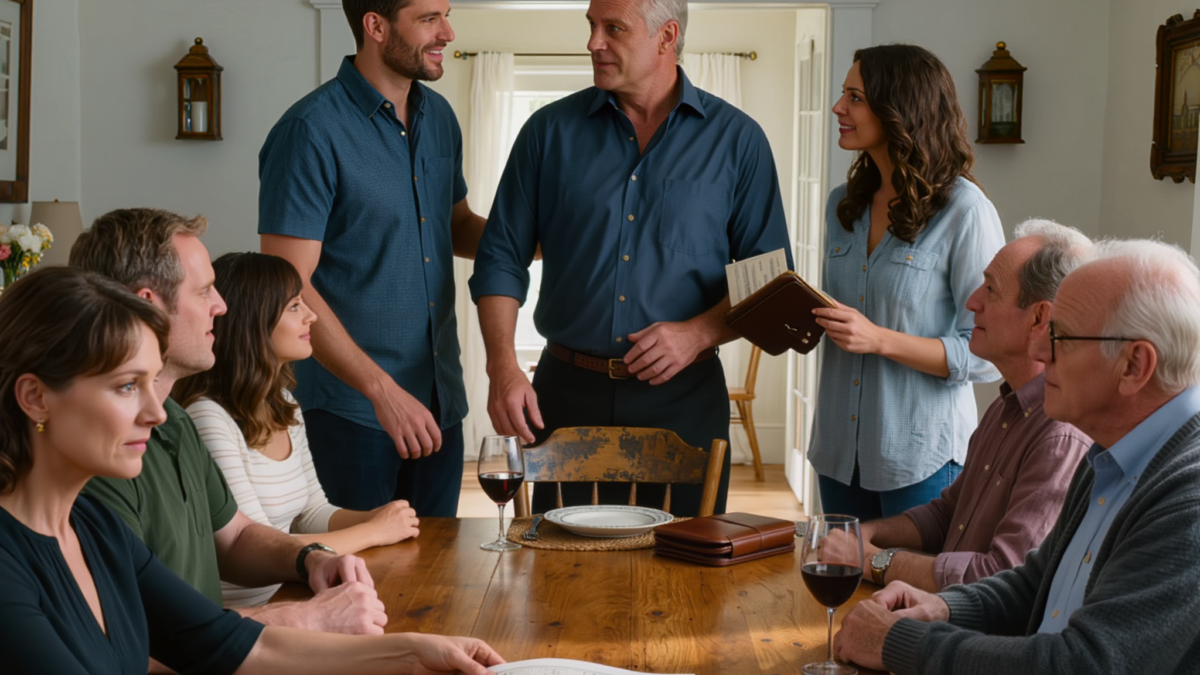
My father waited three years before putting me in front of fourteen relatives and telling them I was the reason our family had fallen apart.
“You shamed this family into the grave.”
He pointed across my grandfather’s dining table as if he had been waiting years to say it in front of an audience.
Grandpa Walter’s chair sat empty beside him. Walter had been dead three weeks. Someone had still set a plate, folded napkin, and wine glass at his place.
My brother, Brandon, stared down at his plate with the faintest hint of a smile.
My mother poured wine.
My father kept talking.
Greedy. Heartless. Difficult. The daughter who had tormented a dying man and then come back looking for money.
The louder he got, the more certain I became that all that noise was covering something.
So I let him talk.
Forty minutes.
Then I set my glass down.
“Before you vote on me, ask Dad about March 14.”
His chair hit the floor before he was fully standing.
Fourteen faces turned toward him.
My name is Rachel Keller. I was thirty-four, and I processed health information for a regional hospital network. I spent my days reading medical charts, discharge summaries, physician notes, medication records, and nurses’ hourly documentation.
That was the only reason I already knew what my father had done before he stood up from that table.
But the story began weeks earlier with a phone call.
It came on a Tuesday in June.
I was at my desk sorting discharge summaries when my cousin Nathan’s number appeared on my phone. We had not spoken in almost a year.
I watched it ring twice before answering.
“Rachel.”
His voice was careful.
“There’s a family dinner Sunday at the house.”
“The house?”
“Grandpa Walter’s house.”
The white farmhouse on nine acres off Route 9.
The house Walter’s father had built.
The property where I had learned to swim in a stock tank when I was six.
“Why now?” I asked.
Nathan paused.
“Your dad wants everyone there. He says it’s time to settle things.”
Settle things.
Two words that immediately made my stomach tighten.
I had not set foot in that house in three years.
Not since the last fight.
Not since my father stood in Walter’s kitchen and told me I was dead to him.
“Is this about Grandpa?”
Nathan did not answer immediately.
That silence told me enough.
Walter Keller had died three weeks before Nathan called.
I knew the exact time because eventually I saw it in his record.
4:52 a.m.
Cardiopulmonary arrest.
Do not resuscitate order honored.
Family notified.
Nobody notified me.
I found out from a funeral home’s public obituary listing while sitting alone in my car during lunch.
Beloved father.
Cherished grandfather.
Survived by his son Frank and grandson Brandon.
There was no mention of a granddaughter named Rachel.
I sat in that parking lot for almost an hour.
Two days later, I went to the cemetery alone.
They had already buried him.
I found the grave by the temporary marker pressed into the fresh earth.
Walter James Keller.
Beloved father.
Cherished grandfather.
Someone had left grocery-store carnations beside the dirt. The edges were already turning brown.
I had not brought flowers.
I had not planned the visit.
I knelt and put my hand on the ground the way I used to put my hand on his.
I told him I was sorry I had not been there at the end.
Then I made him a promise.
I would find out what they had done with what he built.
That was all.
I was not a lawyer.
I was not wealthy.
I was not particularly intimidating.
I was simply good at reading records.
And I knew that paperwork often told a cleaner story than people did.
My great-grandfather had bought those nine acres in 1948 with money he made shoeing horses. He built the farmhouse himself.
When he died, the property passed to Walter.
For as long as I could remember, Grandpa said the same thing at holidays, birthdays, and Sunday suppers.
“This land doesn’t get sold. Not by anybody. It gets kept.”
When I was younger, I noticed that he often looked directly at my father when he said it.
I did not understand why then.
I understood later.
My father, Frank, had spent most of his adult life convinced that financial success was one deal away.
There had been a boat dealership that failed.
A storage-unit venture.
A land-flipping partnership with his younger brother Dale that ended badly enough to leave a lien and two years of silence between them.
Frank did not look at nine acres and see family history.
He saw value.
Brandon generally saw whatever Frank wanted him to see.
Three years before Walter died, I discovered by accident that my father had taken Grandpa to a bank and tried to refinance the farmhouse.
The property had been paid off since 1974.
Frank wanted to put a mortgage on it and pull cash out.
Walter was seventy-eight then. He was starting to have trouble following complicated conversations, and he trusted his son.
I found the loan paperwork on the kitchen counter during a visit.
I read it in less than two minutes.
Then I took Walter to another bank the following morning and helped him stop the transaction before it funded.
The house stayed free and clear.
Frank found out.
He stood in that same kitchen and accused me of humiliating him.
He said I had turned his own father against him.
He called me jealous and meddling.
Then he said I was dead to him.
After that, we stopped speaking.
But I did not stop seeing Walter.
For three years, I drove out on Sundays when my father was not there.
I brought lemon cookies because Grandpa liked them.
I brought a newspaper because he refused to read news on a screen.
We sat on the porch swing while he told me the same stories I had already heard dozens of times.
I listened anyway.
Walter knew about the estrangement between my father and me. He rarely commented on it.
Once, near the end of a visit, he squeezed my hand.
“You’re the only one who comes here wanting nothing.”
At the time, I did not know what to say.
Later, the meaning became obvious.
Frank wanted the property.
Brandon wanted whatever Frank told him he was entitled to.
Dale wanted another deal.
Walter was aging in the middle of all of them.
Then, in early March, he had a stroke.
My family did not tell me.
I learned six days later that he had been admitted to the intensive care unit at St. Bridget’s, another hospital in the same regional network where I worked.
His name crossed a transfer summary that came across my desk.
My grandfather was twenty minutes away, seriously ill, and I discovered it because his name appeared on a piece of paper.
That night, I went to see him.
I did not sneak in.
I signed the visitor log at 7:14 p.m. as family.
Walter was intubated.
A ventilator breathed for him.
There were IV lines, medication pumps, and a monitor keeping time beside the bed.
I had heard those sounds thousands of times professionally.
They were different when the patient was someone I loved.
I sat there for two hours.
His chart documented continuous sedation.
Propofol.
Fentanyl.
The nurse’s notes said he was unresponsive to verbal stimuli and showed no purposeful movement.
He could not squeeze my hand.
He could not hold a pen.
That night was March 14.
I did not know yet how important that date would become.
The night nurse introduced herself as Marisol.
She was in her mid-fifties, calm and direct, with the manner of someone who had spent years helping families through difficult nights.
She told me she had cared for Walter since his admission.
She promised they would keep him comfortable.
Then she said something I remembered later.
“You’re the first family member who’s come at night.”
I looked at her.
“Your father and your brother usually come during the day,” she said. “Usually with papers.”
Papers.
I registered the word but did not pursue it.
At the time, I was more concerned with Walter breathing through a machine in front of me.
Over the following weeks, I visited several more times.
He stabilized, declined, improved slightly, then declined again.
At one point, he came off the ventilator for nine days.
He never truly returned to the man I remembered.
My father and I never crossed paths at the hospital.
He came during the day.
I came at night.
Walter died on a Thursday in June.
Two days later, the obituary erased me.
Three weeks later, Nathan called about the family dinner.
I almost refused.
I sat in my apartment with my keys in my hand and thought about everything I had built during three years without my father.
The quiet.
The distance.
The boundaries.
They had excluded me from Walter’s illness.
They had excluded me from his burial.
Now they wanted to summon me back to the farmhouse to “settle things.”
I put my keys down.
Then I remembered Marisol’s words.
Usually with papers.
And then Brandon texted me.
It was the first message he had sent in three years.
Just come and be normal. Don’t make a scene. Dad’s doing this the right way for once. Sign what you need to sign and we can all move on.
I read it four times.
Sign what you need to sign.
So there was paperwork.
And for some reason, they needed me.
That changed my decision.
Before the dinner, I requested Walter’s complete medical record.
I followed the proper process.
I filled out the paperwork through the Release of Information department at St. Bridget’s.
I identified myself as his granddaughter.
I signed my own name.
Rachel Keller.
The clerk compared my identification with the patient name.
“Keller. Same as the patient.”
“He was my grandfather.”
“I’m sorry for your loss.”
It was the first time anyone connected to the hospital had said those words to me.
Then she looked at her screen.
“You’re the second family member to request his records this month.”
I kept my expression neutral.
“Someone came a couple weeks ago,” she continued. “But it looks like they only requested the billing summary and admission face sheet.”
Not the clinical record.
Only the paperwork showing that Walter had been admitted and when.
Someone had checked the outside dates.
I wanted the inside.
Everything.
The request took nine business days.
The copying fee was $41.
During those nine days, I repeatedly wondered whether I was imagining more than there was.
Maybe my anger toward my family was making me suspicious.
Maybe Walter had been alert on a good afternoon.
Maybe the record would prove that everything was perfectly ordinary.
Part of me wanted that.
Then a thick manila envelope arrived.
I made tea, sat at my kitchen table, and opened it.
Inside was Walter’s final illness in chronological order.
Admission notes.
Medication records.
Ventilator settings.
Nursing documentation.
Consent forms.
Signatures.
I read slowly, the way I read charts professionally.
The stroke.
The transfer to intensive care.
The intubation.
The sedation.
Then March 14.
At 8:00 a.m., the chart documented that Walter was intubated, mechanically ventilated, under continuous sedation, unresponsive to verbal stimuli, and showing no purposeful movement.
At 4:00 p.m., there was no meaningful neurological change.
A physician note documented that family members had been updated at the bedside regarding Walter’s poor likelihood of meaningful recovery.
I sat at my kitchen table staring at that date.
Someone in my family had been standing beside Walter on March 14 while a doctor explained how seriously impaired he was.
I still did not know exactly what my father planned to present at dinner.
But I suspected a will.
A medical chart alone would not be enough to answer every question.
I needed to see what Frank’s document claimed.
My father had already opened a probate case.
The initial filing included the will as an exhibit.
A scanned copy was available through the county system.
I requested it.
Late that night, Walter Keller’s supposed last will and testament appeared on my laptop.
It was dated March 14.
The house and nine acres were left to Frank and Brandon.
Nothing was left to me.
The document was witnessed and notarized.
The notary’s name was Gerald Pratt.
Then I looked at Walter’s signature.
It was clean.
Strong.
Steady.
Walter Keller written in one smooth line.
I had watched Grandpa’s hand deteriorate over the previous year.
That signature did not look like the hand I remembered.
The next morning, I searched through a box of cards and notes Walter had given me.
I found a birthday card he had tried to sign for my mother in February, shortly before the stroke.
I had been sitting on the porch when he tried.
His hand shook so badly that the first letter wandered off course.
He laughed about it and asked me to finish addressing the envelope because his grip was failing.
He never mailed the card.
Now I placed that February signature beside the signature on the March will.
The difference was difficult to ignore.
In February, before the stroke, Walter’s hand trembled.
In March, while hospital records placed him on a ventilator under sedation, the signature was smooth.
I made copies.
Then I returned to the other name on the will.
Gerald Pratt.
The notary.
A notary is supposed to witness a signature.
If Gerald Pratt had notarized Walter’s signature in the ICU on March 14, he should have entered that locked unit.
And everyone entering that ICU signed the visitor log.
I knew because my own name appeared there five times.
I requested the March logs.
They arrived separately.
I read every line.
My name appeared on the nights I visited.
Frank’s appeared several times during the day.
Brandon’s appeared twice.
Dale’s appeared once.
Gerald Pratt did not appear.
Not on March 14.
Not on any March date.
No notary appeared in the unit log that month.
I called Marisol.
She remembered me.
I told her about the will.
I told her the date.
I told her about Gerald Pratt.
There was a long silence.
“I charted that patient every hour,” she finally said. “There was no signing. There was no notary. I would have stopped it.”
“I know.”
I explained what I was facing.
My family already believed I was bitter.
If I challenged Frank alone, he would say I had manufactured the entire dispute because I wanted the land.
“I need someone in that room who isn’t a Keller,” I said. “Someone who was actually there. I’m asking you to come to a dinner and tell the truth. That’s all.”
She was quiet.
Then she asked, “They came during the day, didn’t they? With papers?”
“Yes.”
“I hate that,” she said softly. “I hate what people do to them at the end when they can’t say no.”
Another pause.
“Text me the address. I’ll come. But I’m going to tell it exactly how it was. I won’t shade it for anybody, including you.”
“That’s the only version I want.”
By the time I hung up, I had medical records, visitor logs, two versions of Walter’s signature, and a nurse willing to tell the family what she had seen.
I told no one.
On Sunday, I drove to the farmhouse with a plain leather folder on the passenger seat.
The gravel driveway was full of vehicles.
Nathan’s truck.
Dale’s Silverado.
My mother’s old Buick.
Brandon’s leased SUV.
I counted eleven cars before parking on the grass.
The farmhouse looked almost unchanged.
White clapboard.
Green shutters.
The porch swing where Walter and I had spent so many Sundays.
Near the barn, I noticed a real estate evaluation sign turned toward the wall.
I walked over and looked at it.
On the back was a sticky note in my father’s handwriting.
Split 340.
$340,000 divided.
Someone had already been calculating what the property might produce.
I turned the sign back toward the wall and returned to my car.
Then I picked up the folder.
My mother opened the door.
Lorraine Keller was sixty-one.
Three years seemed to have aged her more than they should have.
“Rachel.”
Her voice was neither warm nor openly hostile.
“You came.”
“You sound surprised.”
“I told your father you wouldn’t.”
“He’ll be disappointed.”
I stepped inside.
The smell of coffee, pot roast, and my grandmother’s old potpourri hit me first.
Fourteen relatives filled the front rooms.
Conversation dropped the moment I appeared.
Frank sat at the head of the long dining table.
He was fifty-nine, broad through the chest, wearing the button-down shirt he saved for occasions when he wanted to look especially respectable.
He did not stand.
He smiled.
“Well,” he said loudly, “look who decided the family was worth her time after all.”
Dale sat at Frank’s right.
Brandon was nearby, already looking relaxed.
Nathan and his wife, Priya, sat closer to the middle.
My mother took the chair beside Frank.
Aunts, cousins, and other relatives filled the remaining seats.
Beside my father sat Walter’s empty captain’s chair.
No one had ever used it while Grandpa was alive.
Someone had placed a plate, folded napkin, and empty wine glass in front of it.
I looked at the chair.
Frank noticed.
“We set his place,” he said, his voice suddenly softer. “So he could be here. So he could see this family finally stand up for him.”
Then he looked at me.
“Against the person who hurt him most.”
A murmur moved through the room.
I found the only seat left.
It was at the opposite end of the table.
There was no plate in front of it.
No napkin.
No glass.
Just bare wood.
My mother noticed.
“We weren’t sure you’d come.”
She started to get up.
Frank stopped her.
“Don’t. She won’t be staying for dinner.”
Several people gave nervous laughs.
Brandon reached toward Walter’s place, took the roll sitting beside the empty chair, buttered it, and ate it.
Nobody objected.
That was when the structure of the evening became obvious.
This was not a family meal.
It was a hearing.
Frank was presenting the case.
The family was the audience.
Walter’s empty chair was the symbol.
And I was the defendant.
Before Frank began, he raised his wine glass toward Walter’s chair.
“To Dad. To a great man who deserved better at the end than what he got.”
His eyes found me.
“To honoring his wishes.”
Glasses went up around the table.
My mother poured one for me and set it on the bare wood.
I did not lift it.
Frank watched.
“Even now,” he said. “She won’t toast her own grandfather. You see what I’ve been dealing with?”
I left the glass untouched.
Then Frank began his case.
He had a legal pad.
He put on reading glasses.
“I’m not going to make this ugly,” he said. “But this family deserves the truth.”
Then he pointed toward me.
“My father spent his last months tormented by her.”
He said I had badgered Walter.
He said I appeared at the hospital at odd hours.
He said I went through Grandpa’s belongings.
He said I filled Walter’s head with ideas.
He said I wanted the farmhouse.
He said I wanted the land.
I watched relatives turn toward me one by one.
In my family, Brandon had always been the easy child.
I had always been the difficult one.
If Brandon wrecked a car, he had bad luck.
If I earned a scholarship, I thought I was better than everyone.
If Brandon borrowed money, family was supposed to help family.
If I set a boundary, I was abandoning people.
Frank had an old role ready for me.
He only had to fit the new story inside it.
My mother tried once.
“Frank. Maybe we don’t know everything.”
“Lorraine.”
He barely looked at her.
“They need to hear it.”
She became quiet.
Dale leaned forward.
“Tell them about the house.”
“I’m getting there.”
“Tell them what Dad wanted.”
“I said I’m getting there, Dale.”
I noticed Dale’s impatience.
He did not sound like a man defending a memory.
He sounded like a man waiting for a transaction.
Frank talked for forty minutes.
He said Walter had cut me off for good reason.
He said I had returned for money.
He said Walter had made his final wishes clear.
Not one relative interrupted to defend me.
Then Aunt Carol became Frank’s witness.
“Tell them what you saw at the hospital,” he said.
Carol dabbed her eyes with a napkin.
“I saw her there in March. In his room. Going through the drawer by his bed.”
That part was true.
I had opened Walter’s bedside drawer.
The nurse had told me his glasses might make him more comfortable, and I had been looking for them.
Carol did not know that.
“And she was whispering to him,” she continued. “Leaning over him. Who knows what she was saying?”
I knew exactly what I had been saying.
I love you.
I’ll bring the lemon cookies when you get out.
But I did not interrupt.
Then Dale announced that I had been contacting lawyers.
“A grieving granddaughter doesn’t lawyer up in three weeks,” he said. “A greedy one does.”
Again, part of the statement was true.
I had spoken to an attorney.
But nobody knew why.
Every true detail was being aimed in one direction.
Drawer.
Whispering.
Attorney.
By the time Dale finished, I could see the room settling into Frank’s version.
Then Nathan spoke.
“Uncle Frank?”
Frank looked at him.
“When did Grandpa make these wishes known? Because I visited him in April, and he couldn’t even tell who I was.”
The table became quiet.
“He had good days and bad days,” Frank said.
Nathan hesitated.
“Was the 14th a good day?”
I looked at my father.
Something moved across his face.
A flicker.
Gone almost immediately.
But it was enough.
“Enough questions,” Frank said. “This isn’t a courtroom.”
Then he reached beside his chair and lifted a leather portfolio onto the table.
Inside was a document protected by a clear sleeve.
“This is my father’s last will and testament,” Frank announced. “Signed, dated, and witnessed. Everything he wanted in his own hand.”
He held it up.
“He left the house and the land to me and Brandon. To keep it in the family.”
Then he paused.
“And he left nothing to the granddaughter who broke his heart.”
Several people reacted audibly.
Brandon finally looked directly at me.
He smiled.
Frank placed the will in front of Walter’s empty chair.
“There’s a copy going to probate Monday. But I wanted the family to hear it from me first.”
He looked around the table.
“Does anyone object to honoring my father’s last wish?”
Then he turned to me.
“Rachel. Anything to say for yourself?”
I looked at the will.
Then the empty chair.
Then my father.
I already knew the date.
I knew what Walter’s medical record said on that date.
I knew what medication was running through his IV.
I knew what the visitor log did not contain.
But I did not start with any of that.
I let the silence stretch.
Brandon shifted.
Dale cleared his throat.
Then I set my glass down.
“Before you vote on me, ask Dad about March 14.”
Frank’s chair hit the floor as he stood.
“What did you say?”
His voice had changed.
“I said ask you about March 14. That’s the date on the will, isn’t it?”
He stared at me.
“Read the date to the room.”
“I’m not going to sit here and let you—”
“You’re standing,” I said. “And you’re not answering.”
My mother said my name quietly.
“Rachel.”
Brandon leaned forward.
“This is insane. She always does this. She makes everything about her.”
“I’m not playing games.”
I turned to him.
“Brandon, you get half the house under that will. Were you there when Grandpa signed it?”
His mouth opened.
Then closed.
“Did you watch him sign it?”
Brandon looked at Frank.
“Dad handled it.”
I repeated the words.
“Dad handled it.”
The room began looking at my father instead of me.
Frank picked his chair up slowly.
Then he changed tactics.
“I can’t believe you’d do this at my father’s table. He’s been in the ground three weeks, and you come into his house accusing me of what?”
He spread his hands.
“Say it, Rachel.”
I understood the invitation.
He wanted me to make an accusation before I had established the facts.
So I did not.
“I’m not accusing you of anything yet. I’m asking you to read a date.”
I looked around the table.
“I process medical records for a living. Hospital charts document what happens to a patient hour by hour. Medication, neurological status, procedures, responses. It is written down.”
Then I looked at Frank.
“Grandpa had a stroke in March. On March 14, he was in the ICU at St. Bridget’s. He was intubated. A machine was breathing for him. He was on continuous sedation, and the nurse documented that he was unresponsive to verbal stimuli.”
I paused.
“So how did a man who could not respond to a voice on March 14 sign a four-page will in his own hand on March 14?”
Dale reacted first.
“You don’t know that’s the date. You haven’t even seen the will.”
“You’re right,” I said. “So Frank can read the date and prove me wrong.”
Everyone looked at him.
He did not read it.
“This is absurd,” he said. “Wills get dated at different times. Notarized at different times. You don’t understand how these things work.”
“I understand paperwork.”
Nathan spoke quietly.
“Dad, just show everyone the date. If it isn’t the 14th, this is over.”
Frank became angry.
He snatched the will from the table.
“Fine. You want dates? He signed it March 14. Yes. In the hospital. With a notary present and everything witnessed and legal.”
Then he stopped.
The room had heard him.
“With a notary present,” I repeated. “In the hospital. On March 14.”
“That’s what I said.”
“Good.”
Down the table, Walter’s eighty-four-year-old brother, Ray, placed his fork down.
He had barely spoken all evening.
“Frank,” he said. “Your father told me in this room he’d sooner lose that house than let you borrow against it. More than once.”
Frank stared at him.
Ray continued.
“You’d better have a good answer for this girl because I want to hear it too.”
That was the first visible crack in Frank’s audience.
I opened my folder.
I placed Walter’s certified medical record in the center of the table.
“This is Grandpa’s complete chart from St. Bridget’s. I requested it through the hospital’s normal process after he died. It cost me $41 and took nine business days.”
I turned to the tabbed page.
“March 14. Eight in the morning. Patient intubated, mechanically ventilated, continuous sedation infusion. Patient unresponsive to verbal stimuli. No purposeful movement of extremities.”
I turned another page.
“Four in the afternoon. No change in neurological status. Patient remains unresponsive. Sedation continued.”
Then the physician note.
“Family updated at bedside regarding poor likelihood of meaningful recovery.”
I looked at Frank.
“That means somebody in this family was standing beside Walter that day while a doctor explained that he might not meaningfully recover.”
The room was completely quiet.
“And you’re telling us that between those documented assessments, he read and signed a legal will?”
Frank recovered enough to answer.
“Charts are wrong all the time.”
“They usually aren’t.”
“You work in medical records,” he snapped. “You could have made those pages yourself.”
For a moment, I saw doubt return to Carol’s face.
So I turned to the certification page.
“This record came from St. Bridget’s. I don’t work at that hospital. Every page is numbered and certified by their custodian of records.”
I pushed it farther into the center of the table.
“There’s a phone number. Call the department. Ask whether they released it.”
Nobody reached for a phone.
Priya leaned toward the chart instead.
Nathan looked at Frank.
Then I removed two more sheets from the folder.
On one was Walter’s February signature.
On the other was the signature attached to the will filing.
“This is Grandpa’s signature before the stroke.”
I pointed to the first.
“His hand already shook. Look at the W.”
Then I pointed to the second.
“This is the signature on the March will.”
Family members leaned closer.
The difference was visible even without an expert.
“You don’t need to take my opinion,” I said. “A probate judge can order a forensic examination.”
Dale suddenly reached across the table.
I did not pull the papers away.
“They’re copies,” I told him. “Taking those won’t change anything.”
He stopped and sat back.
Brandon stood.
“You can’t prove anything from two pieces of paper.”
“No. But a document examiner can compare them. And a judge can compare them with the medical record.”
I looked at Frank.
“You said you’re filing Monday. Put the signature in front of a judge.”
He said nothing.
Then I moved to the last problem.
“You also told everyone there was a notary in Grandpa’s hospital room on March 14.”
“There was.”
“What was his name?”
Frank looked down at the will.
“Gerald Pratt.”
“Gerald Pratt.”
I nodded.
“The ICU has a visitor log. Everyone entering that unit signs in. Name, time, and patient.”
Frank’s expression changed slightly.
“I requested the March logs.”
Nobody moved.
“My name appears five times. Yours appears several times. Brandon’s appears twice. Dale appears once.”
I looked directly at Frank.
“Gerald Pratt never signed into that unit.”
No one spoke.
“Not March 14. Not any day in March.”
Dale tried first.
“Maybe somebody missed him.”
“Maybe.”
I turned toward the front hall.
“That’s why I didn’t rely only on the log.”
Then I called her name.
“Marisol.”
The screen door opened.
Walter’s night nurse stepped inside.
She wore ordinary street clothes.
No uniform.
No hospital badge displayed like a symbol.
She simply stood inside the room and looked first at Walter’s empty chair.
“Everyone,” I said, “this is Marisol. She was Grandpa’s night nurse.”
Marisol folded her hands.
“I had Walter on night shift from his admission until he moved to step-down care,” she said.
I asked about March 14.
“I don’t have to remember it from memory,” she answered. “It’s in my charting. But I remember that period. He was sedated and ventilated. He wasn’t waking up.”
I asked the question directly.
“Was there a notary at his bedside?”
“No.”
“Could there have been a document signing while he was in that condition?”
“No. A patient in that condition could not consent to that. I would have stopped it.”
She looked around the table.
“There was no signing in my room. There was no notary at that bedside.”
Then she added something I had not expected her to say in front of everyone.
“You came during the day,” she said to Frank.
He looked at her.
“In April. You came with a younger man in a suit and another man carrying a leather bag. I had come in early to cover part of a shift.”
Frank did not answer.
“You asked the day nurse if your father could have a lucid period if she reduced his sedation.”
My mother’s hand tightened around her glass.
Marisol continued.
“You asked if she could lighten it so he could sign some papers. She refused.”
She looked toward the folder.
“That refusal should be in the April charting.”
It was.
“When the nurse refused, you left. The other men left with you.”
Marisol’s voice remained level.
“Whatever paperwork was completed afterward was not signed in that ICU by Walter while I was caring for him.”
Carol put down her napkin.
She looked at Marisol.
Then at me.
“Rachel.”
Her voice was small.
“When I saw you leaning over Walter’s bed, whispering to him… what were you saying?”
“I was telling him I loved him.”
Carol stared at me.
“The nurse said he might still hear a little. I told him I’d bring lemon cookies when he got out.”
Carol covered her mouth.
“Oh, God.”
Across the table, Priya pulled the medical record toward herself and started reading.
Not glancing.
Reading.
“He was on a ventilator,” she said. “It says it right here.”
She looked at Frank.
“He couldn’t have signed anything like that.”
Frank’s face had gone gray.
“This is a private family matter.”
Then my mother spoke.
“She has every right.”
Everyone turned toward Lorraine.
In thirty-four years, I could not remember hearing her contradict my father publicly.
She put down her glass.
“Frank. The man who came to the farmhouse in April with the leather bag.”
Frank said nothing.
“You told me he was from the bank.”
Her voice began to shake.
“That was the notary, wasn’t it?”
“Lorraine.”
“You told me not to mention him.”
She covered her mouth.
“Oh, Frank. What did you do?”
The room came apart quickly after that.
Dale stood first.
“Frank, you told me this was airtight.”
Frank looked at him sharply.
“You told me Dad wanted the sale. You told me the paperwork was clean. I’ve got a buyer.”
Dale stopped.
Too late.
Everyone had heard him.
There was already a buyer.
The land was already being discussed as if the sale were certain.
Walter had been dead only weeks.
Nathan turned toward Dale.
“You already had a buyer?”
Dale sat down.
Nobody answered.
Nathan asked to see the visitor logs and the medical record.
Then he looked at me.
“I’m sorry, Rachel. I sat here and listened to him for forty minutes.”
“You asked the question that mattered.”
Brandon tried to separate himself from Frank.
“I didn’t know about the notary. Dad did the paperwork. I thought it was handled.”
He looked genuinely frightened now.
“I didn’t know the date. Rachel, I swear I didn’t know.”
I believed that part.
That did not erase the fact that Brandon had been prepared to take half the property without asking many questions.
But he had not designed the plan.
Frank had.
Then my father turned on me.
“You did this.”
His voice rose.
“You couldn’t just leave it alone. You had to come back and destroy this family over money? Over a house? He was my father.”
“He was my grandfather.”
I stood.
“You spent forty minutes telling this family I bullied a dying man. You said I came back because I wanted his property.”
Frank looked at me.
“You brought papers to an ICU. You tried to get a man who couldn’t meaningfully respond to sign them. When the staff refused, paperwork still appeared later carrying his name.”
My voice stayed controlled.
“You removed me from the story because I was the person who knew what his chart said.”
I looked toward Walter’s chair.
“This land doesn’t get sold. Grandpa said it at this table for thirty years.”
Then back at Frank.
“Now I understand why he always looked at you when he said it.”
Frank looked toward the empty chair.
Whatever he wanted to say seemed to leave him.
He sat down.
I picked up the wine glass my mother had poured at the beginning of dinner.
It was still full.
“Dad, you wanted a vote.”
He looked up.
“You asked whether anyone objected to honoring Grandpa’s wishes. Fine.”
I faced the table.
“Raise your hand if you still believe Walter Keller signed that document on March 14 while he was intubated, sedated, unresponsive to his nurse, and supposedly accompanied by a notary who never signed into the unit.”
Nobody moved.
Not Dale.
Not Brandon.
Not Carol.
Not my mother.
Not even Frank.
I set the glass back down.
“There’s your vote.”
The supposed will did not proceed the way Frank had planned.
Once my mother disclosed that the man associated with the notarization had been at the farmhouse in April rather than documented in the ICU on March 14, the document faced problems that could not be explained away at the dinner table.
The situation moved out of the family’s hands.
I brought the medical record and related information to the appropriate county office and consulted my own estate attorney.
There was one more person involved that evening whom I had barely noticed.
Mr. Alden.
The family attorney.
Frank had invited him and placed him in the front room so the evening would appear official.
After Marisol spoke, Mr. Alden entered the dining room.
He was in his seventies and had known Walter for decades.
He read the chart.
Then he studied the signatures.
Finally, he removed his glasses.
“Frank,” he said, “I can’t file this.”
My father stared at him.
“I won’t.”
Mr. Alden tapped the chart.
“A person signing a will has to understand what he is signing. This record raises a serious capacity problem on the stated execution date.”
Then he looked at the notarization.
“And this creates another problem.”
Frank said nothing.
Mr. Alden shook his head.
“This is not a document I can put in front of a judge.”
The attorney Frank had invited to lend authority to the evening became the person who refused to support the document.
Walter had an older will.
Mr. Alden already had it in his files.
That document divided things fairly and included me.
The estate proceeded through the proper legal process with a court-appointed administrator.
The farmhouse and nine acres remained in the family.
They were not sold.
The evaluation sign stayed facedown near the barn.
Frank eventually faced charges connected to what had happened.
So did Gerald Pratt.
Dale’s buyer disappeared once there was no clean title to purchase.
Dale stopped speaking to Frank.
Brandon called me about a month later.
He did not really apologize.
He asked if I intended to keep pushing the matter.
I told him it was no longer my decision.
The county had it.
He ended the call.
I did not hear from him again.
My mother left Frank in August.
She moved in with her sister.
The week she left, she called me.
We talked for two hours.
She cried.
Then she finally said the sentence I had waited most of my life to hear.
“I should have said something a long time ago.”
It did not undo thirty-four years.
But it mattered.
After that, she started calling every Sunday.
Nathan and I became close again.
Sometimes we drove to the farmhouse and sat on Walter’s old porch swing.
We did not always talk.
We did not need to.
I also wrote to St. Bridget’s about Marisol.
I wanted the hospital leadership to know that one of their nurses had told the truth first in a patient’s room and then again in a hostile family dining room.
She received a commendation.
Sometimes we met for coffee after that.
A few weeks after everything settled into the legal process, I drove to the farmhouse alone.
The house was quiet.
I let myself inside with the key that had hung near the door since before I was born.
Walter’s captain’s chair had been pushed into a corner after the dinner.
I pulled it back to the head of the table.
Then I sat in it.
I thought about his hand in February.
The way it shook when he tried to sign my mother’s birthday card.
The way he laughed when the W wandered off course.
He could barely control a pen then.
A month later, my father had asked everyone to believe that Walter produced a smooth legal signature while seriously ill in an ICU.
Grandpa had spent thirty years repeating the same sentence at that dining table.
This land doesn’t get sold.
I finally understood that he had not simply been making conversation.
He knew his son.
He knew which direction Frank would move when nobody was there to stop him.
I rested my hands on the worn arms of Walter’s chair and looked across the empty table.
It was never Frank’s to sell.
It never would be.
And Grandpa’s chair was not empty anymore.








