My car was crushed on the highway, and while I was in emergency surgery, my parents chose my sister’s $40 parking ticket instead. “Is she dying? No? Then it can wait,” my father told the nurse. Three days later, he finally walked into my hospital room with coffee in hand—then saw the gray-suited man already sitting beside my bed, and the folder under his arm hit the floor.
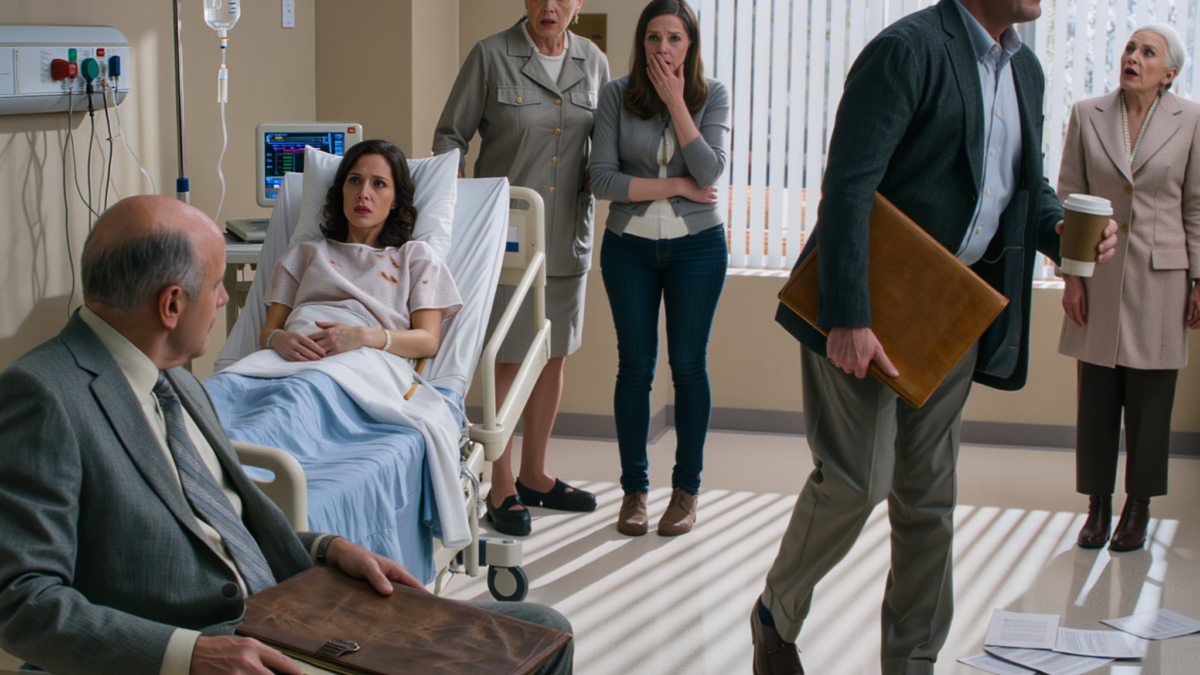
They wheeled me into emergency surgery while my father argued about a parking ticket.
A car crushed my hatchback on the highway. Broken ribs, internal bleeding, a tube in my chest. My sister got a $40 fine that same morning, and she was in pieces, so my parents chose her.
“Is she dying?” my father asked the nurse who called.
“No.”
“Then it can wait.”
He said it flatly, like I was a parcel that could sit at the post office.
Three days.
I lay in that room for three days, the emergency contact line on my chart blank.
Then, on day three, he strolled in with coffee in hand, ready to be forgiven.
He looked at the man already sitting beside my bed, and the folder under his arm slid out of his grasp and cracked against the floor.
My name is Thea Callaway. I was 36, and I read other people’s ledgers for a living. I was the person a company hired when the numbers stopped agreeing with the story someone was telling about them.
I sat in quiet rooms. I found the line that didn’t reconcile.
I didn’t need to raise my voice because the numbers already had.
The man in the chair was not who my father thought he was.
To understand why a folder could hit a grown man harder than a fist, you have to go back three days to the morning the highway took my car.
It was raining the way it rains in early spring, thin and mean, the kind that doesn’t fall so much as smear across the windshield.
I was on the interstate at 7:14, merging left, coffee in the cup holder. I never got to drink it.
There was a box truck riding the lane beside me. I remember the wipers. I remember the yellow reflectors on the merge sign.
Then the truck drifted, and the whole world turned sideways.
The sound my little car made was not a sound I had words for.
I don’t remember the guardrail. I don’t remember the men who cut the door off my car, or the helicopter they didn’t need, or the ambulance they did.
There’s a stretch of that morning my brain has kept for itself, and I’ve stopped trying to take it back.
What I know, I know from the report.
Two lanes crossed. Forty feet of skid. A hatchback folded around a concrete divider.
They told me later that a stranger, a man driving to work behind me, pulled over in the rain and held my hand through the broken window.
He told me help was coming.
I have no memory of his face.
I think about him more than I think about my father.
I remember waking up.
The ceiling had square tiles, the pockmarked kind, and I counted them because counting kept me on the right side of the dark.
Fourteen across.
There was a tube in my chest, taped down, and every breath I took felt like it was being charged to an account I couldn’t afford.
A line ran into the back of my hand. A machine somewhere kept a slow, patient beep, like it had all the time in the world and I did not.
The pain arrived in layers.
Broken ribs are a specific education.
They teach you that breathing is a decision. That laughing and crying can both hurt. That the body will do almost anything to keep you from filling your own lungs when filling them hurts.
I lay there taking the smallest breaths I could take and still stay conscious.
I counted ceiling tiles and waited to find out whether I was the kind of person things happened to and then got better, or the other kind.
A nurse leaned over me.
She had kind, tired eyes and a name tag I couldn’t focus on yet.
She told me I’d been in an accident. She told me I’d had surgery. She told me I was going to make it.
I believed her because I had to believe someone.
Then, before I asked about the tube, before I asked about the pain, before I asked what came next, I asked the only question that mattered to the part of me that was still six years old.
“Did anyone call my parents?”
The nurse’s name was Colleen Fisk, and she was the one who made the call.
I only learned later how it went because Colleen was an honest woman. Weeks afterward, she told me what happened without my having to ask.
But I already knew the shape of it because I knew my family.
She dialed the first number listed.
My father answered on the third ring.
There was noise behind him, a lobby, voices, the particular echo of a public building.
He was standing at a municipal window contesting a parking citation.
Not his.
My sister’s.
Colleen introduced herself. She said the words hospital, accident, daughter, surgery.
She said critical.
She was trained to be gentle with those words, to space them so a heart had time to catch each one.
My father didn’t need the spacing.
“Is she dying?” he asked.
“No.”
“Then it can wait.”
Colleen told me she repeated herself to make sure he understood.
“Sir, your daughter is out of surgery, but she’s critical. She coded twice on the table. She’s asking for you.”
He answered in the same flat tone.
“Is she dying?”
“No.”
“Then it can wait.”
He had somewhere to be.
There was a window, a clerk, and a $40 fine.
And behind that fine, there was a daughter who was upset.
My father had always triaged the family by who was loudest.
I had never been loud.
My mother was with him.
Colleen heard her voice in the background.
Not, “Which hospital?”
Not, “How bad is it?”
Not, “We’re coming.”
She was asking whether the $40 fine could be waived given the circumstances and whether Marlo would need to appear in person because Marlo was so upset she could barely drive.
Two daughters.
One of them had a tube in her chest.
The other had a parking ticket.
There was never any real question which crisis my parents would drive toward.
There never had been.
This was just the first time the arithmetic had been done out loud, in front of a witness, over a hospital phone.
Colleen lowered the phone.
She stood at the nurse’s station with it against her collarbone and looked at nothing for a moment.
Then she looked at my chart.
There was a line near the top of the intake form where they wrote the name of the person to call.
Emergency contact.
Two words and a long white space where a name was supposed to go.
She picked up her pen.
She held it there.
Then she wrote nothing.
That blank line became the center of everything, though I didn’t know it yet.
Colleen left it empty.
Not out of carelessness, but out of a kind of mercy.
She couldn’t make herself write down people who had just told her, in so many words, that I could wait.
I’ve thought about that blankness more than I’ve thought about the crash.
The crash was weather and metal.
The blankness was a decision.
There is something you should understand about me.
In my family, there were always two daughters.
There was Marlo, who was fragile, who needed things, who felt loudly and beautifully, whose emotions arrived like weather everyone had to plan around.
And there was me.
The strong one.
The one who doesn’t need us.
That was the phrase.
My father had worn it smooth over 30 years.
“Thea’s the strong one.”
“Thea doesn’t need us.”
I built a life around being the strong one because it was the only role in that house that came with a door I could close.
I paid my own way at 19. I put myself through an accounting program while working nights at a call center.
Somewhere along the way, I learned that if I never asked for anything, I could never be told no.
For a while, not being told no felt like winning.
I bought a small condo with a bad view and good light.
I learned to want nothing out loud because wanting out loud was Marlo’s job, and there had only ever been one seat for it.
When I was 14, I made the honor roll. My parents missed the ceremony because Marlo, who was 11, had a dance recital the same evening.
I sat in a folding chair with an empty seat on either side of me and clapped for myself.
When I graduated from college, the first person in the family to do it, my mother arrived late and left early because Marlo was having a hard week.
When I bought my condo, my father’s only comment was that it was a shame I’d bought instead of helping out at home.
Things were tight there.
Things were always tight.
That’s what happens when a family spends a fragile daughter’s whole life catching her.
I stopped keeping score eventually.
Not out of forgiveness.
Out of exhaustion.
You can only be surprised by the same thing so many times before surprise stops being available to you.
I made myself into someone who didn’t need the ceremony, didn’t need the seat, didn’t need the call.
I called it peace.
I told myself I’d made peace with them.
I hadn’t.
I had simply stopped setting the table.
So I had learned long ago not to expect the chair beside my hospital bed to be filled.
But that day, it wasn’t empty for long.
The door opened without a knock, which was how I knew it was family before I saw the face.
My aunt Isolda came in the way she did everything, briskly, as though she’d already had the argument in her head and won it.
She was my father’s younger sister, 59, all sharp collarbones and sharper opinions.
I had seen her maybe six times in my adult life.
My grandmother had kept her at a distance, and the rest of the family had followed my grandmother’s lead.
Isolda didn’t cry.
She didn’t gasp.
She pulled the chair to the side of my bed, sat in it as if she’d reserved it in advance, and looked at me with an expression I couldn’t read.
I hadn’t seen her in eight months, since my grandmother’s funeral.
Isolda had stood at the back and left before the reception. My father had made a small, cold joke about her, and everyone had laughed.
In my whole life, I had probably spent fewer than a dozen days in this woman’s company.
To me, she was the family footnote. The aunt you nodded at and forgot.
And she was the only one who came.
I did the arithmetic even then, doped and broken as I was.
Three days.
Two parents.
One sister.
A handful of cousins, all within an hour’s drive.
And the person sitting in the chair was the one they had all agreed to treat as barely family.
“You look terrible,” she said.
I stared at her.
“Good. That means you’re awake.”
I tried to laugh.
My ribs reminded me not to.
She poured me water, held the straw to my mouth, and watched me drink with an auditor’s own attention.
Then she asked me a question that had nothing to do with cars, ribs, or surgery.
“Has anyone from the lawyer’s office called you?”
I stared at her.
My mind was still fourteen ceiling tiles wide.
“A lawyer?”
She repeated the question more slowly.
“Has anyone from the lawyer’s office reached out to you, Thea, about your grandmother’s estate?”
“What lawyer?”
She looked at me for a long moment.
Something moved behind her eyes.
Relief or dread, I couldn’t tell.
“Nobody’s told you anything,” she said, almost to herself.
Of course they haven’t.
My phone buzzed on the tray table before I could ask what she meant.
Isolda glanced at it.
So did I.
The screen said Marlo.
I answered on speaker because my hands were clumsy with the IV line.
My sister’s voice filled the little room fast and thin and already mid-complaint.
She didn’t ask if I was alive.
She didn’t ask where I was.
She launched straight into the middle of her own crisis, the way she always did, as if I had been standing beside her the entire time.
“The lawyer still won’t release anything,” she said. “It’s been eight months, Thea. Eight months, and he keeps saying it’s not that simple. Do you know what ‘not that simple’ is doing to my life right now?”
“Marlo…”
“I have things due. I can’t keep doing this. Someone needs to make him move.”
Then she was gone.
She hung up and moved on to the next fire.
The room was quiet again except for the patient beeping of the monitor.
She hadn’t asked one question about me.
Not the crash.
Not the surgery.
Not the tube.
She had called her injured sister’s phone to complain about a lawyer and hung up as if she had accomplished something.
That was twice in one hour.
The word lawyer had come from two different mouths, both pointing toward something I didn’t know existed.
Isolda was watching me.
“Drink your water,” she said.
But her eyes had gone somewhere far away, toward a decision I couldn’t see.
My grandmother’s name was Rosalyn Callaway.
She was the only adult in my childhood who ever looked at me as though I were a whole person and not a spare one.
She had died eight months before the crash.
Ninety-one years old, in her own bed, in the old house on Fern Street with the wraparound porch and the crooked back stairs.
When I think of her, I think of her hands.
Spotted. Strong. Always doing something.
Shelling peas.
Sorting mail.
Pressing things into other people’s palms.
She noticed things.
That was her particular gift, and it was a quiet one.
The world doesn’t hand out prizes for noticing.
She noticed which grandchild finished her plate and which one left the vegetables.
Which one asked for more.
Which one had learned not to.
When I was nine and my parents forgot my birthday two years in a row, Rosalyn showed up at the school gate the third year with a small wrapped box and a lemon cake she had made herself.
She never said a word against my parents.
Even then, she was a strategist.
She simply filled the empty seat and let the emptiness speak for itself.
“You’re the one they don’t worry about,” she told me once when I was maybe 16.
She was driving me home after a weekend at her house, looking straight out through the windshield.
“That’s supposed to be a compliment in this family. It isn’t. Don’t let them make you proud of it.”
I hadn’t understood her.
I thought she was being harsh about my parents.
I understood her now with a completeness that hurt.
At the funeral arrangements, in a sad beige room where the family chose flowers nobody would remember, my grandmother’s lawyer had handed me a small padded envelope she had left for me.
Inside was a brass house key on a faded green ribbon.
The ribbon had gone soft as cloth from years of handling.
My grandmother had pressed that same key into my hand years earlier when I was leaving her house late after helping her with something.
“Keep this one,” she had said, closing my fingers over it.
I thought she meant keep this visit.
Keep this evening.
I thought she meant sentiment.
I put the key in my jewelry box and didn’t think about it.
After the crash, it came to the hospital in the plastic belongings bag they used for whatever had been in my pockets.
It sat on the windowsill, meaning nothing, catching the gray light.
But the last thing my grandmother had given me wasn’t the key.
It was a letter.
Folded.
Sealed.
My name on the front in her slanted hand.
I hadn’t opened it for eight months.
I couldn’t make myself break the seal because as long as it remained sealed, she was still, in some small way, mid-sentence.
That letter was in the belongings bag too.
My mother finally called on the afternoon of the first day.
I saw her name and felt, God help me, something like hope.
The reflexive kind.
The kind that survives everything.
Maybe Colleen had called again.
Maybe someone had repeated the word critical and it had finally landed.
“Thea,” my mother said. “Thank goodness. Listen, I need you to do something for me.”
I waited.
“It’s your sister. She’s spiraling over this whole ticket business. And now with the estate on top of it, she’s just… she’s not sleeping, Thea. She’s not eating. Would you talk to her? You’re so good at calming her down. You’ve got that steady way about you.”
I lay there with a tube in my chest and listened to my mother ask me, from my hospital bed, to manage my sister’s feelings about a $40 fine.
“Karen,” I said.
I had started calling her Karen in my own head years earlier.
Sometimes it slipped out.
“I’m in the hospital.”
“I know, sweetheart. And I’m sure they’re taking wonderful care of you. You’ve always landed on your feet. Just when you get a minute, call her. It would mean the world.”
She did not ask what my injuries were.
Not that first day.
Not the second.
Not the third.
In three days of phone calls, my mother never once asked me what was broken.
That night, something went wrong.
I don’t remember the beginning of it.
Only the alarms.
A shrill, stacking, urgent sound.
The numbers on the monitor above me started sliding downward.
My oxygen had been in the nineties.
Then it was 81.
There is a particular terror in watching a number that represents whether you are alive and seeing it fall while knowing there is nothing you can do to make it stop.
I clawed at the sheets.
My chest wouldn’t fill.
The room filled with people and hands.
Someone pressed a mask over my face.
Someone said, “Stay with me, honey. Big breaths.”
And I remember thinking, with the strange clarity terror sometimes gives you, that a stranger was calling me honey while my parents were asleep across town, untroubled, having decided that very morning that this exact night could wait.
I was afraid.
I want to be honest about that because I was calm about so much else.
In that moment, watching the number fall, I was as afraid as I had ever been.
And I had one thought I had never told anyone.
If I die tonight, no one will be here.
The emergency contact line was blank.
If the worst happened, a nurse would have to look up a next of kin who didn’t want to be one.
My father would take the call the way he had taken the first.
Only this time, if he asked whether it could wait, someone would tell him it couldn’t.
I was 36 years old, contemplating dying alone in a room where the loudest thing was a machine.
And there was no one in the world thinking of me except Colleen.
Colleen stayed.
When the crisis passed and the number climbed back, the others peeled away.
She stayed.
She sat in the chair Isolda had left and held my hand.
She didn’t say anything about everything happening for a reason.
She said, “You’re not going anywhere tonight. I’ve got you.”
She said it like a fact, not a comfort.
From a woman who dealt in facts about who lived and who didn’t, I believed it.
She stayed until I slept.
A stranger in a chair my family had left empty.
I’ve thought since that the whole story turns on that chair.
Who fills it?
Who leaves it empty?
And what a person learns by watching which is which.
When I woke the next morning, two people were standing at the foot of my bed.
One was Isolda.
The other was a man I had never seen.
He was tall, close to 60, dressed in a gray suit that had been expensive a decade earlier and carefully maintained ever since.
He held a leather folder against his chest with both hands, the way you might hold something you didn’t want to set down on a hospital surface.
He didn’t tell me who he was.
He was courteous in the specific way of people who make their living being careful.
He apologized for intruding.
He said he could see I was still very weak.
He set the leather folder on the tray beside my untouched breakfast and told me he would come back when I was stronger.
There was no rush that couldn’t accommodate my recovery.
Isolda stood beside him with her arms crossed.
When I looked at her with the question on my face, she looked toward the window.
“Isolda,” I said. “Who is this?”
“Get some rest. We’ll talk when you’re up to it.”
The man inclined his head in a small, old-fashioned bow and turned to leave.
As he lifted his hand from the folder, I saw the front of it.
My grandmother’s name was embossed in dull gold across the leather.
Rosalyn Callaway.
I stared at it long after he left.
The letters were worn at the edges where a thumb had opened and closed the folder a hundred times.
There was something almost unbearable about seeing her name in the room, as if a piece of her had walked in and sat beside the breakfast I hadn’t touched.
Whatever was inside that folder, she had touched it.
She had chosen it.
And, without any evidence, I felt that it had been meant for me.
Otherwise, why would this careful man have brought it here?
To the bed no one else would sit beside?
I was too tired to open it.
That was the plain truth.
My body had opinions about how the day was going to go, and none of them involved reading legal documents.
I looked at the folder with my grandmother’s name on it and decided it could wait a few hours.
Before I closed my eyes, I asked Isolda one thing.
“Why are you really here?”
Not the polite version.
The real one.
She was the one who had come.
The only one.
And she and my grandmother had barely spoken in 20 years, at least where anyone could see.
Isolda was quiet for a moment.
Then she pulled the chair closer, sat down, and took my hand the way Colleen had.
“Because your grandmother asked me to be.”
I didn’t understand.
Not yet.
But something in the way she said it, flat and certain, like a promise being kept to a dead woman, told me that the ground underneath this whole thing was not where I thought it was.
The morning wore on, gray and slow.
Then came my father’s first direct message to me since the crash.
It was a text.
Not a call.
Not a knock at the door.
A text I read three times to make sure I wasn’t imagining it.
Sign whatever the lawyer sends so we can move forward as a family.
That was it.
No how are you?
No which hospital?
No what did the doctor say?
Move forward as a family.
From a man who had said that I could wait.
I turned the phone face down.
Sign what?
I didn’t know.
There was a leather folder on my tray table with my dead grandmother’s name on it, and my whole family seemed to want me to sign something inside without my ever having read a page.
Move forward as a family.
As if there had ever been a family to move forward as.
As if the last three days hadn’t drawn the shape of us in permanent ink.
The auditor in me sat up.
I had spent my career in rooms where people wanted signatures before questions.
The instinct that says slow down and turn the page isn’t a talent.
It’s a scar.
But scars can be useful.
Mine was suddenly wide awake.
Isolda came back at 9 with two coffees, one of which she was not supposed to give me.
She gave it to me anyway.
I showed her my father’s text.
I read it word for word.
Her jaw tightened with each sentence.
“That’s your father,” she said. “One line, no question mark. He didn’t ask if you’d woken up. He asked you to sign.”
She set the forbidden coffee on the tray.
“I’ve known that man his whole life. I watched our mother try to make a warm thing out of him for 60 years. She stopped trying in the end. You should know that.”
“Isolda, what is he trying to make me sign?”
She was quiet, weighing something.
“Your grandmother’s estate is tied up,” she said finally. “It’s not a simple inheritance. There’s a structure. The lawyer doesn’t answer to your father. He answers to the trust.”
The trust.
There it was.
Not a will.
Not a check.
Not a house passed from hand to hand.
A trust.
In my work, that word had a spine.
A trust was a set of rules that outlived the person who wrote them.
A way of reaching a hand out from beyond the grave and keeping it on the wheel.
“Who’s the trustee?”
She looked toward the window again.
That window was doing a lot of work.
“Isolda. Who controls it?”
“Drink your coffee before it gets cold and I get in trouble for nothing.”
The door banged open.
No knock.
Marlo came in like weather.
She had grocery-store flowers still in their plastic sleeve and a phone wedged between her shoulder and ear.
She finished a conversation with someone else, dropped the flowers at the foot of my bed, ended the call, and looked at me.
Actually looked at me.
For a second, I watched her register the tube, the bruising, the machines.
“Oh my God,” she said. “You look awful.”
“Car accident.”
“I know. I know. It’s insane.”
She perched on the edge of the mattress and jostled it.
Pain flared through my ribs.
“Listen, while I’m here, Thea, you have to talk to the lawyer. You have a way with these people. Tell him to hurry it up. I’ve got a payment due Friday, and if it doesn’t clear, I am genuinely finished.”
“A payment on what?”
She waved one hand.
“It’s complicated. I sort of already spent some of it.”
“The money that’s coming?”
“I put money down on things assuming it would be here by now, and now it’s not. It’s not my fault the lawyer’s dragging his feet.”
I went very still.
“You spent money you don’t have yet.”
“Everyone does that,” she said, already reaching for her phone. “It’s called an advance, Thea. God. You of all people should understand advances.”
Then she was gone.
The flowers sat at the foot of my bed, still wrapped in plastic.
I was left with a colder question than before.
Spent it on what?
And whose money did she think she had already spent?
I couldn’t sleep after that.
My mind, once it has a thread, pulls it.
So it pulled me backward nine years, to another hospital room.
A smaller room.
A smaller emergency.
I had my appendix removed when I was 27.
Routine, they said.
And it was.
But there is a night after any surgery when you are 27 and alone, and the anesthetic wears off under a dark ceiling, and you would give almost anything for one familiar face.
I had called my parents.
My father was supposed to come.
He didn’t.
Marlo had a thing.
An audition.
A crisis.
A boyfriend.
I never got the details straight.
And where Marlo had a thing, my parents went.
But someone else came.
My grandmother arrived at 9 that night in a taxi she could barely afford, 90 pounds of outrage in a wool coat.
She sat with me until sunrise.
I remember her that night more clearly than I remember most of my own life.
She brought a thermos of coffee and a paperback she never opened.
She held my hand.
She asked the questions my mother hadn’t.
“Does it hurt?”
“Are you frightened?”
“Do you want the light on or off?”
Small human questions.
The kind that tell a person they’re a person.
At some point in the dark, she said something I filed away and didn’t examine for nine years.
“Your father called me,” she said, “to ask if I’d come sit with you so he wouldn’t have to.”
She was quiet for a moment.
“He thinks that’s the same as caring, Thea. Getting someone else to sit in the chair. It isn’t. I want you to know the difference so you don’t spend your life confusing them.”
When I was discharged, I was fumbling with a bill I didn’t know how to pay on an entry-level salary.
The business office told me it had already been settled.
Anonymous, they said.
But there was a brass key on a green ribbon left on my nightstand that morning.
I didn’t know why she had left it.
I thought it was a spare to her house.
In a way, it was.
I remember my grandmother’s face as she buttoned her coat that morning.
Something changed in it.
Something set.
Something decided.
She stood at the foot of my bed with her handbag over her arm.
She looked at me.
Then she looked at the empty chair beside me, the chair my father should have filled.
Something in her jaw hardened into a decision.
At the time, I thought she was tired.
I thought she was an old woman disappointed in her son.
Now I understood.
I had watched a woman make up her mind.
That morning, in that room, looking at that empty chair, my grandmother decided what she was going to do with everything she owned.
It took her years to write it down.
But she decided it there.
I had been in the room and never knew.
Nine years later, I lay in another hospital bed and thought about that key.
She had pressed it into my hand the other time I was abandoned.
And now it was in my belongings bag again.
What had she been trying to tell me?
The only person who could answer had been dead for eight months.
Her name was stamped in gold on a folder I still hadn’t opened.
So I opened the letter instead.
I asked Colleen to bring me the belongings bag.
My hands shook, and not from the injuries.
I worked my thumb under the flap.
The glue had gone brittle.
Inside was a single sheet of my grandmother’s cream-colored stationery.
There was a faint coffee ring near one corner, where she must have set down a mug while writing.
Her handwriting was smaller than it used to be.
I could see where the pen had pressed harder and where it had wavered.
My Thea, it began.
Not Dear Thea.
My Thea.
She wrote that she was proud of me.
She had never once said those words out loud.
In ink, they felt heavier.
Like they had been waiting somewhere safe.
She wrote that she knew I thought I had raised myself and that, in the ways that mattered, I had.
She made clear that this was not a compliment to the people who should have raised me.
Then she wrote a line I read four times.
You’ll understand when the time comes.
That was all.
No explanation.
I turned the page over.
Nothing.
Then I saw one more instruction at the very bottom, almost like a postscript written in a firmer hand.
If you ever need him, call Thaddius Vain. He knows what to do.
I read the name.
My stomach dropped.
The man in the gray suit, the one who had placed my grandmother’s leather folder beside my breakfast and quietly backed out of the room.
Isolda had murmured his name to Colleen when he left.
I had half heard it.
Thaddius Vain.
The pieces slid together with the ugly click of a lock.
The man at the foot of my bed had not been a stranger.
He was the lawyer.
The lawyer Marlo had been raging about.
The lawyer my father was telling me to obey.
The lawyer the family had spent eight months pushing against.
And he had come here.
Not to them.
To me.
I didn’t tell Isolda immediately that I had figured it out.
That wasn’t how I was built.
When you know a number the other person doesn’t know, you hold it.
You let them keep talking.
But I asked Colleen for one thing.
I asked her to help me sit up.
Crank the bed.
Bank the pillows.
Get me upright.
Whatever my grandmother had made, I wasn’t going to meet it lying down.
I didn’t get to meet it that afternoon.
The doctor arrived with a resident and a careful voice.
A careful voice is rarely good news.
My recovery had hit a complication.
A small collection of fluid.
Nothing they couldn’t manage, but it meant more days, more monitoring, a slower climb than they had hoped.
I took it the way I took bad numbers.
A nod.
A question.
But underneath the nod, the walls of the room seemed to lean inward.
Then Isolda came in white-faced with worse.
“Your father called the firm,” she said. “He told them you’re incapacitated. His word. He says you’re not competent to sign anything right now. He’s trying to have the decisions routed around you while you’re in here.”
“Routed to whom?”
She didn’t answer.
She didn’t have to.
If I could be painted as too damaged to hold a pen, then whatever authority sat inside that leather folder might move somewhere else.
And I already knew, in the pit of my stomach, where my family would want it to move.
Toward the loudest hand.
I lay back against the banked pillows and did the math.
A man had said I could wait.
Now that same man was calling a law firm, arguing that I was too damaged to matter.
He didn’t know what he was arguing against.
But I was beginning to.
Isolda cracked that afternoon.
I think it had been costing her to hold the truth in.
Seeing me sit up, ready to fight for something I couldn’t even name yet, broke something loose.
“Your grandmother didn’t leave it to Marlo,” she said, low and fast, glancing toward the door. “Everyone thinks she did. Your father built his whole life around thinking she did, but she didn’t. She left it to be decided.”
She stopped herself.
“Decided?” I said. “Decided by who?”
She stood.
“I’ve said too much. He’ll explain it properly. It has to come from him on the record or it doesn’t hold.”
“Decided by who?”
But she was already gathering her coat.
She left me with that word ringing in the room.
Decided.
Not given.
Decided.
My mother called again later.
This time her voice was made of sugar.
“Sweetheart.”
Sweetheart.
Twice in one week from a woman who had called me Thea in a flat, administrative tone for years.
“How are you feeling? You sound stronger. I’ve been so worried.”
“Have you?”
“Of course. Listen, when you’re up to it, no rush at all, I think it would be lovely if we all sat down together as a family about Grandma’s things. Just to make sure everyone’s on the same page and nothing gets, you know, complicated.”
They could smell it.
That was the whole call underneath the sugar.
Something had shifted in the machinery of the estate.
Some tremor had reached them through the lawyer’s careful silences.
My mother didn’t know what it was.
She only knew that suddenly I was worth being sweet to.
“I’ll let you know when I’m up to it.”
I hung up.
The smell of money had done in one week what 36 years of being alive had never managed.
It had made my mother curious about me.
My father came to the hospital that afternoon.
But he did not come to my room.
Colleen told me he went to the administration desk on the ground floor, produced identification, announced himself as my father and next of kin, and asked to speak with someone about my care and my records.
He wanted access.
He wanted authority.
He wanted to be the man in charge of the situation before he had figured out what the situation was.
A nurse stopped him.
Politely.
Immovably.
I was 36 years old.
A competent adult.
There was a line on my chart where the emergency contact went.
His name was not on it.
Nobody’s was.
That blank line, the one Colleen could not bring herself to fill when I was admitted, had turned into a wall.
He had no standing.
He had spent my whole life being my father in the ways that cost nothing and none of the ways that counted.
Now, when he finally wanted the standing, the paperwork asked a simple question he could not answer.
Where were you when they filled this in?
Colleen said he got loud.
“I’m her father.”
The administrator told him, kindly, that being my father was not the same thing as being an authorized contact.
According to the records, there was no authorized family contact on file.
He was welcome to leave a number in case I chose to add one.
In case I chose.
Colleen said he stood there, turning red, like a man who had just discovered the world did not run entirely on his say-so.
Then he left.
He drove all the way to the hospital where his critically injured daughter lay.
He got as far as the ground floor.
He was told he had no authority to see my records.
And then he turned around and went home.
He didn’t come upstairs.
He didn’t ride the elevator.
He didn’t climb a flight of stairs to see the daughter he was supposedly there to take charge of.
He left.
And I understood something clean and cold about him.
He had come to the building for the estate.
Not for me.
When the building wouldn’t give him the estate, the daughter wasn’t worth the elevator.
That was the moment I stopped waiting.
I asked Colleen for a phone.
Then I looked up the number for the offices of Thaddius Vain and dialed it myself.
A receptionist answered.
I gave my name.
“Thea Callaway.”
The change in her voice was instant.
It went from ordinary professional warmth to something careful, almost hushed.
“Miss Callaway. Of course. Mr. Vain has been hoping you’d call. He’ll want to come to you right away.”
I set a meeting.
I hung up and sat in the gray light, understanding that in whatever file this firm kept, I was already somebody.
Somebody important.
Somebody I didn’t yet know I was.
Then a memory came back to me.
A year before my grandmother died.
Her kitchen on Fern Street.
Late morning.
The smell of the coffee she always made too strong.
I had stopped by with groceries.
I did it quietly twice a month because her pension didn’t stretch very far, and she would have died before asking for help.
I remember pushing the door open with my hip, arms full of bags.
The kitchen table was occupied.
My grandmother sat at the head.
Isolda sat beside her.
Isolda, who was almost never in that house.
And there was a man in a gray suit with a leather folder.
Paper covered the oilcloth table.
A pen rested in my grandmother’s spotted hand.
“Thea,” she said.
Something quick crossed her face, then disappeared before I could read it.
“Put the milk in the fridge, love, and go on. We’re just doing paperwork. Boring grown-up nonsense. I’ll call you Sunday.”
I put the milk away and left.
I thought nothing of it.
Old woman.
Lawyer.
Will.
People her age did paperwork.
But my memory had kept one detail without my permission.
As I turned to leave, my grandmother reached out and caught my wrist.
She looked up at me from that table full of documents.
Something urgent was in her face.
Something she wanted to say but couldn’t, with the lawyer sitting there.
She squeezed my wrist once.
Hard.
Like you might grip someone before they walked into bad weather.
“You’re a good girl, Thea. Better than this family deserves. Don’t you forget it.”
I laughed because it sounded like the kind of thing grandmothers say.
Then I went home and forgot about it by dinner.
She hadn’t been sentimental.
She had been looking at the granddaughter she had just made the keeper of something important.
And she had been unable to tell me.
That squeeze on my wrist had been the closest she could come.
Now I understood what I had walked in on.
Isolda as witness.
Thaddius Vain with his folder.
My grandmother’s pen moving across a page.
They had not been doing boring nonsense.
They had been building a structure.
And somehow, while I stood in the doorway holding grocery bags, they had been putting me in the center of it.
Marlo called again not long afterward.
She wasn’t sugar.
She was panic.
“They’re calling me,” she said.
No hello.
Words tumbling over one another.
“The creditor, Thea. They’re actually calling now. They want the money this week or they’re going to… I don’t even know what they’ll do. And it’s just sitting there. The money’s just sitting there and nobody will release it. And I know it’s you. Everyone says the lawyer’s waiting on you now. So please. Please. You have to sign. You have to tell him to release it.”
“Marlo,” I said, calm and careful. “I don’t control Grandma’s money.”
Silence.
Then she laughed.
A short, ugly, disbelieving laugh.
The laugh of someone watching the last thing they trusted come apart.
“That’s exactly the problem,” she said. “That’s the whole problem, Thea. You do.”
She hung up.
I sat there holding the dead phone.
Across the room, the leather folder waited on the tray table.
My grandmother’s name was on the front in dull gold.
You do.
My sister, who had never once been told no by the people who raised us, had just told me the truth in a fury.
The lawyer was waiting on me.
The money answered to me.
The family that had left my emergency contact line blank had somehow spent eight months waiting on another blank line.
Mine.
Sometimes, when people are angry enough, they tell you what they never meant to say.
It was time to read the folder.
Thaddius Vain came that same afternoon.
He had dressed for it.
A cleaner suit.
A fresh shirt.
Before he sat down, he asked the nurses whether I was strong enough.
Colleen said I was.
He took the chair beside my bed and placed the leather folder on the tray.
Then he opened it.
The small, dry sound of the cover lifting seemed unnaturally loud.
“Miss Callaway,” he said, “before we begin, how are you feeling?”
“Like I’ve been in a car accident.”
The corner of his mouth moved.
“Your grandmother said you were funny in exactly that way. Dry. She admired it.”
He folded his hands.
“She spoke about you a great deal at the end. I want you to know that.”
I didn’t answer.
My throat had done something inconvenient.
“I’m going to explain what you’re holding. And I’m going to do it plainly because you’re the one person in this family who I suspect will actually understand it. And because your grandmother wanted you to understand it before you did anything at all.”
He drew a breath.
“Miss Callaway, do you understand what your grandmother made you?”
“No. And I’d like to.”
So he told me.
He explained it the way a good professional explains complicated things.
No drama.
No flourish.
Just the architecture, beam by beam.
My grandmother’s entire estate.
The house on Fern Street.
The shares she had quietly held for 50 years in a company that had done better than anyone in the family realized.
And a fund larger than I would have guessed.
At her death, none of it passed directly to anyone.
It moved into a trust.
A discretionary trust.
Thaddius was careful with the word discretionary because that was the hinge everything swung on.
The money did not belong to Marlo.
It had never belonged to Marlo.
It did not belong to my father.
It sat in the trust.
Nothing moved from that trust.
Not a dollar.
Not the house.
Not the key to the front door.
Unless one person approved it.
The trustee.
“Your grandmother named you.”
He turned the folder so I could see the page.
Then he placed one finger on a line halfway down.
Sole trustee.
Full discretion.
“It means that legally, Miss Callaway, nothing in this estate moves without your signature. Marlo was never the heir. Your father was never entitled to assent. The advances he’s been living on for years, the money he borrowed against what he assumed was coming, that was his assumption. It was never a promise. It was pressure, and it has no standing against this document.”
His finger rested on my name.
Thea Rosalind Callaway.
She had given me her own name in the middle.
I hadn’t known that either.
My mother had once told me, casually, that my middle name was just a family thing.
Your grandmother insisted.
I had been named for her at birth.
Decades before she wrote that name into the center of a fortune.
She had been playing a longer game than any of us.
“How much?” I asked.
Because I was an auditor, and I needed the number to make it real.
“The whole estate. What’s the figure?”
He told me.
I won’t repeat it.
But it was more than my father had ever earned in his life.
More than the house, the good car, and the whole performance of small-town respectability had ever been worth.
My grandmother had held it quietly for decades, wearing the same cardigans, taking taxis she pretended she could barely afford, allowing her son to believe she was getting by on a pension.
She had never wanted him to understand what was actually at stake while she was alive to protect it.
“There’s one more thing you should know today,” Thaddius said. “Before your family does anything else.”
He looked at me steadily.
“Your father has spent the last week trying to have you removed as trustee. He’s been calling my firm daily.”
I stared at him.
“He doesn’t know yet that he can’t. He doesn’t know it’s you. He thinks he’s fighting a stranger who won’t release his inheritance.”
A pause.
“He’s fighting his own daughter. And he’s going to lose because your grandmother built this specifically so that he would.”
I had felt a lot of things in quiet rooms full of other people’s numbers.
I had never felt what I felt then.
It wasn’t triumph.
There was no triumph.
It was more like reaching the top of a staircase in the dark and discovering one more step than you expected.
That sudden drop inside you.
That lurch.
The woman who had never been the emergency, never been the phone call, never been the name on the line was holding the future of the people who had left that line blank.
It was too big.
It didn’t fit inside the body I had been carrying around all week.
And underneath the vertigo was grief.
Because there was only one way my grandmother could have known to build this.
She had watched.
All those years I thought nobody was looking, she had been looking.
She had seen every empty chair.
Every missed call.
Every time I made myself smaller so the house would stay quiet.
She had said almost nothing.
Then she went home and patiently built me a wall out of the only material the world reliably respects.
I thought about every Sunday.
She called me every Sunday until the end.
I thought those calls were habit.
An old woman filling an afternoon.
Now I understood that she had been checking on the grandchild she had staked everything on.
Still standing?
Still herself?
Still worth what she had already decided she was worth?
I had taken those calls in my car, half listening while running errands.
And she had been across town, holding the whole thing together with the sound of my voice.
The worst part was realizing that she died knowing.
She died eight months earlier in that bed on Fern Street knowing what she had built.
Knowing what was coming.
But not knowing whether she would ever see it land.
Whether it would work.
Whether I would be strong enough.
Whether the family would somehow find a way through it anyway.
She had spent her last years protecting me.
Then she had to let go and trust that the knot would hold.
And I had left her final letter sealed for eight months.
“Why me?”
My voice cracked.
Thaddius didn’t answer right away.
He reached into the folder and slid a second page toward me.
This one was in my grandmother’s handwriting.
Not legal language.
Hers.
A signed statement of reasons, Thaddius explained.
Something attached to the trust so that no one could later argue she had been confused or manipulated.
She wanted her voice in the file.
She had written that she made her decision on a specific night.
The night she sat in a hospital with her granddaughter after surgery because the girl’s own father would not come.
Because a louder daughter had a louder need.
She wrote that she watched me at 27, alone under a dark ceiling, and decided in that chair that she would not die and leave me at the mercy of people who had already shown her what they would choose.
She named my father.
She wrote that she had seen Gerald leave his own child in a hospital once, and she promised herself it would never cost me again.
You’ll understand when the time comes.
This was the time.
This was the understanding.
I read it twice.
Then a third time.
The coffee ring on the earlier letter and the pressed pen on this page told the same story.
An old woman writing carefully.
Making sure.
Guarding a granddaughter from the far side of a door she knew she would soon close.
“There’s an urgent matter,” Thaddius said gently when he saw I was finished. “I need to tell you today because it’s time-sensitive, and because it will be the first decision you make as trustee.”
The urgent matter was Marlo’s loan.
She had borrowed money against the inheritance she had been so certain was coming.
Not a small amount.
Tens of thousands.
More than I made in half a year.
My father had co-signed.
He had put his own name behind money nobody had ever promised him or Marlo.
The creditor had run out of patience.
They wanted the trust to make them whole.
The trust could.
There was more than enough.
One signature from me and the entire mess disappeared.
My father and sister would not even have to feel the edge of the consequences.
Or I could decline.
It was entirely within my discretion.
That was what the word meant.
I could pay it.
Or not.
Help them.
Or let the consequences reach the people who signed the loan.
No relative could override me.
My grandmother had made sure of that.
“I want to be clear about one thing,” Thaddius said.
He took off his glasses, which I had already learned was his way of stepping out from behind the law for a moment.
“Whatever you decide, you are not obligated to explain it. Not to them. Not to a judge. Not to me. Discretionary means discretionary.”
He paused.
“Your grandmother chose that word deliberately over my advice. I suggested a structure with more guardrails.”
He almost smiled.
“She said no.”
“What did she say?”
“I remember it exactly. She said, ‘I don’t want to hand Thea a set of rules. I want to hand her the power to make them. She’s spent her whole life obeying this family’s rules. Let her write some of her own.’”
He put his glasses back on.
“So it’s yours. All of it. The decision most of all.”
I sat with that.
My grandmother had been given a chance to make everything safe.
To spell out exactly who got what.
To bind my hands into doing whatever seemed fair or expected.
She refused.
Instead, she trusted me completely.
She handed a woman she had watched be small for most of her life the one thing that family had never given her.
The final say.
“You don’t have to decide now,” Thaddius said. “Take the night.”
I said I would.
I already knew what I was going to do.
I think I had known from the moment his finger touched my name.
But I wanted the night.
And I wanted one more thing.
I wanted them to come to me.
I wanted the whole loud family assembled in that quiet room before I said a word.
Not to gloat.
I had no interest in gloating.
I wanted them to arrive believing the old story.
Thea’s the strong one.
Thea doesn’t need us.
Thea will sign.
I wanted the truth to already be in the room when they walked in.
My father texted at 4:00.
Coming by tomorrow morning to sort this out. Have the papers ready.
He thought he was coming to collect.
He thought the papers were his to have ready.
He had no idea what the document said.
No idea whose name was on the line that mattered.
No idea that the man he had been fighting for eight months would be sitting three feet from his daughter’s bed when he arrived with his coffee.
I spent the evening getting clear.
There was nothing to scheme.
The documents did all the work.
Isolda came by.
I told her I knew everything now.
She let out a breath she looked as though she had been holding for eight months.
“I hated not telling you,” she said. “But Thaddius said it had to come from him, clean, or your father would find a way to say you had been coached.”
There was one thing that still bothered me.
“Why did Grandma keep you at arm’s length? You were her daughter. Why did she act like she could barely stand you?”
Isolda smiled.
It was sad and complicated.
“Because I was the one person on this earth she actually trusted.”
I stared at her.
“Think about it, Thea. If your father had ever suspected your grandmother and I were close, that she told me things, that she made me a witness, he would have watched both of us. He would have worked on her. Worked on you. So she played it cold.”
In public, my grandmother treated Isolda like the family embarrassment.
She skipped birthdays.
Made little comments at dinner.
Let everyone believe there was bad blood.
“There was no bad blood, Thea. There was a plan. She’d call me at 10 at night from a landline, never her cell, and we’d talk for an hour. Then the next Sunday at the family table, she’d barely acknowledge me in front of your father.”
“For how long?”
“Years. The last eight years of her life.”
Her eyes were wet.
She was too proud to touch them.
“Do you understand what that costs a person? To spend the end of your life pretending to be estranged from the one person who’s actually on your side so the people you’re protecting never catch the scent?”
She wiped her eyes angrily.
“She died with them thinking she couldn’t stand me. She let them think it because that was the price of keeping you safe.”
Then she looked directly at me.
“So don’t you dare feel guilty about that money. She didn’t build it to make you comfortable. She built it to make you unreachable. There’s a difference. She knew it. And now you do too.”
I sat with that long after she left.
My grandmother had spent the last years of her life performing a family estrangement as camouflage.
So the people who had never valued me would never think to check whether someone else did.
That night, before I slept, I read her letter one more time.
I held the brass key on its faded green ribbon in my fist.
You’ll understand when the time comes.
I understood.
And I decided what the morning would look like.
Not vengeance.
I kept reminding myself of that.
Vengeance is a fire.
I am not a fire.
I am a ledger.
What I planned was simpler.
And harder.
I would tell the truth in order.
With documents.
Then I would draw a line, put the consequences on the far side of it, and keep my voice down.
Morning came.
So did my father.
Right on schedule.
Coffee in hand.
I heard him before I saw him.
He was in the hallway using the warm, booming, good-man voice he saved for strangers.
The voice he had never once aimed at me across a hospital bed.
He was telling a nurse that he was there to take care of his daughter and handle some family business.
Wasn’t it a shame?
These things bring you together.
Thank you for all you do.
Karen was beside him.
I could hear the click of her heels and the anxious flutter of agreement in her voice.
Marlo was behind them.
Silent for once.
Thaddius was already in the room.
He had arrived quietly at 9 and taken the chair beside my bed, the leather folder on his knees.
Isolda stood near the window.
Colleen was charting at the foot of the bed and, I noticed, in no hurry to leave.
My grandmother’s brass key sat on the tray table where I had placed it, the green ribbon catching the morning light.
My father pushed the door open with the flat of one hand.
Coffee steamed in the other.
His face was arranged into the expression of a man arriving to be reasonable and eventually forgiven.
He got two steps into the room.
Then he saw the man in the chair.
I watched recognition move across his face.
First, the pleasant blankness of a man who doesn’t recognize someone immediately.
Then the suit.
The folder.
The particular gray.
Then recognition arrived from the wrong direction.
Because my father had filed this man under adversary.
Under the office we cannot reach.
Under the enemy.
And here that enemy was.
Sitting beside his broken daughter as though he belonged there.
The coffee cup tipped in his hand.
He caught it.
Barely.
The leather folder under his arm, his own papers, the ones he had told me to have ready, slipped free.
It struck the linoleum.
Papers fanned out across the floor between us.
“What is he doing here?”
His warm stranger voice was gone.
Thaddius Vain rose from the chair without hurry.
He buttoned the middle button of his jacket.
Then he answered my father exactly the way he answered everyone else.
Without heat.
“I’m here at the trustee’s request.”
My father’s mouth opened.
“The trustee is…”
He stopped.
The sentence he had been saying to himself for eight months ended with a name.
Marlo.
Marlo stood behind him.
Her face had gone white.
Some part of my father understood a full second before his pride allowed the rest of him to catch up.
The name was wrong.
The room recalibrated around that unfinished sentence.
Karen’s eyes moved from Thaddius to me and back again.
Marlo’s hand rose toward her mouth.
My father stood frozen.
For eight months, they had pictured an enemy.
A faceless lawyer.
A bureaucratic wall.
A stranger sitting on what they believed was theirs.
The enemy had a face after all.
And that face was the daughter they had left in a hospital.
The one who didn’t need them.
The one whose emergency contact line they had never filled.
One by one, every head in the room turned toward me.
I let the silence sit.
My career had taught me the weight of a silence held one beat beyond comfortable.
The way a number nobody wants to say aloud gets heavier until eventually someone has to.
I let them look at me.
Hospital bed.
Tube.
Bruises.
And put together the arithmetic they had avoided for eight months.
Then I said it quietly.
“Grandma made me trustee.”
I waited.
“Nothing moves without me.”
Marlo made a small sound and sat down hard in the visitor’s chair near the door.
Karen’s hands rose to her collarbone.
My father’s color changed.
He had entered flushed from performing warmth.
Now the blood seemed to drain from his face.
I had never seen that expression on him before.
Because I had never once told him something he could not dismiss.
Then he laughed.
It was the wrong move.
The laugh of a man reaching desperately for the old script.
Thea is the strong one.
Thea doesn’t need us.
Therefore Thea doesn’t matter.
“This is ridiculous,” he said. “Thea, sweetheart, you’ve been through a trauma. You’re on medication. You don’t want to be in the middle of this. Let the adults sort out Mother’s estate. You were never interested in any of this. You’ve got your own little life.”
“Sit down, Gerald.”
I didn’t say it loudly.
That was what reached him.
I didn’t say it loudly.
He didn’t sit.
He escalated.
First came denial.
This had to be a mistake.
His mother hadn’t been in her right mind.
Lawyers could be challenged.
No court would let someone in my condition hold the family’s future.
He spoke fast and got faster.
Thaddius allowed him to run out of road.
Then he answered in the same unbothered voice.
The statement of reasons had been signed.
Witnessed.
Medically attested.
Any challenge would fail.
And he would advise strongly against one because it would put on the public record exactly how Gerald Callaway had earned his mother’s decision.
That stopped the denial.
So my father reached for the next tool.
The oldest and sharpest one our family owned.
Guilt.
“After everything we’ve done for you,” he said. “Everything your mother and I sacrificed. Do you have any idea what we gave up? And this is what you do the first chance you get? You hoard your grandmother’s money over some childhood grudge, some story where you’re the victim? You’d let your own sister go under? Your own flesh and blood?”
He was breathing hard.
The coffee trembled in his hand.
“Blood is blood, Thea. Money comes and goes, but blood is forever. When this is all over, when you’re out of that bed and back in your empty little apartment with your empty little life, you’ll still need a family.”
He leaned into the words.
“And we will remember. We will remember exactly how you behaved when we needed you.”
He thought that was his winning card.
He had played it my whole life.
The threat of being cut off from a warmth that had never actually been extended.
The eviction from a house I had never been invited fully inside.
It worked on me when I was 10.
It worked when I was 20.
He didn’t know it had stopped working the night a stranger called me honey.
I looked at him.
My ribs hurt.
The monitor kept its patient count.
Then I gave him back the only thing of his I had ever kept.
“Is she dying?” I said.
Flat.
His cadence.
His weight.
“No? Then it can wait.”
I watched the words land.
I watched him hear where they came from.
That municipal window.
That hospital call.
That nurse’s careful silence.
His own sentence came walking back toward him in his daughter’s voice.
The room went quiet enough to hear the monitor.
Nobody moved.
Then Marlo broke.
“So that’s it?”
She was crying now.
Real tears.
The loud crisis finally attached to a real one.
“You’re going to let me drown? You’re going to sit there and let them take everything from me to get back at Dad? I have a payment, Thea. I have a payment due. I’ll lose everything.”
She stood.
“I made a mistake. Okay? I borrowed against it. Everyone told me it was mine. Everyone said the money was coming. I didn’t know.”
Then she turned on our parents.
“You said it was mine. You told me it was handled. Both of you.”
For the first time, the golden child was genuinely in pieces.
Not performing.
Not demanding attention because she knew it would come.
Actually in pieces.
The floor she had stood on her entire life had turned out to belong to somebody else.
And underneath the panic, I saw another realization beginning.
The loan was co-signed by our father.
When the creditor came, they would come for both of them.
The parents who spent 31 years assuring Marlo she was special, cherished, the one the money was meant for, had handed her a pen and let her sign a debt against a fortune they had never controlled.
They had set her up to fall through their own certainty.
And hadn’t even known they were doing it.
“You told me it was mine,” Marlo said again.
Quieter this time.
It was almost unbearable to hear.
For the first time in her life, my sister sounded like me.
“You told me not to worry about it, Mom. You said Grandma would want me to have nice things. You said…”
Karen wouldn’t look at her.
My father stared at the folder.
“You said,” Marlo whispered.
No one in the room was willing to have said it.
I didn’t gloat.
There was nothing satisfying about watching my sister understand that she had been raised to spend money that was always a fiction.
She was as much a thing my parents had made as I was.
They had built her to need.
They built me not to.
Neither of us had been asked.
The difference was that my grandmother had seen what they were doing.
She chose the daughter who had been taught to expect nothing over the daughter who had been taught to expect everything.
Because she believed one of us could be trusted not to burn the whole thing down.
“So you’re going to let me drown,” Marlo said again, quieter, “to get back at Dad.”
“No.”
I reached toward the tray table slowly.
Fast was not available to my ribs.
I picked up the brass key on its faded green ribbon.
I closed my fingers around it the way my grandmother once had.
Keep this one.
“I’m going to tell you what happens now,” I said. “All of you. Then I’m going to ask you to leave.”
Only Isolda knew what the key meant.
That was enough.
I spoke the way I spoke to clients.
Precise.
No heat.
Each item on its own clean line.
Thaddius took notes.
From that morning forward, my words in that room had the force of instructions.
The trust would not be raided.
Not for the loan.
Not for anything.
The creditor would deal with the people who signed the loan.
Marlo.
And Gerald, whose name was on it as co-signer.
The trust would not make them whole.
The trust existed to protect what my grandmother built.
Not to underwrite what my family had spent while pretending it already belonged to them.
My father’s advances stopped.
Effective that morning, every arrangement by which he had been drawing against the estate ended.
The quiet payments.
The standing expectations.
The comfortable machinery of living on a dead woman’s money.
All of it.
He would live on what he had.
He would learn what that meant.
Marlo would repay her own loan on whatever schedule she could arrange.
The trust would not cover a dollar of it.
She was 31.
It was, I said, and meant as the only kindness I had left, past time she learned what a consequence weighed.
The house on Fern Street would stay in the trust.
My grandmother’s house.
The crooked back stairs.
The wraparound porch.
It would not be sold to pay their debts.
It would be held.
Maintained.
Protected.
For me.
And for whatever I chose to do with it.
Which, as it happened, was to live there.
I finished.
Thaddius uncapped an old fountain pen.
He turned the leather folder toward me.
Then he placed one finger beside a line, exactly as he had done before.
I signed.
Thea Rosalind Callaway.
My grandmother’s name safe in the middle of mine.
In ink.
Protecting everything she had guarded from a family that had never once thought to guard me.
The pen scratched across the page.
It was the only sound.
Karen had been quiet through all of it.
I should have known she was saving her last shot.
She stepped past my father.
Her face softened into the expression that had ended a thousand arguments in my childhood.
“Thea,” she said.
Her voice trembled just right.
“I don’t know where all this coldness came from. This isn’t you. We’re still your family. Whatever your grandmother did, whatever papers she signed, we raised you. We’re your mother and father. That doesn’t just stop mattering. You can’t put us out like we’re strangers.”
I looked at her for a long moment.
“For three days,” I said, “there was a line on my chart.”
She stared at me.
“Emergency contact. It was blank.”
Nobody spoke.
“Nobody called. Nobody came. A nurse I had never met sat in that chair when I couldn’t breathe because there was no one else to sit there.”
I let the words stand.
“You want to know where the coldness came from?”
My mother’s mouth tightened.
“That line.”
I looked directly at her.
“You taught me who my family is. You wrote it in blank.”
Her mouth worked.
Nothing came out.
“I’d like all of you to leave now. Thaddius has my instructions. He’ll be your contact from here on.”
I paused.
“Not me.”
They left the way they had never imagined they would.
My father first.
No booming warmth.
No last word.
His own papers still scattered on the floor where he had dropped them.
He didn’t stoop to pick them up.
Marlo went next, hollow-eyed, hugging herself.
At the door, she looked back once.
I couldn’t name the expression.
I didn’t try.
Karen left last.
Of course she did.
She paused in the doorway for one final look designed to be remembered.
By then, I had already turned toward the window.
The door closed.
The folder closed.
The room seemed to exhale.
Thaddius gathered his things with quiet efficiency.
Before leaving, he paused beside the bed.
“She would have liked how you did that.”
I looked at him.
“Not the words,” he said. “The way you kept your voice down.”
He almost smiled.
“She used to say the loudest thing in any room should be the truth, and it should never have to shout.”
Then he left.
Isolda crossed from the window.
She pulled the chair closer.
The chair my father had never sat in.
The chair Colleen had filled when I couldn’t breathe.
She sat.
She took my hand.
And she stayed.
For the first time in three days, I wasn’t alone.
And the person in the chair was not the person I had spent my whole life being taught to want.
She was better.
She was the one who came.
Weeks passed the way weeks do.
Follow-up appointments.
Slow healing.
Ribs knitting themselves back together.
My father, cut off from the advances that had propped up his life, sold the good car and put the big house on the market.
Last I heard, he was renting something modest across town and telling anyone who would listen a version of events in which he was the victim of an ungrateful daughter and a vindictive old woman.
Marlo, with no bailout coming, went onto a repayment plan that would take years.
Somewhere in the middle of those years, I hope she meets the person she might have become if anyone had ever allowed her to fail before.
I don’t have contact with my parents.
That is my choice.
I made it in ink.
I don’t lie awake over it.
I recovered.
On a clear, cold morning, I drove out to Fern Street.
My grandmother’s house.
My house now.
Held safely in the trust she built with her careful hands.
I stood on the porch with the brass key in my palm.
The faded green ribbon was soft as cloth.
Keep this one, she had said years ago, closing my fingers around it.
I thought she meant a memory.
She meant a door.
This door.
This morning.
This key turning in this lock.
Opening the house she had made certain nobody could take from me.
I let myself in.
The rooms still smelled like her coffee.
Or I let myself believe they did.
There was one more thing I did that first week home.
It was the smallest thing in the whole story.
And the one that undid me.
I had a form to fill out.
New doctor.
New address.
Ordinary paperwork from an ordinary life.
Then I reached the line.
Emergency contact.
I sat with the pen over it for a long time.
The way Colleen once sat over mine.
Then I wrote a name where my parents’ names had always gone automatically.
The name of the woman who came.
The woman who sat in the chair.
The woman who kept a dead woman’s promise.
I wrote Isolda.
Being seen was never only about who sat in the room.
My grandmother had seen me from years away.
From the far side of a door she knew she would eventually close for good.
She looked out for me when I was certain I was alone.
And when the time finally came, she had already understood exactly what I would need.








