My brother banned me from my niece’s private-school gala: “We can’t have the family ATM showing up dressed like the help.” He said it in a suit I paid for, while his wife drove a Porsche I funded and my parents looked away. I went home, opened my laptop, and stopped the tuition, $3,200 rent, and car payment. Days later, my 13-year-old niece brought me an old answering machine with my name on the tape.
My name is Jodie Skinner. I’m 40 years old.
Two weeks ago, my brother looked me in the eye at my niece’s private-school gala and said, “We can’t have the family ATM showing up dressed like the help.”
His wife laughed.
My parents stared at the floor and said nothing.
He was wearing a suit I had paid for, standing inside a school I had paid for, while his wife’s Porsche sat outside with a payment that came from my debit card every month.
I didn’t raise my voice. I didn’t make a scene.
I drove home, opened my laptop, and before midnight I stopped three automatic payments.
Tuition.
Rent.
The car.
But this was never only about the money.
What I did that night set something in motion that none of them saw coming. Eventually, every one of us would have to look at the real debt my family had been collecting from me for 20 years.
To understand why one sentence at a school fundraiser could finally break something that had lasted half my life, you have to understand what my family had turned me into.
In our family, I was never simply the younger child.
I was the apology.
I grew up in Nashville in a house that always seemed to have room for everyone’s mistakes except mine. My brother, Garrett, is three years older than me. He was the one people watched when he entered a room, the one my parents introduced first, the one whose failures were called setbacks and whose plans were called vision.
I was the quiet one. The organized one. The one who remembered which bills were due and which cousin had a birthday coming up.
If Garrett was the story my parents wanted to tell about our family, I was the accountant who kept the story solvent while they told it.
I can explain the shape of my childhood with one memory.
I was about nine. Garrett was 12. He threw a baseball through a neighbor’s expensive old window.
When the neighbor came to the door, my mother’s first reaction was to look at me and ask what I had done to distract him.
That was our household.
Garrett acted, and somehow I was responsible for the consequences.
He broke the window. I got asked why I hadn’t stopped the ball.
The strangest part was that I accepted it.
I apologized to the neighbor for a window I hadn’t broken while Garrett stood behind our mother and let me.
That was practice.
I just didn’t know what I was practicing for.
For most of my adult life, I believed I owed my family something. Not in the ordinary way people feel obligated to help the people they love. I carried it like an actual debt, a number with my name on it that I could never quite pay down.
That debt began on a night in the spring of 2006, when I was 20 years old.
There were four of us in the car on the way home from a family dinner. Garrett was driving. My father, Dale, was in the front passenger seat. My mother, Sherry, was behind him, and I was beside her in the back.
I have replayed that night more times than I could ever count.
Garrett had been drinking.
I hadn’t.
I was the sober one that evening, which wasn’t unusual in my family. I was usually the person keeping track of everyone else.
Garrett insisted on driving anyway, and my parents let him because saying no to Garrett was something our family had never been very good at.
I don’t remember the crash the way people might expect.
I remember the sound.
I remember the stillness afterward.
I remember my father badly hurt in the front seat and the headlights of another car washing everything in white.
Most of all, I remember my mother gripping my shoulders, bringing her face close to mine, and repeating the same sentence.
“You were driving, Jodie. Do you understand me? You were driving.”
She didn’t ask me what had happened.
She told me what had happened.
I was 20. My father was seriously injured. My mother’s voice had the terrible steadiness of someone who had already decided how the world was going to be.
By the time the police arrived, the only story anyone told was the one my mother had given us.
My father survived. His spine was badly injured, and although he eventually walked again, he needed a cane. He still keeps it propped in the corner of the living room.
From that night forward, the cane became more than a cane.
It became an accusation.
And the accusation had my name on it.
There were things I could never explain, even to myself.
I had no memory of taking the wheel.
Garrett’s jacket had been on the driver’s seat, not mine.
No one ever asked why.
And no one, not once in 20 years, let me read the police report.
I used to think that was mercy. I thought my family was protecting me from the details of the worst thing I had ever done.
I understand now that the mercy was never meant for me.
After the accident, Garrett continued to be forgiven for things.
I was reminded of one thing forever.
When Garrett lost a job, my parents said the market was difficult.
When a relationship collapsed, they said the woman hadn’t been right for him.
Whenever I hesitated to do something for the family, my mother had a way of letting her eyes drift toward the corner where my father’s cane rested.
That was usually enough.
I would fold.
No one ever said my place in the family was conditional, but I learned the condition anyway.
Usefulness.
If I was useful enough, gave enough, solved enough problems and paid enough bills, maybe someday the debt would be settled.
Maybe I could simply be their daughter again.
They kept the debt alive through small reminders.
At Thanksgiving, someone would raise a glass to my father and talk about how strong he had been since the accident. The table would become quiet, and people would glance toward me.
At Christmas, my mother sometimes retold the story for relatives who hadn’t heard it recently. She never pointed at me. She didn’t have to. The story always ended with my father’s courage and somehow never mentioned who else had been in the car.
Nobody needed to say, “It was your fault.”
The entire family had built a language in which I was already guilty.
There was one person who never looked at me like a verdict.
My grandmother Ruth, my father’s mother.
She was in her 70s when the accident happened. She was sharp, quiet, and unimpressed by all of us in a way I loved even before I understood it.
She sent me a birthday card every year in her small, careful handwriting.
Sometimes she would look at me across the dinner table as though she were on the edge of telling me something.
Once, when I was in my late 20s, I had just wired Garrett money I couldn’t really afford to lose. Ruth caught my wrist in the kitchen.
“You don’t owe what they say you owe, Jodie,” she said softly.
I thought she was trying to comfort an exhausted granddaughter.
I thanked her and let it go.
She watched me for another moment, then released my wrist.
She never said it more plainly than that while she was alive.
I wish I had understood what she meant.
The first time I gave Garrett a substantial amount of money was in 2011.
I was 25 and finally earning decent money as an office manager.
He called one evening with that warm, easy voice he used whenever he needed something and wanted me to feel good about giving it to him.
“Just a bridge,” he said. “Just till my next check comes in. You know I’m good for it.”
It was a few thousand dollars.
He even wrote me a note promising to repay it.
“To keep it official,” he joked.
I kept the note because I have always been the kind of person who keeps paperwork.
He never mentioned repayment again.
Neither did I.
That note is still in my files.
It is the only thing he ever signed.
“Just this once” became one of the most expensive phrases in my life.
There was always another emergency.
A missed car payment.
A deposit needed by Friday.
A business idea that required startup money, then a little more, then another cushion while Garrett waited for it to succeed.
It never did.
Garrett moved through jobs and ventures with complete faith that the next one would finally work.
Every time the ground disappeared beneath him, I was there.
I had been trained since childhood to believe that catching Garrett was part of what I owed.
By 2015, I was no longer making occasional loans.
I was paying rent.
Garrett and his wife, Ashley, had committed themselves to a house they couldn’t quite afford. What began as help for one difficult month slowly became permanent.
Eventually, I was paying $3,200 every month directly to their landlord through my bank’s automatic bill-pay system.
The first time I set it up, I told myself it was temporary.
I told myself that for nine years.
There was only one time before the gala when I seriously tried to say no.
It was 2017.
Garrett had another business venture, something involving imported furniture, and it had collapsed. He needed $11,000 to clean up the financial mess.
For once, I hesitated.
I had just put a deposit on a small one-bedroom condo with good light. It was the first real thing I had ever tried to buy for myself.
And $11,000 was the difference between keeping it and losing it.
I told Garrett I couldn’t help.
My hands shook when I said it because saying no to him felt more frightening than it should have.
Garrett didn’t need to argue.
Within an hour, my mother called.
At first, she didn’t mention money.
She asked how I was doing. Then she casually mentioned that my father had been having a difficult stretch with his pain. Cold weather made his back worse, she said. He had been sitting alone lately, thinking about things.
Then she said, very quietly, “He gave you everything, Jodie.”
That was enough.
I knew what “before” meant in our family.
Before the accident.
Before I had supposedly changed my father’s life.
My mother never said, “Give Garrett the money.”
She didn’t have to.
She simply put my father’s cane back in the room between us and waited.
I gave Garrett $11,000 the next morning.
I lost the condo.
No one acknowledged it.
Not Garrett.
Not my parents.
No one mentioned the money, the condo, or the fact that I had tried to say no and folded within a day.
My yes was never treated like a gift.
It was treated like payment on a debt.
Ashley was different from Garrett.
Garrett wanted money and affection. He wanted me to give him what he needed and smile while I did it.
Ashley mostly wanted the money, and she wanted me to understand that giving it was the least I could do.
She married into a family that told a flattering story about itself.
Successful. Close. Admirable.
Ashley took to that story as if she had been hired to manage it.
Appearances were her department.
And appearances were expensive.
In 2019, appearances got a Porsche.
We were at a family lunch when Ashley showed my mother a photo on her phone of a white Porsche Macan.
“This is the one,” she said.
She spoke as though the decision had already been made by the person paying for it.
Technically, it had.
That person just wasn’t her.
She looked at me when she said it.
My mother made an approving sound. Garrett said something about how the family needed to look successful, how image mattered at Paisley’s school and opened doors.
I did the math in my head and said nothing.
The lease went in Ashley’s name.
The $1,050 monthly payment came from my debit card.
They called the arrangement “simple.”
Simple meant I paid and they lived.
I have never sat in that car.
I only made its payments.
Over time, almost everything I covered for Garrett and Ashley came out of one place.
My account.
My card.
Rent.
The Porsche.
Eventually, tuition.
I was the organized one. I was good with paperwork. It was easier, everyone said, if I handled things.
No one stopped to consider that the person controlling the payments was also the only person who could stop them.
At the time, I didn’t see that as power.
Neither did they.
Even a charitable donation ran through my card.
Ashley pledged money to Paisley’s school in the family’s name. It was the kind of contribution that got your name displayed where other parents could see it.
I hadn’t signed anything or agreed to anything.
Months later, I noticed the charge on my statement.
I said nothing.
While I financed the image of their comfortable life, mine looked completely different.
I drove a 12-year-old Honda with a cracked windshield.
I ate leftovers at my kitchen counter.
My apartment was small, clean, and mostly empty because furniture was something you bought when money remained after the bills.
For me, it rarely did.
I hadn’t taken a real vacation in years.
I earned a good living, but I lived like a stranger to my own income.
On paper, I should have been comfortable.
Month after month, the money disappeared through the same doors before I had a chance to use it for myself.
My family called me rich.
None of them came to my apartment often enough to see how I actually lived.
At work, I was a completely different person.
I had started as an office manager and eventually worked my way up to running the business side of a group of dental practices. Billing, staffing, vendor contracts, payroll, and the thousand small decisions required to keep four offices functioning all came through me.
The dentists trusted me.
One year, a payroll problem surfaced two days before Christmas. I fixed it overnight.
The senior partner sent me flowers afterward with a short note.
“We would sink without you.”
I kept that note.
It mattered because work was the one place in my life where being needed and being valued felt like the same thing.
At home, they were very different things.
For years, there was one reason I kept myself tied to Garrett and Ashley.
Paisley.
Their daughter.
She is 13 now.
To the adults in my family, I had gradually become the ATM.
To Paisley, I was Aunt Jodie.
When I came to dinner, she saved me the seat beside her.
She sent me pictures of her drawings and asked which one I liked better. She actually cared about my answer.
On birthdays the adults often forgot, she made me handmade cards.
I kept them.
Not long before the gala, she texted me a question that stayed with me for days.
“Why don’t you come around anymore?”
I didn’t know how to answer a 13-year-old honestly.
Her parents had slowly stopped inviting the person while continuing to invite the payment.
The adults also talked about me in a family group chat they seemed to forget I was part of.
When someone needed something, another person would write, “Just hit up the ATM.”
Laughing reactions would follow.
My mother read those messages.
She never objected.
One evening, Ashley posted a photo of a countertop she wanted and wrote, “adding it to Jod’s list, lol.”
Four laughing faces appeared beneath it.
One came from my father.
I told myself they were joking.
Families joke.
But I took screenshots.
You don’t usually save evidence of something you truly believe means nothing.
Some part of me was already keeping records.
In early 2023, Paisley started at Kingsley Hall, a private school with a crest on the gate, a waiting list, and tuition of $32,000 a year.
Garrett and Ashley enrolled her.
I paid.
The tuition went onto the same card through the school’s payment portal.
By then, paying for my family barely felt like a decision. It had become a reflex.
Then Paisley got a school assignment.
A family heritage project.
She was supposed to interview relatives, sort through old photographs, and build a story about where she came from.
My grandmother Ruth’s belongings had been sitting in my parents’ garage since her death in 2021. Paisley began going through the boxes.
One evening, she called me, excited about what she had found.
Old letters.
Photographs of relatives neither of us could identify.
And an old answering machine.
One of the beige plastic machines with a small cassette inside.
“Grandma Ruth kept everything,” Paisley said. “There’s even this old answering machine. I plugged it in and it still plays and everything.”
I barely thought about it.
Ruth had been gone for years.
I told Paisley the project sounded interesting, helped her think of questions to ask relatives, and put the answering machine out of my mind.
I had no idea I had just stood beside the truth and walked away.
Then the Kingsley Hall gala invitation went out.
The family group chat became busy for a week.
Who was attending.
What everyone was wearing.
Which table they wanted.
Who they hoped to impress.
No one asked whether I would be there.
They had apparently already decided.
I was expected to fund the evening.
I was not expected to attend it.
At one point Ashley wrote, “Let’s keep the table classy,” followed by a laughing face.
I knew exactly who the joke was about.
Normally, I probably would have stayed home.
But Paisley would be there.
And I was tired of paying for a life I was never allowed to stand inside.
So I put on the plainest dress I owned and drove to the school I had been paying for.
Kingsley Hall knew how to stage a gala.
Warm lights hung across the main hall. Servers moved through the crowd with trays. A long silent-auction table lined one wall while parents studied bid sheets for vacations, wine tastings, and dinners with the headmaster.
It was the kind of room designed to make everyone inside it feel selected.
Garrett was already there, moving through the crowd and shaking hands as if he had personally earned every part of the evening.
Ashley greeted other parents with effortless precision.
My parents stood near the back. My father had his cane. Both of them looked proud.
The program listed “The Skinner Family” as patrons.
I found Paisley across the room.
She saw me before anyone else did.
Her face brightened, and she started walking toward me.
For a second, the whole room seemed irrelevant.
It was just my niece trying to reach me.
She made it about halfway before Ashley intercepted her.
A hand on the shoulder.
A smooth turn toward another family.
A conversation Ashley apparently considered more useful.
Paisley looked back over her mother’s arm and gave me a small wave.
I waved back and mouthed that it was okay.
It wasn’t okay.
But it wasn’t Paisley’s fault.
I made sure she knew that.
Whatever happened next, I was not going to punish the only person in that family who had ever crossed a room simply because she was happy to see me.
Then I noticed the donor wall.
Near the entrance was a tasteful arrangement of engraved brass plates thanking families who supported the school.
One plate caught the light.
The Skinner Family.
I knew immediately which donation it represented.
Ashley’s pledge.
My card.
My money had been transformed into their generosity and bolted to a wall for everyone to admire.
I stood there longer than I meant to.
That was when Diane Whitfield, the school’s development director, approached me.
She was warm and polished, the kind of person whose job was to remember donors and make them feel appreciated.
She saw me looking at the plate and connected me correctly to the Skinner name.
She just connected the generosity to the wrong people.
“You must be so proud of your brother and his wife,” she said. “Their commitment to this school. Families like yours are why we can do what we do.”
I opened my mouth and couldn’t think of anything useful to say.
What was I supposed to tell her?
That their commitment had been charged to my card?
I nodded.
Diane squeezed my arm kindly and moved on.
I was still standing near that wall when Garrett found me.
Ashley was beside him.
My parents stood a step behind.
Garrett looked slowly down at my plain dress, then back at my face.
I knew that expression.
It was the look he wore just before saying something cruel and calling it honesty.
He leaned close enough that only the people around us could hear.
“We can’t have the family ATM showing up dressed like the help.”
Ashley laughed.
Not an embarrassed laugh.
A real one.
My parents stood there.
My father looked down at his shoes.
My mother focused on a point somewhere past my shoulder.
Neither said my name.
Neither told Garrett to stop.
I looked at my mother one last time and gave her the same opportunity I had been giving her my entire life.
The chance to choose me.
She looked away.
Something inside me finally became quiet.
I turned and walked out.
At the valet stand, a young man was bringing Ashley’s Porsche around.
The Porsche I paid for.
A car I had never been invited to sit in.
Out of old habit, I tipped the valet.
That absurd little moment stayed with me more than Garrett’s insult.
I had just tipped someone for parking a Porsche I financed but wasn’t welcome to ride in.
I got into my 12-year-old Honda with the cracked windshield and drove home.
I did math the whole way.
By the time I reached my apartment, I understood what I was going to do.
I wasn’t going to punish anyone.
I was going to stop rescuing them.
Those are not the same thing.
I logged into the Kingsley Hall parent portal.
I found the billing section and removed myself as the payer.
One checkbox.
I did not withdraw Paisley from school.
I did not cancel her enrollment.
I simply removed my name and card.
The next tuition invoice would go to the parents whose names were actually attached to her enrollment.
Then I opened my bank’s bill-pay system.
There was Garrett’s recurring $3,200 rent payment.
I deleted it.
The lease was never in my name.
Only the money was mine.
The third payment required a different approach.
Ashley’s Porsche lease belonged to Ashley. I couldn’t cancel it, and I had no intention of trying.
But the monthly payment was being charged to my debit card.
So I locked the card and requested a replacement with a new number.
New card number.
Same lease.
Same person legally responsible for paying it.
Just no longer me.
I closed the laptop shortly before midnight.
Three payments were gone.
The next morning, the phone started ringing at 8:02.
Garrett.
Then Garrett again.
Then again.
I let the calls go to voicemail.
When I finally listened, he wasn’t angry yet.
He sounded confused.
“Jodie, hey, something’s wrong with the account. The school sent Ashley some kind of notice. And the rent bounced. Just call me back and fix whatever this is, okay?”
His first question was not whether I was all right after the gala.
It was what had happened to the account.
That told me almost everything.
By that afternoon, he had realized the system wasn’t broken.
I had stopped.
He caught me on the fourth call.
At first, he sounded reasonable.
“Okay. Last night got ugly. That was Ashley being Ashley. You know how she gets. Let’s not blow the whole family up over a bad night. Just switch the payments back on and everybody cools off. All right?”
I stayed quiet.
His tone changed.
“You’re seriously going to do this over a joke?”
Then he used the one thing he knew mattered more to me than anything else.
Paisley.
He accused me of being willing to put my own niece out on the street.
He said I was risking her education just to make a point.
Over the next several days, the texts and voicemails kept coming.
Think about the child.
The child.
The child.
What struck me was that Garrett rarely used her name.
Paisley had become a lever.
My parents joined in next.
My mother used the weapon that had worked for 20 years.
“After everything this family has done for you.”
I sat in my nearly empty apartment and tried to think of what belonged on that list.
Then she said the sentence I had been conditioned to obey.
“After what you did to your father.”
For 20 years, those words had been a switch.
She would say them, and I would picture the cane.
Then I would pay, apologize, help, or surrender.
This time, something was different.
The sentence didn’t make me ashamed.
It made me suspicious.
I began noticing how reliably the accident appeared whenever someone needed something from me.
It had stopped sounding like grief.
It sounded like a collection notice.
I told my mother I needed time and ended the call.
Within a week, Garrett and Ashley began telling relatives their version of what had happened.
According to them, I hadn’t set a boundary.
I had snapped.
I was unstable.
Fragile.
Apparently I had been that way since the accident.
I found out when an aunt cautiously asked whether I was doing all right.
In a matter of days, the dependable family member had become the family problem.
Garrett even came to my apartment.
He almost never visited.
When I opened the door, he had left the angry version of himself somewhere else.
He brought the charming brother instead.
For a moment, he looked around my small apartment.
The bare walls.
My old car keys on the counter.
The quiet evidence of where all my money had not gone.
“I didn’t realize…” he started.
For one second, I thought he might actually see me.
Then he sat at my table and started working through strategies.
First nostalgia.
“Remember when we were kids, Jodie? Remember how it used to be, just the two of us?”
Then guilt.
Mom was devastated.
Dad couldn’t sleep.
I was tearing the family apart over one bad night.
Then came the cheapest confession he could afford.
“Look, I’ve leaned on you too hard. Okay, I’ll say it. But you don’t punish an entire family for that. You don’t put a kid’s school on the line to make a point.”
“I’m not making a point,” I said. “I’m making a decision.”
His expression changed.
He stood.
He told me I would regret it.
He said I would end up alone, with a full bank account and an empty life.
For most of my adult life, that threat would have worked.
I had spent years paying not to be alone.
But standing there in my apartment, I understood something.
I had already been alone.
I had simply been paying for company.
“You should go,” I said.
He left.
Ashley never came to see me.
She sent a long text instead.
Her argument was all about Paisley’s future, the family’s reputation, and what people at the school were saying.
Did I understand how this looked?
Did I understand how difficult reputations were to rebuild?
I read her message twice.
Then I answered with one line.
“The reputation was always mine. You were just wearing it.”
She didn’t respond.
That week, I finally opened the folder on my computer that I had avoided for years.
It was simply called Family.
I sat at my kitchen table with a cup of coffee beside me and began doing the math I had refused to do for myself.
Fifteen years of transfers.
Automatic payments.
Emergency rescues.
Rent.
Tuition.
The Porsche.
I built the spreadsheet the way I would build one at work.
Clean columns.
Dated rows.
Every amount connected to a statement.
No estimates.
No dramatic rounding.
At one point I found a transfer from years earlier with a memo I had typed myself.
Dad’s birthday dinner. Garrett short again.
I had paid for a dinner where I sat at the far end of the table while my family quietly reminded me what I owed my father.
I had forgotten.
When I finally reached the bottom of the spreadsheet, the total was $680,000.
I stared at it.
I had spent the equivalent of a house on people who would not spend a chair on me.
And even that number represented only what could be calculated.
I began building a paper file.
Bank statements.
Autopay logs.
Screenshots of the group chat with laughing reactions beside the word ATM.
The donation to Kingsley Hall.
And Garrett’s handwritten IOU from 2011.
His one signed promise to repay me.
Fifteen years later, it was still unpaid.
I put everything into a folder with dividers and dates.
Then Paisley arrived at my apartment with a folder of history I hadn’t created.
It was Saturday.
She came carrying a plastic grocery bag.
Inside was the old answering machine from Ruth’s boxes.
She put the beige plastic machine on my kitchen counter.
There was a cassette inside.
“It has your name on it,” she said. “Grandma Ruth wrote on the tape.”
I looked through the small plastic door.
A strip of masking tape was stuck across the cassette.
In Ruth’s careful handwriting were words that made me stop.
The night of the accident, keep.
Paisley watched me closely.
“I already listened to a little bit,” she admitted.
Her face was more serious than I had ever seen it.
“It’s Grandma Sherry’s voice. She’s crying really hard. I didn’t really get what she was saying.”
She hesitated.
“But she says your name, and it didn’t sound like the way they always tell that story.”
Paisley had heard something that didn’t match the family version of the accident.
And instead of ignoring it, she had brought it directly to me.
Ruth had kept that tape until she died.
Afterward, it had sat in a box in my parents’ garage until a 13-year-old doing a school project plugged the machine in.
I sent Paisley home with a long hug.
I told her she had done nothing wrong.
Then I sat alone in my kitchen and pressed play.
The recording began with my mother crying.
Hearing her voice from 20 years earlier was disorienting.
She sounded younger than I was now.
For a moment, before I fully absorbed the words, I simply heard the mother I remembered from before everything between us became complicated.
Then I understood what she was saying.
I listened to the tape once.
Then again.
By the fourth time, I was calm.
The recording had stopped being only a wound.
It was evidence.
I made two copies.
Then I called my mother.
“Let’s have that family meeting.”
They had been demanding one for days.
They wanted a sit-down where everyone could talk sense into me, fix the accounts, and return life to normal.
They thought they were summoning me.
I was already planning to come.
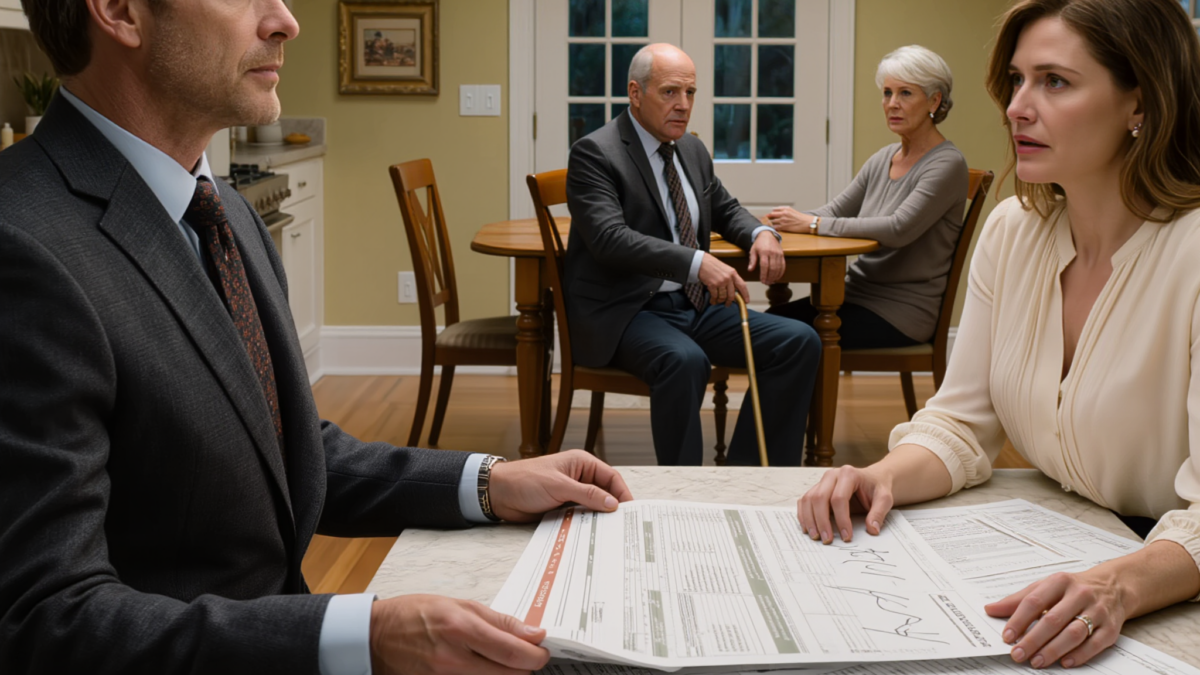
The meeting happened at my parents’ house, around the kitchen table where so many years of family pressure had been delivered.
My father sat at the head with his cane hooked over the back of his chair.
My mother sat beside him.
Garrett and Ashley took the other side.
They had positioned my chair so that all four of them faced me.
It felt like a tribunal.
That was fine.
I had brought a folder.
“This has gone on long enough,” my father said before I had fully sat down.
He meant my refusal to pay.
I placed the folder on the table.
“I agree.”
Garrett went first.
“Fix the account, Jodie. This isn’t a game anymore. You’re hurting people who love you.”
Ashley crossed her arms and tapped one manicured nail against the table.
She said I had humiliated them in front of the school.
She said Paisley was paying for my tantrum.
My mother brought up my father’s health.
My father used the tone he had used when I was a child.
I let all of them speak.
I had learned that if you stay quiet long enough, people eventually tell you exactly what they believe they hold over you.
Finally, Garrett leaned forward.
“You can’t just cut us off.”
I opened the folder.
“I didn’t cut anyone off,” I said. “I stopped paying for things that were never in my name.”
I placed the lease for their house on the table and turned it toward him.
“This is in your name, Garrett. Yours and Ashley’s. I was never on it. I was a bank transfer. That is all I ever was on this.”
Then I put down the Porsche lease.
“This one is in your name, Ashley. That car has always been yours to make payments on. I simply made them for you. I’m not making them anymore.”
Next came the tuition records.
The autopay history.
The school donation.
Fifteen years of statements.
One by one, I placed the pages between us.
Last, I took out Garrett’s handwritten note from 2011.
The ink was faded, but his signature remained clear.
I put it face-up on the pile.
Garrett looked at it.
Then he looked away.
Of everything on the table, the six-figure total, the leases, the tuition, the years of payments, that small handwritten note seemed to affect him most.
It was the only promise on the table that had come directly from him.
He had promised to repay me.
I had kept the promise longer than he had.
Ashley’s expression changed when she understood the Porsche situation.
The car really was hers.
That was the problem.
The lease was hers to pay.
And hers to lose if she couldn’t.
“For 15 years,” I said, “you all believed you were letting me help. You believed you held something over me, something I’d spend the rest of my life paying down. You didn’t. You held a stack of contracts with your own names on them.”
I looked at the documents.
“And I held the one card that fed every one of them.”
The room became quiet.
“I could have stopped any month I chose,” I said. “I just never knew I was allowed to want to.”
For a moment, Garrett had nothing to say.
My father looked from the papers to my brother.
Ashley stared at the Porsche lease.
They were seeing the arrangement in a way they had never been forced to see it before.
Then each of them tried the method that had always worked.
Garrett used force.
He told me I was making a mistake I could never undo. He threatened to tell every cousin, aunt, and family friend that I had abandoned my own family.
“You think you come out of this looking good?”
“You’re welcome to tell them anything you like,” I said. “I have copies of everything.”
Ashley tried negotiation.
“What do you want?” she asked. “Just tell us the number. We’ll do a payment plan. We’ll pay you back. There’s a version of this where everyone’s fine.”
As if 15 years had simply been one unusually long loan.
“I don’t want the number,” I said. “I already have the number. The number was never the problem.”
My father tried authority.
“Jodie, that’s enough now. Sit down and let’s fix this like adults.”
I heard the old tone.
For years, it had carried enormous weight.
Now it sounded like an old man saying his daughter’s name across a kitchen table.
Then my mother stood.
She gripped the edge of the table and pointed toward the living room.
Toward the cane.
“You cost your father his legs, Jodie.”
Her voice broke.
“You put him in that chair. And the very least, the very least you can do after what you did is keep this family whole.”
There it was.
The sentence behind every payment.
The weapon they had used for two decades.
I felt the old reflex reach for me.
This time, I didn’t fold.
“You’re right,” I said quietly. “Let’s talk about that night.”
I reached into my bag and lifted out the old answering machine.
My father saw it first.
His eyes went to the masking tape.
He recognized his mother’s handwriting.
The color left his face.
“Ruth kept this,” he whispered.
It wasn’t really a question.
“She kept it for 15 years until she died,” I said. “Then it sat in your garage for five more until your own granddaughter found it doing a school project about her family.”
I placed my finger on the play button.
“She kept it for me.”
Then I pressed play.
My mother’s voice filled the kitchen.
Thin.
Young.
Shaking.
“Ruth, Ruth, it’s Sherry. Please pick up, please.”
There was a ragged breath.
“There’s been an accident. Dale’s hurt. Ruth, it’s bad. It’s really bad.”
Then her voice changed.
The panic narrowed into something deliberate.
“Listen to me. We’re going to say Jod was driving. We have to. Garrett had been drinking. He was over the limit. Ruth, if they test him, it’s a felony. He’ll go to prison. He’ll lose everything. His whole life gone.”
No one at the table moved.
“And Jod is stone cold sober. If she says she was driving, it’s just an accident. A young driver, a bad road. Nothing happens to her. It’s the only way to save him. It’s the only way.”
Then my mother’s recorded voice said, “Please don’t tell anyone we talked.”
The tape clicked.
A long hiss followed.
No one denied it.
That was the loudest reaction in the room.
Garrett sat with his mouth slightly open.
He said nothing.
My father closed his eyes.
My mother slowly sat down and covered her mouth with one hand.
My whole life rearranged itself in those few minutes.
Every glance toward the cane.
Every reminder.
Every time Garrett had been forgiven while I had been blamed.
Every dollar I had paid because I believed I owed my father for what happened to him.
The guilt had been built on a lie.
A lie decided by frightened people on the worst night of our lives.
My father spoke first.
“We were protecting the family.”
“No,” I said. “You were protecting him.”
I nodded toward Garrett.
“And then you found something out. You found out that a guilty daughter is a generous one. You found out my shame paid your bills.”
Garrett still wouldn’t look at me.
“So you didn’t just let me carry it,” I said. “You built the weight, and then you charged me rent on it for 20 years.”
I reached into my pocket and took out one final item.
It wasn’t a financial record.
It was one of Ruth’s birthday cards.
The last one she had sent me.
For all those years, Ruth had never blamed me. Not in one card, not in one look across a dinner table.
I had believed she was simply kind.
Now I understood that she had known.
“You don’t owe what they say you owe.”
Her words finally made sense.
“Grandma Ruth knew,” I said. “She couldn’t say it out loud while she was alive, so she left me a way to hear it for myself.”
I stood.
I gathered my folder and put the original tape in my pocket.
I left one copy of the recording in the middle of the table.
“I don’t owe you,” I said. “I never did. I just finally have the receipt.”
At the door, I looked back.
“The originals are mine. Behave accordingly.”
Then I walked out.
I didn’t have to destroy anything.
I simply stopped being the person keeping everything from falling.
Within days, consequences began arriving on their own.
Kingsley Hall’s business office sent tuition notices to the parents whose names were actually attached to Paisley’s enrollment.
Garrett and Ashley had never had to deal directly with those bills before.
Their landlord did not receive the $3,200 payment that had arrived automatically for years.
The Porsche payment stopped going through.
None of those situations resolved overnight.
Repossession takes time.
Housing consequences take longer.
But the direction had changed.
I hadn’t taken anything from Garrett or Ashley.
I had stopped giving.
From their side of the arrangement, those two things apparently felt identical.
The brass donor plate at Kingsley Hall remained on the wall.
The Skinner Family.
A permanent little monument to a contribution that had come from my card.
Meanwhile, relatives began hearing pieces of the real story.
My aunt, the same one who had cautiously asked whether I was all right, called about a week after the family meeting.
Someone had talked.
I never found out exactly who.
Paisley was 13, honest, and beginning to ask her grandmother questions that didn’t have comfortable answers.
My aunt didn’t ask me to defend myself.
She said, “I always wondered why they never let you grieve that accident like the rest of us did. Now I understand.”
Then she apologized.
It was the first apology I received that did not bend back toward money.
She didn’t ask me to turn anything on again.
She was simply sorry.
Other parts of Garrett and Ashley’s life began adjusting too.
Garrett’s charm had always depended partly on an audience that believed he was doing well.
That audience became smaller.
Ashley stopped posting photos of countertops and getaways.
The life they had displayed to other people had always depended on money arriving quietly from someone they barely acknowledged.
Now it had to fit inside what they actually earned.
I don’t want to pretend their lives were destroyed.
They weren’t.
Garrett still had his health, his personality, and every opportunity to build something real if he chose to.
Ashley still had her marriage and daughter.
Nobody ended up on the street.
The consequences were not catastrophic.
They were simply proportionate.
For people who had avoided proportionate consequences for years, that probably felt enormous.
Eventually, the apologies started.
At first there had been anger.
Then the anger failed to restore the payments.
My mother’s messages became softer.
Garrett started using the word sorry.
Even Ashley sent one.
They said they had been wrong.
They said they missed me.
They reminded me that families forgive.
But every message eventually curved toward the same idea.
Things could go back to how they had been.
That mattered.
An apology that appears only after money stops is difficult to separate from the request hidden inside it.
Maybe part of my mother genuinely meant hers.
I believe people can feel regret and still want the old arrangement restored.
But they were not only asking me to forgive the lie.
They were asking the ATM to start working again.
There was one person I refused to let the consequences fall on.
Paisley.
That had always been Garrett’s strongest argument.
The child.
If I stopped paying for everything, Paisley could lose her school in the middle of the year.
He knew I loved her enough that I might pick up the entire family again just to protect her.
So I separated her from the rest of it.
I called Kingsley Hall myself.
I asked to speak with Diane Whitfield, the same development director who had thanked me at the gala for Garrett and Ashley’s generosity.
I told her a cleaner version of the truth.
I explained that I had funded Paisley’s tuition for three years.
I was no longer willing to finance the household around her, but I did not want Paisley’s education disrupted over problems that had nothing to do with her.
I asked whether there was a way to support Paisley directly through the school without money passing through her parents.
There was.
I arranged to fund the student, not the performance.
Paisley’s tuition would go directly to the school under terms I controlled, with her parents removed from that financial arrangement.
It cost almost exactly what I had already been paying.
But emotionally, it was completely different.
For the first time in 20 years, I made a large payment because I freely chose to help someone I loved.
No guilt.
No debt.
No price of admission to a family table.
When Paisley found out she would not lose her school, she sent me a heart.
No long message.
Just a heart.
It was probably the first family transaction in decades that cost me nothing and gave me everything I needed.
Two weeks after my brother stood at a gala in a suit I paid for and called me the family ATM, the money was either settled or settling.
Garrett’s rent became Garrett’s responsibility.
His difficulties stopped being my emergency.
Ashley’s Porsche became Ashley’s responsibility.
If she could afford it, she could keep it.
If she couldn’t, the school pickup line would survive without it.
Paisley’s tuition continued, but it went directly where I intended it to go.
The three doors through which the family had been draining my account were closed.
I had no intention of reopening them.
But the money turned out to be the smallest part of what changed.
For a few nights, I thought I had lost my family.
From the outside, that was probably what it looked like.
Eventually, I understood that I had not lost what I thought I had.
What I had lost was a bill I had been paying in exchange for belonging.
I had spent years believing that if I gave enough, fixed enough, forgave enough and paid enough, one day they might love me for something other than what I could provide.
I grieved that belief.
Even an illusion can leave real grief behind when you finally let it go.
For the first time in my adult life, my refrigerator is full.
That sounds small.
It isn’t.
For years, I lived like a stranger to my own income so that people who mocked me could live beyond theirs.
Now, the money I earn is mostly money I decide how to use.
I bought a bookshelf.
A lamp.
A chair that belonged only to me.
One evening, I sat under that lamp in that chair and read a book until it was late.
No one called asking for money.
No emergency appeared.
Nothing needed to be rescued.
It was an ordinary evening.
For most of my adult life, ordinary peace was one of the things I could never afford.
My family still reaches out.
The apologies have become gentler.
I don’t answer most of them.
I have left the door unlocked, but I have not left it open.
If my parents ever decide they want to be my parents instead of guardians of a lie and collectors of a debt, they know where I live.
They would have to say plainly what they did on that dark road in 2006.
They would have to apologize without attaching a request for money.
They would have to change.
That was always the part they skipped.
I still speak to Paisley.
I always will.
Not long ago, she asked whether the family was going to be okay.
I told her the truest thing I knew how to tell a 13-year-old.
Being needed by people and being loved by them are not the same thing.
I told her I hoped she learned the difference much earlier than I did.
For 20 years, I believed usefulness was how I earned my place.
I thought if I carried enough, paid enough and forgave enough, I could finally settle the debt and be allowed all the way inside.
Now I know the debt was never mine.
It came from a night my family lied about.
They placed it on a 20-year-old daughter because her guilt was easier to live with than her brother’s consequences.
I spent half my life paying interest on something I had never done.
I don’t do that anymore.
My name is Jodie Skinner.
Not the ATM.
Not the apology.
Not the one who owes.
The morning after the family meeting, I opened a new account at a different bank just for myself.
When the form asked for the name of the account holder, I wrote my own name.
For the first time in my life, it felt less like a signature and more like the truth.








