Nine years after my parents threw me out at 19 and pregnant, they showed up at my Ohio door carrying a baby-blue gift bag marked “For our grandson.” My mother looked past me and my father asked, “Where’s our boy?” Then my eight-year-old daughter stepped into the hallway, and the story they had told everyone for nine years began to crack.
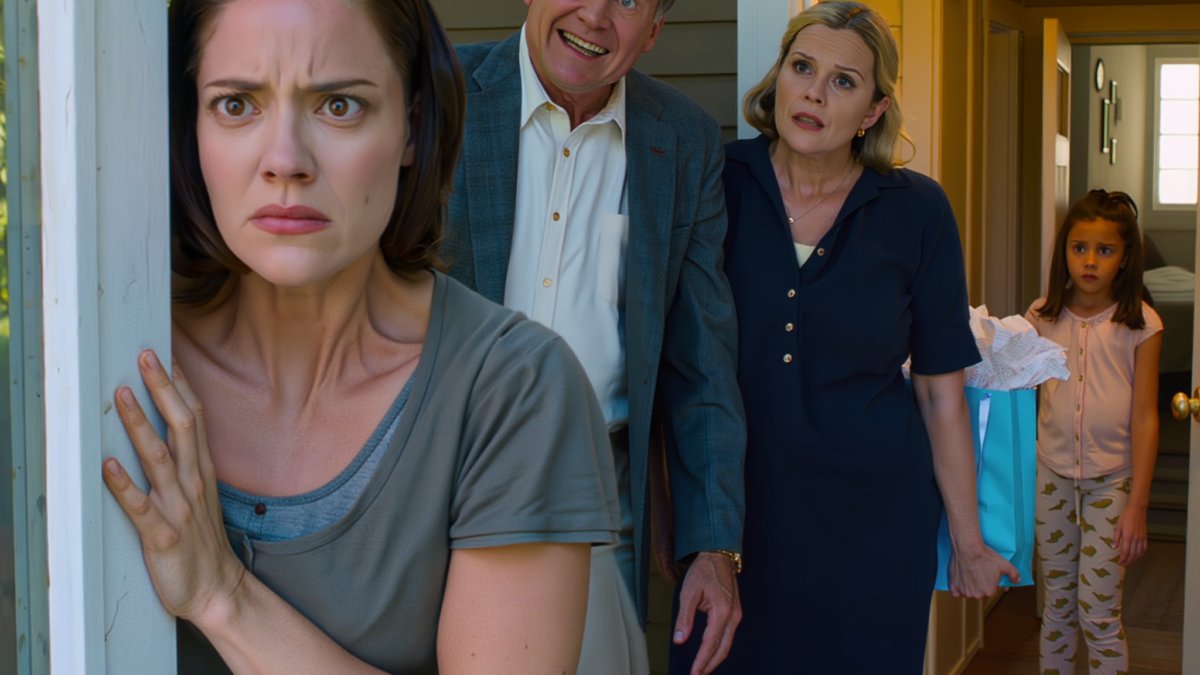
Nine years after my parents threw me out at 19 and pregnant, they showed up at my Ohio door carrying a baby-blue gift bag marked “For our grandson.” My mother looked past me and my father asked, “Where’s our boy?” Then my eight-year-old daughter stepped into the hallway, and the story they had told everyone for nine years began to crack.
I’m Mora, 28. I spend my nights as a labor and delivery nurse, helping other women meet their babies. It is a strange job for someone who met hers alone.
The people standing at my door had been telling a story about my child for nine years. They had never once asked to hear the true one.
I live in Mary’sburg, Ohio, a town small enough that the pharmacist knows your name but big enough that you can disappear if you keep your head down. I rent a two-bedroom place on Delaney Street with a crooked porch and a maple tree that drops helicopters all over the walk every spring.
My daughter Juny is eight. She has a gap between her front teeth, opinions about everything, and a habit of reading under the covers with a flashlight as if she invented the idea.
I built this life, every ordinary piece of it.
I work nights at St. Brides three or four shifts a week. I know the exact sound a monitor makes when a heartbeat is fine and the different sound when it isn’t. I’ve held strangers’ hands while they cried. I’ve caught babies whose mothers had entire families waiting outside the room.
I never begrudged them those crowded hallways.
I just noticed them.
You notice the things you didn’t get.
In the back of my closet is a navy hardshell suitcase with one wheel that sticks. It is the suitcase I left my parents’ house with nine years ago. I keep winter blankets in it now because throwing it away always felt too much like pretending the leaving never happened.
And I don’t pretend.
For nine years, that suitcase and I understood each other. We had a quiet life. Nobody from before knew my address.
Then, one Tuesday in July, someone knocked like they had every right to be there.
I wasn’t expecting anyone. I thought Juny was at her friend Priya’s for a sleepover, and I had the rare gift of a night off and a book I wasn’t actually reading.
The knock came again before I reached the door.
Three sharp raps. Then the doorbell my landlord had never fixed, pressed twice anyway.
I looked through the side glass, and my stomach dropped.
My mother.
My father.
Standing on my porch in Ohio in July, dressed for church.
Diane wore the navy dress she saved for Easter. Ray wore a sport coat despite the heat. And in my mother’s hands was a baby-blue gift bag with tissue paper spilling over the top.
A little card had been stapled to the handle.
Even through the glass, I recognized my mother’s looping handwriting.
For our grandson.
Nine years.
Not one birthday card. Not one call. Not one attempt to find me when I gave birth two towns away.
Now they stood on my porch with a wrapped present and expectant faces, as if they had merely been running late.
My hand stayed on the deadbolt.
I hadn’t decided to open it.
I didn’t invite them inside. I only needed to see if they were real.
“Mora.”
My mother’s voice came through the door, bright and sweet.
“Mora, honey, we know you’re in there. We came to meet him.”
Him.
That one word told me everything and nothing.
I opened the door six inches.
No more.
My mother immediately stepped forward as though six inches meant welcome. I felt the old reflex in my body, the instinct to move aside and give her room.
I hated that it was still there.
I held the door where it was.
“Look at you,” she said.
Her eyes moved over me from head to toe, and somehow she managed to look disappointed before her gaze slid past my shoulder into the hallway.
“Where is he? Where’s our boy?”
My father stood behind her, bigger than I remembered, his sport coat pulling at the buttons.
He was smiling.
It was the same wide public smile he used at church potlucks, the smile that appeared whenever someone might be watching him do something generous.
“We’ve heard so much,” he said. “Nine years. That’s long enough for anybody to be stubborn, Mora.”
He lifted the gift bag from Diane’s hands like a man presenting a trophy.
“Where’s the young man?”
Then a door opened down the hall.
I had forgotten.
Juny hadn’t gone to Priya’s yet.
The sleepover was the next night. I had mixed up the dates the way you sometimes do when you work while the rest of the world sleeps.
She padded into the hallway in dinosaur pajamas, hair messy from bed, eyes half closed.
“Mom, who’s here?”
My father’s mouth was still open around whatever he had been about to say.
His grandson.
The boy.
Him.
Then he saw my daughter.
The smile remained on his face one second longer than the rest of him could support it.
“That’s not…”
He stopped.
Nine years of a story he had told at reunions, Sundays, funerals and church gatherings collapsed in my hallway in the time it took an eight-year-old to rub her eyes.
I put Juny back to bed.
I told her they were people I used to know.
That was true.
Then I returned to the front door.
“You should go,” I said.
My mother’s face had turned almost the same color as the tissue paper.
“Mora, there’s clearly been a misunderstanding. We were told…”
“You weren’t told anything,” I said. “You told yourselves.”
I looked at my father.
He hadn’t spoken since Juny appeared.
“Good night, Ray.”
I had not called him Dad in nine years.
I watched the word land.
Then I closed the door and turned the deadbolt.
Through the glass, I saw them stand there for another moment. Two people in church clothes holding a gift for a child who did not exist.
That was when I understood something I should have understood the second I saw that bag.
You do not drive across three counties after nine years of silence to meet a grandchild you never asked about.
Not because of love.
Love does not wait for an occasion.
Something had changed.
Something had made a grandson suddenly necessary, and my silence suddenly inconvenient.
I just didn’t know what yet.
To understand why that knock mattered, you have to go back to Thanksgiving 2017.
I was 19 and five months pregnant.
I was terrified, and I made the mistake of thinking a holiday dinner table was a safe place to tell the truth.
When I finished speaking, my father put down his fork.
Then he stood.
“You’re not my daughter. Not anymore.”
He pointed toward the front door.
He said it loudly enough for both of his brothers to hear him do it.
Gordon was there. So was my uncle Pete, who has since passed away.
The table went silent.
My aunt stared at her plate.
My mother picked up her butter knife and, God help me, buttered a roll as though the dinner were the thing in danger.
Only my grandfather Walter moved.
He set down his fork slowly and looked at his son.
Walter was not a man who shouted. He simply stared at Ray with an expression I would spend years trying to name.
It looked like a man seeing his own child clearly for the first time and not liking what he saw.
Nobody stood up for me.
Not really.
But Walter set down his fork.
At 19, that was the only thing anybody did.
I went upstairs and packed one suitcase.
Navy hardshell.
I took what fit and left everything else behind, including, apparently, my name.
Juny was born the following April at a hospital two towns away, where nobody knew the Canellas.
The chair beside my bed stayed empty all night.
There is a chair in every delivery room for somebody. A partner. A mother. A sister. The person who is supposed to sit beside you.
Mine held my coat.
A night nurse named Rosa found me between contractions, alone and gripping the bed rail.
She was near the end of a double shift. She could have kept walking.
She didn’t.
She pulled the empty chair close, took my hand and said, “You’re not doing this by yourself, honey. Not tonight.”
She stayed past the end of her shift.
After me, Rosa was the first person to hold Juny.
I became a nurse because of her.
Not for the money. There isn’t much.
I became a nurse because Rosa taught me that the person in the empty chair matters. She taught me you can choose to be that person for a stranger even when nobody chose to be it for you.
That was the wound.
Not the money.
Not even being disowned.
It was the people who sat at that Thanksgiving table and watched.
The way an entire room can see a pregnant girl being thrown out and still reach for the butter.
I told myself I didn’t need people like that.
Most of the time, I believed it.
But I kept the suitcase.
And every April on Juny’s birthday, I remembered the empty chair.
The letters started in the spring of 2018.
The first envelope had no return address. It carried a Mary’sburg postmark and my name and address in a shaky, deliberate hand I didn’t recognize at first.
Inside was $200 and an index card.
Four words were written on it.
Buy the girl shoes.
There was no signature.
But only one person at that Thanksgiving table had set down his fork.
I almost sent the money back.
Pride is a luxury, though, and children’s feet grow.
So I bought Juny the shoes.
The envelopes kept coming every few months.
Sometimes there was money.
Sometimes there was only a card with a line about the weather, a joke about the Browns or some small observation. Once, there was a pressed maple leaf.
There was never a phone number.
Never an invitation.
Never a request to visit.
Walter seemed to understand that showing up would cost me something, and that a man who had watched his son throw me out had no right to demand anything more from me.
I never told my parents.
I never told anyone.
I kept the blue envelopes in a cigar box on the top shelf of my closet beside the navy suitcase.
Two things from before that I allowed myself to keep.
For years, one person from that family quietly proved he knew I existed.
And the week before my parents appeared on my porch demanding to meet a grandson, that person died.
I just didn’t know it yet.
The voicemails began the next morning.
The first was from my mother, syrupy sweet.
“Mora, honey, we got off on the wrong foot. Call me back. Family is family.”
Four hours later, the second message was thinner.
“Your father is very upset. You embarrassed him.”
By the third, the sweetness was gone.
“After everything we’ve been through for you, the least you could do is pick up the phone.”
Everything they had been through for me.
I wrote that sentence on the back of a receipt because I wanted to remember the exact shape of it.
By Thursday, there were nine messages.
Somewhere in the middle, my mother accidentally said the part that mattered.
“People are asking questions, Mora. The whole church is asking. Do you know what it’s like to have people asking?”
The church.
Of course.
Whatever this was, it had an audience.
And my mother had never done anything in her life that didn’t.
I did not call back.
But I saved every voicemail.
Nine years had taught me something about the Canellas.
They never appeared without a reason.
And the reason was rarely you.
I found out about Walter from a coworker.
Deb Prader had worked labor and delivery at St. Brides for 31 years. She trained me. She was the kind of woman who remembered every baby’s birth weight and every mother’s maiden name.
She also read county obituaries the way other people read horoscopes.
“Canella,” she said one night at the nurses’ station without looking up. “Any relation?”
She slid the folded paper toward me.
Walter Canella, 82, Mary’sburg.
“Handsome old fellow in the picture,” Deb said. “Died last week.”
The floor seemed to shift beneath me.
I put one hand on the counter.
“Last week?”
The blue envelopes had stopped that spring.
I had told myself he was slowing down. A man in his eighties could get tired of driving to the post office.
Instead, he had been dying.
And I hadn’t known.
I hadn’t gone.
“Mora,” Deb said. “Honey, sit down.”
I read the obituary standing up.
It was short, the way proud men’s obituaries often are.
Then, halfway through the list of surviving family members, I saw the sentence that turned grief into something colder.
Walter was survived by his son Raymond, daughter-in-law Diane and his beloved great-grandson.
His great-grandson.
Printed in the county paper.
The lie had a byline now.
Deb brought me into the break room, poured the terrible coffee and didn’t ask anything I wasn’t ready to answer.
She simply watched me put the pieces together.
“He died last week,” I finally said. “Two days later, my parents came to my porch with a present for a grandson they’ve never met.”
I looked at her.
“You don’t do that for a child. You do that for a will.”
Deb nodded.
“There it is.”
I did not know the terms.
I did not know the numbers.
But I knew Walter owned the house on Cardinal Road outright and 40 acres his father had farmed before him.
And in a family like mine, land was the only love language everybody seemed to speak fluently.
Something in Walter’s estate needed a grandson.
My parents had spent nine years telling the entire county they had one.
Now Walter was dead, and the truth about my child was suddenly dangerous to them.
My child.
My girl.
I drove home as the sun came up and sat in my driveway for a long time.
I was grieving the one member of that family who had chosen me in the only way he knew how.
Underneath the grief, something sharper began to rise.
They had not come for Juny.
They had come to use her.
And when she turned out to be the wrong shape for their story, my father’s smile had died in my hallway.
Not because he was sorry.
Because my daughter had cost him something.
I decided I was going to find out exactly what.
Ray’s letter came Saturday.
It was typed, which somehow made it worse.
My father had never typed anything to me in his life.
Dear Mora, it began, as though we were distant pen pals.
He wrote about Walter’s passing, the shortness of life, forgiveness, reconciliation and the Lord’s plan.
For almost a page, he asked for nothing.
Then the request arrived.
There are matters of the estate that require the family to present itself as one.
He wrote that it would mean a great deal to him and my mother if I introduced “our grandson” to the family attorney.
Then came the sentence that made me read the letter three times.
We can make this easy for you, Mora. We can make it worth your while.
Worth my while.
My father, a deacon at Grace Fellowship, had put in writing that he was willing to pay for access to a boy he now knew did not exist.
That was when the shape of the plan became clearer.
He did not need reconciliation.
He needed a grandson to walk into a lawyer’s office.
Maybe he believed nine years of struggling had made me rentable.
Maybe he thought I would borrow somebody’s son, teach an eight-year-old a new name, sign whatever needed signing and take a check.
He had told the lie so long that perhaps he assumed everybody else would lie just as easily.
Then I did something I had refused to do for nine years.
I searched my mother’s name online.
Her Facebook page was public.
There was an entire life on it from which I had been erased.
And there was the grandson.
A dark-haired boy at a baseball game.
The same child at a fifth-grade moving-up ceremony.
Our grandson made the honor roll. So proud.
Thirty-one likes.
Comments from church women saying he had Ray’s eyes.
I knew the boy.
Not well.
He was Gordon’s grandson, my cousin’s child, living three counties away.
My mother had been taking photographs of my uncle’s family and using them to illustrate my imaginary son’s life.
For nine years, she had performed grief over a grandson she invented while my real daughter learned to ride a bicycle on a crooked porch 14 miles away.
I sat on the closet floor with my laptop beside the cigar box of Walter’s letters.
The grandson was fake.
That was the first answer.
But it created a larger question.
Why was the lie suddenly worth preserving at any cost?
The answer began arriving Monday morning when an unfamiliar number called.
“Miss Canella, my name is Francis Bell. I was your grandfather’s attorney. He asked me to contact you directly, and only you.”
I gripped the phone.
“He asked you?”
“Some time ago. He was very specific.”
There was a pause.
“Walter left instructions that in the event of his death, I was to contact his granddaughter Mora before the estate was read to the rest of the family. Not through your father. Through me. Can you come in this week?”
Before the rest of the family.
Walter had built a door only I had the key to.
And he had done it before he died.
“There’s something else you should understand,” Francis said. “Your father has already contacted my office several times. He’s under the impression the estate is straightforward.”
Another pause.
“It is not straightforward, Miss Canella. Your grandfather made sure of that.”
Francis Bell’s office occupied two rooms above a hardware store. It smelled like old paper and was lined with law books.
She was around 60, with a silver bob and reading glasses on a chain. She had the calm patience of someone who had watched families destroy themselves over money for decades.
She poured coffee and went straight to the point.
“Your grandfather’s estate is substantial. The house, the acreage, and savings that will reach into the high six figures once the land is valued.”
She let that sit.
“The bulk of the estate is governed by a single condition. When Walter dictated it, I told him it was unusual. He said that was the point.”
Then she read it to me.
The primary bequest, including the house, land and accounts, appeared to pass to the first great-grandson who carried the Canella name.
A grandson.
In black and white.
“You understand what this looks like,” Francis said. “Your father believes there is such a boy. The family has spoken about him for years. Your father intends to present that boy and claim the estate. If no qualifying male heir comes forward, the property passes to your father’s brother, Gordon, whose grandson does qualify.”
She removed her glasses.
“That is what the document says on its face.”
“On its face,” I repeated.
Francis nodded.
“Walter left a second envelope. It is sealed and can only be opened at the reading in front of the family. He was very clear about that.”
She looked directly at me.
“I don’t know everything in it, Miss Canella. But I knew your grandfather for 30 years, and he did not write a cruel clause by accident. He wrote it to make someone say something out loud.”
I told her about the blue envelopes.
Eight years of them.
The shoes.
The money.
The maple leaf.
Francis was quiet.
Then she opened a drawer.
She placed another blue envelope on the desk.
Same shaky handwriting.
Addressed to her.
Unopened.
Across the front, Walter had written instructions to hold it for the reading.
“He wrote to you for eight years,” she said softly. “And he wrote one more for the day he couldn’t be in the room.”
She touched the envelope.
“I think he knew exactly how your father would behave once there was money on the table. And I think he decided long ago that he was going to stand behind you when it happened, even if he had to do it from the grave.”
I drove home understanding the trap for the first time.
My father intended to walk into a room and claim a grandson who did not exist in front of everybody whose opinion mattered to him.
My grandfather had designed a situation where Ray would have to commit to the lie in public.
And I carried the truth that could expose it.
The question was no longer what my parents wanted.
The question was whether I was willing to walk into that room.
And whether I would bring Juny with me.
Ray answered part of that question two days later when he stopped asking politely.
I came off a night shift at 6:00 in the morning and found him leaning against my driver’s door in the St. Brides parking lot.
No sport coat.
No church smile.
Just my father blocking the car as though he owned the space around it.
“You’ve made your point,” he said. “You want an apology? Fine. But you’re not going to humiliate this family at your grandfather’s service. You’re going to stay home. You and whoever that was.”
“Her name is Juny,” I said. “Your great-granddaughter.”
Something crossed his face and disappeared.
“I don’t know what Walter told you or what you think you’re owed, but I’ve spent 30 years building a name in this county. You are not going to walk in and burn it down over spite.”
He pushed himself away from the car.
“I can make things very hard for a single mother who works nights, Mora. Custody people ask questions. Landlords hear things. Don’t make me be that man.”
There he was.
The real Ray.
Standing in a parking lot at dawn, threatening to cause problems for my home and my child.
I did not move.
“You should go home and get your story straight,” I said.
Then I unlocked my car and made him step aside.
He thought he was threatening a woman with nothing.
He had no idea what was sitting in the cigar box on my closet shelf.
My mother tried a different method.
Where Ray brought threats, Diane brought tears.
She caught me outside the grocery store two days later. She must have followed my car, because she was waiting before I had even shut the trunk.
“I’ve lost my father-in-law, and now I’m losing my daughter in the same month,” she said, carefully dabbing beneath her eyes. “Mora, I am begging you. Whatever your grandfather told you, whatever is in that letter, just let your father handle the estate. Come to the reading. Sit quietly. Be a family for one afternoon. That’s all we’re asking.”
“Sit quietly while Ray claims a grandson who doesn’t exist?”
“It’s more complicated than that.”
“It isn’t complicated at all. You made up a child because the truth embarrassed you. Now the made-up child is worth money and the real child is in the way. That’s not complicated, Mom. That’s ugly.”
Her tears stopped with remarkable speed.
“You always did think you were smarter than this family,” she said. “You’ll go to that reading and ruin your father, and afterward you’ll still have nothing and no one, same as the last nine years. At least think about what it does to you.”
“I’ve had my daughter for eight years. That’s not nothing. That’s the whole thing.”
I put the last grocery bag in the trunk.
“You should have met her, Mom. That’s the part you can never get back. Not the farm. Her.”
I drove away.
In the rearview mirror, my mother already had her phone out.
That night, after Juny went to sleep, I took Walter’s cigar box down from the closet and read every letter in order.
I had never done that before.
Individually, they were money and weather and small observations.
Together, they were a portrait of a man watching a life he believed he had no right to enter.
He knew things.
That was what undid me.
One November, the year Juny started school, he wrote:
Buy the girl a winter coat. She’ll be walking to that bus stop.
He knew she took a bus.
In April, he always remembered her birthday.
One envelope contained $200 and another note.
They tell everyone she’s a boy at church. I let them. Easier for you if they look the wrong direction.
I sat there staring at those words.
Walter had known about the lie.
He had known Juny was a girl.
And he had let my parents point the entire county toward an imaginary boy because an imaginary boy could never lead them to us.
At the bottom of the box was the newest envelope, from March.
Inside was a bank slip.
A 529 college savings account in Juniper Canella’s name.
Eight years of small deposits.
The balance at the bottom made me sit down on the closet floor.
Walter had been quietly building my daughter a future while her grandparents built her an imaginary brother out of stolen photographs.
Juny found me sitting among the letters.
“Are you crying?” she asked.
I had always tried not to cry in front of her.
“A little,” I admitted. “Good kind.”
She sat down beside me and picked up the pressed maple leaf.
“What’s all this?”
“Letters from your great-grandpa Walter.”
“My grandpa? I have a great-grandpa?”
“You had one. He passed away.”
She absorbed that.
Then I told her the part that mattered.
“Out of everybody, he’s the one who remembered you. He bought your shoes when you were little. He helped with your winter coat. He was saving money for you for later.”
She studied my face.
“Did he know I was a girl?”
The question landed hard.
“He knew exactly who you were.”
She nodded as though that settled the matter.
Then she leaned against my arm.
Two nights later, I was at work during a delivery where the mother had an entire hallway of family waiting for the baby.
Grandmothers on both sides.
A father who cried.
Aunts holding balloons.
When the baby was placed on the mother’s chest, the family outside cheered through the door.
I did my job.
I charted the weight. Watched the bleeding. Checked the vitals.
Then, on my break, I stood alone in the stairwell and let myself feel what I had spent nine years trying not to feel.
I had not had that.
No cheering hallway.
No grandmothers.
No balloons.
I had Rosa and an empty chair with my coat on it.
And the people who should have been there had spent the next nine years inventing a grandson to perform for a church.
That was when I understood why I could not simply stay home.
It wasn’t the money.
I had lived without the farm, the land or anybody’s permission for almost a decade.
If I stayed silent now, Juny would inherit that silence.
She would grow up knowing her grandparents chose a fiction over her and never see anybody answer for it.
I finished my shift.
By the time I checked the 4:00 a.m. vitals, the decision had settled inside me.
I was going to walk into whatever Walter had built.
Deb became my unofficial adviser over bad break-room coffee.
She had grown up two pews behind the Canellas at Grace Fellowship and knew everybody involved.
“Louise Bradock runs the prayer chain,” she told me. “Which means she runs the gossip. Same thing, nicer hat. Your mother has been feeding that woman grandson stories for years.”
“Baseball. Honor roll.”
Deb shook her head.
“I always wondered why nobody ever met the boy.”
“Nobody thought that was strange?”
“In that church? Questioning a grieving grandmother would have been bad manners. Your mother figured that out fast. The less anybody saw the kid, the more sympathy she got because you were supposedly keeping him away.”
Then I told Deb about Walter’s will.
“If there’s no qualifying boy, Gordon’s line gets it.”
Deb went quiet.
“So your daddy has to make his boy real.”
“In a room full of people he has been lying to for nine years.”
Deb slowly smiled.
“Mora, do you understand what your grandfather did?”
Francis understood perfectly.
Walter had sat in her office months earlier and dictated the clause.
She had warned him that a court might question a gender condition. Gordon could challenge it. The clause might invite litigation.
Walter had answered, “Francis, I’m not writing it to hold up. I’m writing it to make my son stand up in front of God and everybody and claim a grandson he’s never met.”
After Ray committed himself publicly, the clause itself would no longer be the point.
Walter wanted his son to choose the lie out loud.
Francis tapped the sealed envelope.
“Once he does that, I open this.”
She told me Walter’s true wishes did not depend on anybody being a boy.
He had also left a physician’s letter and two witnesses from the signing in case anyone later argued he was not competent.
“The only thing he couldn’t control,” Francis said, “was whether you would come.”
She looked at me over her glasses.
“The trap only works if you are standing in the room.”
Then she made me do homework.
If Ray challenged the will, his attorneys would likely claim I had influenced Walter.
So we built the record before they could define it.
Every envelope.
Every postmark.
Every check.
Even the $200 I had once tried to return.
I still had the returned envelope.
Spread across Francis’s conference table, the pattern was obvious.
Walter reached out.
I kept my distance.
There was not one letter from me asking him for money.
Not one visit I initiated.
If anyone had pursued anyone, it had been an old man trying to repair something with the granddaughter he had watched leave.
The will itself had been signed in Francis’s office with two witnesses.
Hollis Rener farmed land next to Cardinal Road.
His wife, Ada, had taught Sunday school with my grandmother before she died.
Both had watched Walter sign.
Both were prepared to say he was clear-minded and knew exactly what he was doing.
I met Hollis once before the service.
He was in his seventies, weathered, with a handshake like a work glove.
When I told him who I was, his face changed.
“You’re Walter’s girl.”
Not a question.
“He talked about you. Kept your school picture in the visor of his truck for years. One from before.”
Hollis looked toward the window.
“Ray never knew.”
Then he looked back at me.
“You’d best believe I’ll be at that reading.”
Walter had built his trap from ordinary people my father never considered threats.
My parents, meanwhile, were preparing the town.
Through Deb, I learned what was being said at Grace Fellowship.
Walter’s estranged granddaughter had returned the moment he died.
She was after money.
She was troubled.
Possibly unstable.
The family needed prayer during this difficult time.
My mother had spent nine years teaching that congregation to see me as a cautionary tale.
Now she was teaching them to see me as a threat.
It worked.
At least for a while.
Then Louise Bradock noticed something.
She had been gathering photographs for Walter’s memorial board and reviewing the grandson pictures Diane had given her over the years.
One showed the boy in a school jersey.
The district was three counties away.
Exactly where Gordon’s family lived.
Louise’s sister taught there.
She made a phone call.
It was only a crack, but cracks matter.
The harder conversation happened at home over pancakes.
“Why don’t I have grandparents?” Juny asked.
Priya had four.
Juny knew there were supposed to be more people on a family tree than just the two of us.
“You have some,” I said carefully. “They live near here. But when you were a baby, they and I had a big disagreement, and they decided not to be part of our family because of me.”
I heard the mistake as soon as I said it.
Because of me.
The same wound was moving into another generation.
“No,” I said.
I put down my fork.
“Never because of you. They didn’t even know you. That was their loss. It was the dumbest choice two grown-ups ever made.”
I made sure she was looking at me.
“You were wanted, Juny. By me. And by your great-grandpa Walter.”
She nodded.
“Are they the people who came to the door?”
“Yes.”
“I didn’t like how the man looked at me.”
Then she went back to her pancakes.
A child had seen my father clearly in four seconds.
It had taken me 19 years.
That was when I decided she was not going to grow up believing she had been somebody’s inconvenience.
The night before I made my final decision, I drove Juny out to Cardinal Road.
I had never seen Walter’s farm.
Forty acres stretched gold in the evening light. Corn on one side, soybeans on the other, and a white farmhouse with a wraparound porch and a barn that needed paint.
Nothing grand.
Just land a family had held for three generations.
“Is this Great-Grandpa’s?” Juny asked.
“It was. It’s going to be part of a big grown-up argument.”
I looked toward the farmhouse.
“The people from the door wanted it. That’s why they came to see us.”
Juny was quiet.
Then she said, “They wanted a house, not me.”
I could have softened it.
I didn’t.
“They wanted the house,” I said. “Your great-grandpa wanted you. Those are two different kinds of people, and you’re going to meet both kinds your whole life.”
We sat there until the light faded.
Driving home, Juny fell asleep against the window.
Somewhere near the county line, I made the decision.
I would go.
Not for the 40 acres.
Not for the house.
Because my daughter already understood that people had wanted property more than they wanted her, and I refused to let that be the final lesson.
Ray learned that Walter and I had been in contact when Francis’s paralegal requested records for the 529 account.
Someone in the family’s orbit apparently saw Juniper Canella’s name associated with an account Walter had funded for years.
Ray called me that night.
The performance was gone.
“You’ve been in contact with him.”
“He wrote to me,” I said. “You threw me out. He didn’t.”
“Do you have any idea what you’ve done?”
Under his anger, I heard fear.
His entire plan had rested on the assumption that I was isolated, uninformed and easy to pressure.
If Walter had written to me for years, maybe I knew about the will.
Maybe I knew about the sealed letter.
Maybe I knew everything.
“I’ll see you at the service, Ray.”
Then I hung up.
He spent the next week trying to make sure I never reached that room.
Francis called on Wednesday.
“Your father retained a Columbus firm. They filed to contest the will.”
“On what grounds?”
“Undue influence.”
“By who?”
“You.”
Their theory was that I had spent years cultivating a vulnerable elderly man in order to turn him against his son and redirect the estate.
The letters.
The money.
The savings account in Juny’s name.
They intended to characterize all of it as manipulation.
I laughed because it was so completely backward.
“He contacted me.”
“I know,” Francis said. “You know. But a contest doesn’t have to win to cause damage. It can freeze an estate for months or years.”
Meanwhile, my mother’s version of events spread through Grace Fellowship.
The estranged daughter who came back for money.
The confused old man.
The grieving family being dragged into court.
Somebody organized a meal train for Ray and Diane.
The town was bringing casseroles to the people who had thrown their pregnant daughter out in November.
For nine years, I had been erased.
Now I learned there was something worse.
Being rewritten.
My mother had taken the true story, a frightened 19-year-old asking for help and being cast out, and reversed every role.
In her version, she was the wounded mother.
I was the danger.
It followed me into the pharmacy.
I was picking up Juny’s inhaler refill when two women I knew vaguely from her school went quiet as I passed the greeting cards.
Then they started whispering just loudly enough for me to catch pieces.
Grace Fellowship.
Money.
Poor Diane.
One of them had once complimented Juny’s science fair volcano.
Now she looked through me at the register.
I paid.
I walked out calmly.
Then I sat in my car with my hands at ten and two and shook.
Because this wasn’t only about me anymore.
This was the town where my daughter had to grow up.
Even work stopped feeling separate.
A patient’s mother saw Canella on my badge and asked whether I was connected to “that estate business.”
I smiled and took her daughter’s blood pressure while she decided what kind of person she thought I was.
Deb found me in a supply room afterward.
“It’s bad,” she said. Deb never lied to make me feel better. “Your mother has half the county thinking you came back from the dead to rob a saint.”
Then she put her hand on my arm.
“But a story moving that fast is scared, Mora. People don’t work that hard to bury something harmless.”
It did not feel scared.
It felt like it was winning.
Then Ray produced a note.
Francis called me again.
“Your father’s attorneys submitted a handwritten document they claim Walter wrote two months before his death. It says his final wish was that everything go to the grandson who carries the family name.”
My stomach tightened.
“Is it valid?”
“No. It doesn’t meet the requirements to replace the executed will. But that is not necessarily why they produced it. It creates another version of Walter. It muddies the story.”
“Is it his handwriting?”
“It’s close.”
That was its own answer.
Walter had been dead for a month, and somebody had produced a note that looked like his writing.
That night, I nearly decided not to go.
I sat on the closet floor surrounded by blue envelopes.
Ray’s lawyers would call the money grooming.
The letters cultivation.
The college account evidence of manipulation.
I imagined years of litigation swallowing everything Walter had tried to leave Juny.
And beneath all of it was the old wound.
A room full of people deciding I was the problem.
“I can’t win this,” I said aloud.
Juny heard me.
She appeared in the doorway in her nightgown.
“Win what?”
“A grown-up fight. With the people from the door. About your great-grandpa’s things.”
“Do we need his things?”
That stopped me.
“No,” I said. “We don’t. We’ve been fine without anybody’s things.”
“Then why are you sad?”
I pulled her onto my lap.
“Because they’re telling everybody a story that isn’t true. They’re saying I’m bad. They’re saying your great-grandpa didn’t really love you. And I don’t know how to make them stop.”
Juny thought about it.
“Then go tell the real one.”
She said it as if it were obvious.
“You said I was wanted. Go tell them I was wanted.”
Deb said almost the same thing the next night.
“You’re thinking about this like a lawsuit,” she told me. “Forget the money. Walter did not build this whole thing just to make you rich. He built you a door back into that room.”
She pointed toward the photo of Juny on my locker.
“She’ll see you walk through it.”
The service was held Saturday at Grace Fellowship.
Walter had left written instructions that his estate be read there, where the family had gathered, in front of whoever stayed.
Ray had tried to move the reading to a private office.
Francis refused.
I laid out two dresses the night before.
One for me.
One small dress with a Peter Pan collar that Juny chose herself.
I barely slept.
At 6:00 the next morning, I dressed my daughter for a room neither of us had ever been welcome in.
Grace Fellowship smelled exactly as I remembered.
Lilies.
Coffee.
Old hymnals.
Some smells do not let you grow up.
We entered late on purpose.
Juny held my hand.
The room turned.
Two hundred people, and I watched whispers travel through them.
That’s her.
The daughter.
She brought a child.
My mother went rigid in the front pew.
My father was at the lectern delivering the eulogy. He lost his place for one beat when he saw us, then recovered.
Near the front was Walter’s memory board.
Beside it sat the baby-blue gift bag.
The same one.
For our grandson.
My mother had brought it to Walter’s funeral.
She had been that certain.
We sat in the back.
Juny looked at the large photograph of Walter near the front.
“That’s him?” she whispered.
“That’s him.”
“He looks nice.”
“He was the nicest one.”
When the service ended, Ray announced that the estate reading would take place in the fellowship hall, just as Walter had requested.
When he said family should stay, his eyes found me.
It felt like a dare.
I stood.
I took Juny’s hand.
And I walked toward the room Walter had spent years preparing.
About 40 people remained in the fellowship hall.
Family.
Deacons.
Prayer-chain members.
Walter’s old friends.
Francis sat at a long table with her leather folder. Beside her was Ray’s attorney from Columbus.
Francis had barely begun explaining the process when my father stood.
“Before we get lost in paperwork, let’s remember what my father wanted. He wanted this family whole. He wanted the name carried on. Everyone here knows he had a great-grandson he prayed for every day of his life.”
A murmur of agreement moved through the room.
“And everyone here knows my daughter kept that boy from him, from all of us, out of nothing but spite.”
Then Ray pointed at me.
The same gesture he had used at Thanksgiving nine years earlier.
Different room.
Same finger.
“She’s come back for his money. She couldn’t be bothered to come for the man, so let’s not pretend.”
Then he said it.
“Mora, produce the boy or sit down and stop this.”
Forty faces turned toward me.
For years, those people had heard one version of who I was.
I stood.
“There is no boy.”
The room went still.
“There was never a boy. I have one child. I’ve had her for eight years.”
I looked toward Francis.
“You asked everyone to present the heir. Here she is.”
I brought Juny forward.
“This is Juniper. My daughter. Walter’s great-granddaughter. The only great-grandchild I ever gave this family, and the one you all pretended was a boy because a girl didn’t fit the story.”
Something in Ray’s expression cracked.
“That’s… She’s obviously not… Mora, this is exactly the trick I warned everyone about.”
“A trick?”
I reached into my bag.
I brought Juny’s birth certificate to Francis.
“One child. Female. Born April 2018 at Mercy General, two towns away because none of you would have me.”
Then I faced the room.
“Nine years of honor rolls and baseball trophies. Ask my father for one report card. One team photograph with a date. One record of a boy who ever existed.”
Nobody answered.
In 40 faces, I watched a story begin to come apart.
Then the old hurt broke through my control.
“You want to know the worst part?”
My voice shook.
“I was in that hospital for 11 hours alone. A nurse I met that morning held my hand because not one of you would.”
I looked at the prayer-chain women.
The people who had brought meals to my parents.
“You spent nine years feeling sorry for the wrong grandmother.”
I rested my hand against Juny’s back.
“I’m not telling you this so you’ll feel bad. I’m telling you because you’ve carried the fake story faithfully for nine years, and you deserve the real one.”
Nobody reached for the butter this time.
Ray turned toward my mother.
“Diane. Tell them. Tell them about our grandson.”
My mother opened her mouth.
Nothing came out.
She looked at Juny.
Then at the people she had been telling the same story to for nearly a decade.
That was when Louise Bradock stood up.
She had a manila folder in her hands.
“I made the memory board,” she said. “Diane, you gave me these pictures. The grandson pictures.”
Louise opened the folder.
“This one. The honor-roll boy. That is a Jefferson County jersey. Number 11. My sister teaches there. I called her Tuesday.”
She raised the photograph.
“That’s Gordon’s grandson.”
Gordon was sitting three chairs away.
His face drained.
Those were his grandson’s photographs.
Pictures Diane had taken from his son’s Facebook page and passed around as mine.
Louise stared directly at my mother.
“You have been showing me photographs of Gordon’s grandchild for nine years and telling me he was yours. I prayed for that boy by name, Diane.”
The room changed.
The murmuring was no longer aimed at me.
My mother tried to explain.
“People kept asking after Mora left. They kept asking about the baby, and I couldn’t tell them what we’d done. So I said it was a boy, and then it was easier. Every year, it was easier to keep him than explain.”
There it was.
The most truthful thing she had said in years.
She had not invented a grandson because she missed me.
She invented him because admitting the truth would have meant admitting what they had done.
“You could have told them,” I said. “At any point. You could have said, ‘Our daughter had a little girl, and we were too proud to know her.’”
I held Juny’s hand tighter.
“Every year, you chose the boy who didn’t exist over the granddaughter who did.”
Ray’s attorney leaned close and whispered urgently to him.
Ray brushed him away.
“None of this changes the will,” he announced. “My father’s wishes were clear. Francis, read the note. His real note. The one saying the family name continues through a grandson.”
Then he looked around the room.
“Everything else is theater.”
Francis folded her hands on top of the leather folder.
“Ray,” she said calmly, “I would be glad to read what your father actually wrote.”
She opened the folder.
First came the executed will.
Then the blue envelope.
Walter’s handwriting was across the front.
To be read aloud. All of them. Especially my son.
Ray’s lawyer stood.
“That letter is the product of undue influence. My client has a competing handwritten document, and we intend to contest…”
“You already filed,” Francis said. “And your client just requested in front of all these witnesses that I read what Walter actually wrote.”
She looked at Ray.
“You did ask.”
Then she broke the seal.
“If Francis is reading this, then I’m gone, and my son is standing in a room full of people he’s been lying to, asking for my land.”
Nobody moved.
Francis continued.
“First, the clause about a grandson. I wrote it on purpose. Francis told me it might not hold up, and I told her holding up wasn’t the point. I wrote it because I knew Ray. I knew that when money was on the table, he would stand in front of God and everybody and swear he had a grandson, the boy he and Diane invented the year they threw my granddaughter out into the cold.”
I looked at my father.
He had gone completely still.
Walter’s letter continued.
“I wanted him to say it out loud. I wanted all of you to hear him claim a child he never met, so you would finally see what I’ve watched for nine years.”
Francis turned the page.
“Second, in case my son’s lawyers try to tell you that Mora preyed on a poor old man, I want it on the record that I found her, not the other way around. She never asked me for a dollar. I sent money, and she tried to return it.”
Francis read about the letters.
About Walter reaching out.
About my refusal to ask for anything.
Then came the line that broke something open inside me.
“If anyone in this family was influenced, it was me. Influenced by watching a 19-year-old raise a child alone with more decency than her father has shown in 58 years.”
Somebody behind me began to cry.
Francis kept reading.
“Third, I know the baby is a girl. I’ve known since before she was born. Her name is Juniper. She likes the color green, and she lost a tooth this spring.”
Francis paused.
“I know because I gave her a maple seed in a park two years ago and told her it would grow if she was patient. She looked at me like I was a wizard.”
I covered my mouth.
Beside me, Juny pulled on my sleeve.
“That was him?” she whispered. “The maple man?”
Then she held her hand near her knee.
“The seed’s this tall now, Mom.”
Walter had met her.
Once.
Briefly.
As a stranger.
And he had kept it from me because he did not want to force me to choose between him and the peace I had built.
Francis continued.
“I never told Mora. I didn’t want to make her choose between me and her peace. But I have met my great-granddaughter. She is the best thing this family has produced in three generations.”
Ray’s attorney tried again.
“This letter proves my point. A vulnerable elderly man obsessed with an estranged granddaughter…”
“I’ll stop you there.”
Hollis Rener stood near the back.
He unfolded slowly to his full height.
“I farmed next to Walter Canella for 40 years. I witnessed that will in Francis’s office. Ada and I both did. He was clearer that day than anybody sitting in this room.”
He looked at the attorney.
“Manipulated? Walter drove himself to my place once a month for years to ask about the girl he wasn’t allowed to visit. Nobody manipulated that man into anything.”
Then Hollis reached into his jacket.
He pulled out a small, worn photograph.
“This rode around in the visor of Walter’s truck for years.”
It was my school picture.
I was about 14.
“He used to hold this and say, ‘Hollis, they threw her out and I sat there. I set down my fork and I sat there.’ It ate at him.”
Hollis looked toward my father.
“So don’t stand in his church and call his love for that girl manipulation. It’s the one clean thing in this whole rotten business.”
Ada added quietly, “He knew the baby was a girl the whole time. Told us her name. Told us he met her once in the park and it was the best day he’d had in years.”
The claim of undue influence seemed to collapse right there.
Francis reached the final page.
Her voice shifted into the clear, careful tone of someone reading a legal instruction.
“The house on Cardinal Road, the 40 acres, and the accounts go to the child my granddaughter Mora was carrying the night this family turned her out, regardless of that child’s sex, name, or anything my son has told anyone. Held in trust with Mora as trustee until Juniper turns 25.”
Then came one more line.
“My son gets the pocket watch. He’ll know why.”
A strange sound moved through the room, like everyone had been holding the same breath.
Francis continued with the part addressed to me.
“I’m sorry I only ever came to you in envelopes. I was a coward about the big things, and I know it.”
My vision blurred.
“Nobody stood up for you at that table. I’ve hated myself for nine years because I only set down my fork. So I spent those nine years making sure that when it counted, when the whole family was watching, I would be standing behind you, even if I had to do it from the grave.”
Then Francis read the last line.
“You are my daughter’s daughter, and you were never, not for one day, no daughter of mine.”
Walter had remembered the exact words.
The words Ray had used to throw me out.
And nine years later, from the grave, he had taken them back.
I cried.
Juny reached up and wiped my face with her sleeve.
Then my father lost control.
“He was confused. He was old. That letter…”
His voice rose.
“I gave 40 years to this family, and that farm was supposed to be mine.”
The church polish disappeared.
“If there was no boy, Gordon’s line got everything. I was not going to lose my own father’s farm to my brother over a mistake she made at 19.”
The word mistake landed in the room.
Forty people heard my father refer to the pregnancy that produced the little girl standing beside me as a mistake.
His own lawyer began packing his briefcase.
Then Francis asked one final question.
“And the handwritten note dated two months before Walter died?”
Ray stopped.
“Walter was in hospice two months ago, Ray. He couldn’t hold a pen. I have the nurse’s logs. Would you like to tell this room who actually wrote that note?”
My father opened his mouth.
Nothing came out.
For the first time in my life, Ray had reached the end of his version of the story and found nobody there to finish it for him.
I did not scream.
When the moment finally came, I discovered I didn’t want to.
I picked up the baby-blue gift bag from the memorial table.
For our grandson.
I carried it across the room and set it in front of my father.
“You never opened it to check,” I said. “You bought a gift for a boy you invented, and you never once wondered if you were wrong.”
I looked at him.
“That’s the whole thing, Ray. That’s the whole nine years.”
For one last second, I felt the old instinct to make myself smaller around him.
Then I let it go.
“You said I was no daughter of yours. You were right. I stopped being yours the night you made it true.”
I rested my hand on Juny’s shoulder.
“But you were never going to erase her. She’s a Canella whether you like the shape of her or not. And she just watched you show this entire room exactly what you are.”
When we turned to leave, my mother reached for me.
“Mora, please. We can start over.”
I stopped.
Then I looked at Diane.
“You buttered a roll.”
Her hand dropped.
“Nine years ago, while he threw me out, you buttered a roll. I’ve forgiven myself for a lot of things. I’m not spending another day trying to earn a seat at a table where that is what love looks like.”
I took Juny’s hand.
We walked out of Grace Fellowship into the ordinary July light.
The estate contest ended within a month.
Ray’s Columbus firm withdrew after questions surrounding the handwritten note became impossible to ignore. A handwriting analyst confirmed what the people in the fellowship hall already suspected.
The county prosecutor took an interest in the matter.
Ray was not ultimately charged.
Francis later told me the family had reached an arrangement. I understood that to mean Gordon, humiliated and furious that photographs of his grandson had been used for years, made his brother certain promises with attorneys present.
I did not ask for details.
I was finished with that family’s arrangements.
Walter’s estate settled according to his written instructions.
The Cardinal Road house.
The 40 acres.
The accounts.
All held in trust for Juny, with me serving as trustee until she turns 25.
I have not sold the land.
I lease the acreage to a neighbor who farms it, and the income goes back into the trust.
Someday Juny will decide what a Canella farm means to her.
It will be her choice.
Enough choices have already been made for her.
Grace Fellowship split the way small churches sometimes do.
Some people remained loyal to Ray and Diane.
Others changed sides quickly.
Louise Bradock resigned from the prayer chain and mailed me Walter’s memory board after removing the photographs of Gordon’s grandson.
She included a note.
These were never yours to grieve. I’m sorry it took me nine years to count the jerseys.
The story moved through town faster than my mother’s version ever had.
The women who once whispered about me at the pharmacy were soon whispering about Diane instead.
One of them stopped me at Juny’s school and apologized for everything “that family” had put me through, as though she hadn’t been part of it less than two weeks earlier.
I did not correct her.
I learned that people sometimes need room to change sides quietly.
The person I did not expect to hear from was Gordon.
My uncle called me.
He sounded uncomfortable from the first word.
“Those were my grandson’s pictures,” he said. “My boy’s kid. Diane had been passing him around as her own for years. I didn’t know. I want you to know that.”
There was a long pause.
“Walter tried to tell me once that Ray and Diane had done something unforgivable to your girl. I told him to stay out of it. Family business.”
Another pause.
“I was wrong. For what it’s worth.”
It wasn’t worth much.
But it wasn’t nothing.
And I had stopped throwing away things simply because they weren’t enough.
I told Gordon that someday his grandson might be welcome to know his cousin if the boy’s parents wanted that, on my terms and in daylight.
Gordon said he would like that.
We’ll see.
I do not rush doors anymore.
At school, Juny’s class eventually did a unit on family trees.
I braced myself.
I imagined her with one thin branch while other children filled entire sheets with grandparents, aunts, uncles and cousins.
Instead, she came home glowing.
She had drawn me at the trunk.
Near the top, in green marker, she had drawn one great-grandfather.
Beside his name was a tiny maple seed.
“My teacher said one strong branch is better than a whole tree that’s sick,” Juny announced.
Then she told me what she had said in class.
“My great-grandpa was the strong branch even though he’s in heaven because he planted me a tree for real.”
She drew the maple near our porch taller than the house.
I put the picture on the refrigerator.
It is still there.
Probably the most accurate family tree the Canellas have produced in decades.
Walter kept leaving gifts behind even after he was gone.
Francis eventually told me that the pocket watch he left Ray had an inscription inside.
For the son who always wanted more than he was given.
Walter had known his son very well.
I almost felt sorry for Ray.
Almost.
Then the bank released a safe deposit box.
Inside was one final blue envelope.
This one was addressed to Juny.
Instructions on the front said it was to be opened when she was grown.
I have not opened it.
It belongs to her.
The envelope sits in the cigar box on the top shelf of my closet, beside the years of letters and the navy suitcase.
Juny talks about Walter now.
She calls him the maple man.
The seed he gave her grew.
The little tree is past her knees beside our porch.
Every June, she measures herself against it and reports its progress like a weather forecaster.
“Great-Grandpa Walter planted me a tree,” she tells her friends.
And in a way, he did.
Eventually, I sent my mother and father one email.
I wanted the boundary written down so nobody could rewrite it later.
You are welcome to the story you’ve already told about me. You are not welcome to my daughter.
If that ever changes on my terms, I’ll be the one to say so.
My mother replied 11 times.
I read none of them.
My father never replied.
In some ways, that was the most honest thing he ever gave me.
People sometimes ask whether I regret walking into Grace Fellowship, saying what I said and closing the door afterward.
I don’t.
I regret the 19-year-old who thought a holiday dinner table was a safe place to need help.
I regret the years I spent believing an empty chair meant I was the sort of person nobody chose to sit beside.
But closing the door?
No.
Some doors have to close so the people behind them can no longer decide who you are.
Last week, I took the navy suitcase down from the closet.
The one with the sticky wheel.
The one I packed when I was 19.
I emptied the winter blankets and packed it for the first real trip I had chosen for myself in nine years.
Two weeks at Lake Erie.
A rented cabin.
My daughter and me.
And a bag of maple seeds because Juny insists we need to plant one somewhere new.
The same suitcase I once used to flee a family is finally being used to go somewhere on purpose.
Nobody stood up for me at that Thanksgiving table.
Walter spent the rest of his life regretting that he had only set down his fork.
But in the end, one person seeing me was enough to change what my daughter inherited.
Not just the land.
Not just the account.
The knowledge that someone had known exactly who she was all along.








