At my wedding reception, Dad raised his crystal glass and toasted “the daughter who settled for a warehouse clerk” in front of 90 guests. The room gave him a nervous laugh. My husband stood, buttoned his jacket, and asked why Dad had kept one certified letter addressed to me sealed for three years. Dad’s smile vanished before the glass hit the marble.
Ten minutes into my wedding reception, my father cut the music and took the microphone.
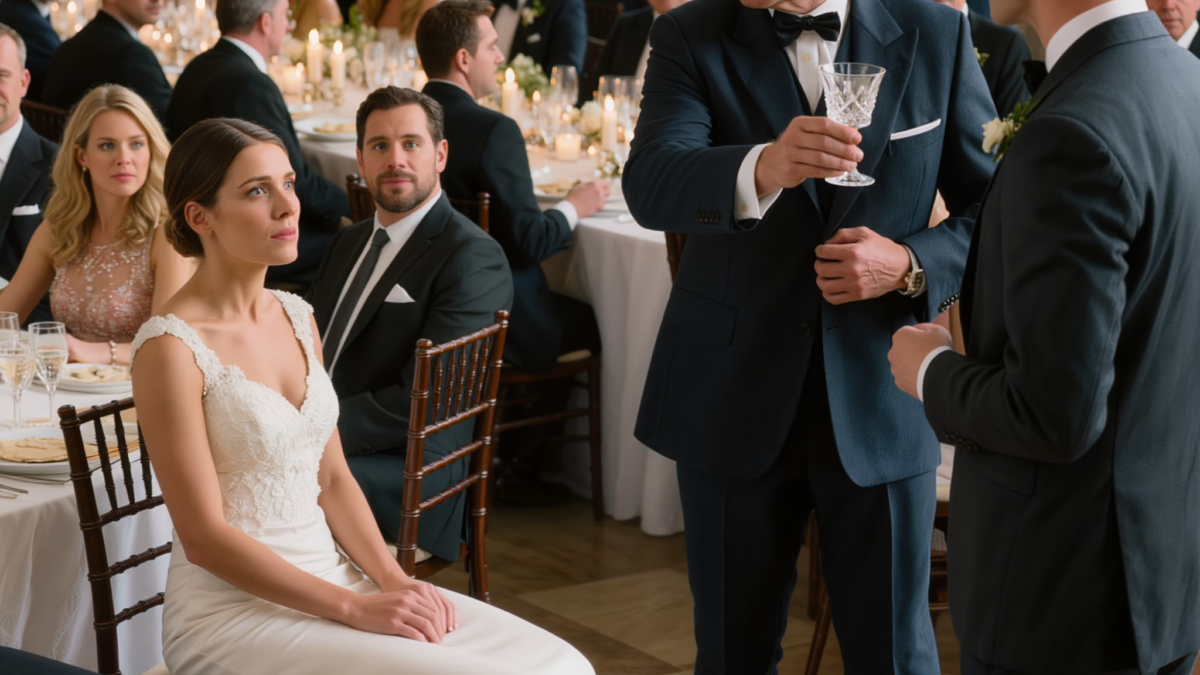
There were 90 guests in the room. I was still in my white dress. Dad stood near the head table with one of his heavy crystal glasses raised in his hand.
All evening, he had found ways to mention my younger stepsister, Bianca. Stanford. The firm. The corner office. Every detail of her life sounded like another item on a résumé he was proud to display.
Then he looked at my husband.
“A toast to the daughter who settled for a warehouse clerk.”
He smiled as he said it.
The room laughed on cue.
Not everyone. But enough.
I stayed where I was. I had spent most of my life learning how to sit still when my father made me feel small.
Then Cole pushed back his chair.
He stood, buttoned his jacket, and looked across the room at my father.
“One question,” he said, “for the father of the bride.”
His voice was quiet, but final.
My father’s face changed.
The glass slipped from his hand and shattered on the marble floor.
For three years, he had been hoping no one would ever ask the question Cole was about to ask.
My name is Darcy. I was 31 years old, and the man my father had just dismissed as a warehouse clerk was the only person in that room who knew how much of my life had been built around something that wasn’t true.
To understand why one broken glass silenced an entire reception, you have to understand the woman my father had spent decades teaching me to become.
The morning of my wedding, I did what I always did when I was nervous.
I made a list.
I stood in the small bridal suite at Beldin Hall wearing a robe, my hair half pinned, and wrote the schedule on a hotel notepad as if I were preparing a case file.
Ceremony at 4:00.
Photos at 4:30.
Dinner at 6:00.
Toasts after the first course.
I underlined “toasts” twice.
At the time, I had no idea how much I would come to hate that word.
Cole found me standing over the notepad.
He wasn’t supposed to see me before the ceremony, so he knocked twice, cracked the door open, and kept one hand over his eyes.
“I’m not looking. I promise.”
I laughed for the first time that morning.
He had brought me coffee the way I liked it, which barely qualified as coffee because it was mostly milk. He set the cup on the vanity without peeking.
“Whatever happens today, you know I’ve got you, right?”
“Of course.”
I meant it.
What I didn’t hear was the warning underneath his question.
By then, Cole had already been carrying something for weeks.
I thought he was nervous about the wedding.
I was wrong.
Before that day, I had spent most of my life being described as quiet, practical, reliable, and easy to manage.
When I was a child, the family joke was that Bianca was the star and I was the stage manager.
Bianca got the spotlight.
I got the clipboard.
For years, I assumed that was simply who I was. Some people were meant to be seen, and other people were meant to keep everything running.
I was the second kind.
At least, that was what my father taught me.
He never shouted those lessons.
That was what made them so effective.
He delivered them gently, the way someone might hand you a coat because he was worried you were cold.
Even now, I don’t think Gerald Vance was a monster in any simple sense.
He showed up.
He paid for braces.
He drove me to community college every fall for four years and told people how proud he was of me.
His cruelty was rarely obvious because it arrived wrapped in provision.
He gave you the coat, and that made it easier to forget that he was often the reason you felt cold in the first place.
My mother left when I was 12.
I don’t pretend to understand every part of what happened between my parents. Children experience the weather of a divorce, not the map.
But I remember the morning after she left.
Dad sat at the kitchen table with both hands flat against the wood and barely moved for what felt like an hour.
I remember looking at him and deciding, in the absolute way children make promises to themselves, that I would never do that to him.
I would never be the one who left.
I built my life around that promise.
My father knew it.
For the next 20 years, he knew exactly how to use it.
When I was 24, a larger firm in the city offered me a job.
It meant a better title, better pay, and an actual path upward.
I was thrilled.
The first thing I did was drive to my father’s house and tell him.
I watched his face warm on the surface while something underneath it seemed to cool.
He didn’t tell me not to take the job.
He asked questions.
Who would look out for me in the city?
Did I really think I would thrive somewhere that competitive?
Would a firm that didn’t know me care about me the way Ruth and the people at my current firm did?
Family was worth more than a title, he said.
By the time I left his kitchen, I had talked myself out of the opportunity.
I had done it in my own voice.
That was my father’s real talent.
He rarely had to forbid me anything.
He made the smaller choice feel wise and the larger one feel selfish or vain. Then he let me close my own door and hand him the key.
I turned the job down the next morning.
I told the recruiter I was needed where I was.
I believed it.
Dad had remarried when I was 15.
My stepmother, Corali, had a laugh that always seemed to last half a second too long. She also had a daughter, Bianca, who was three years younger than me.
My father took to Bianca immediately.
She was going to be somebody.
She was going to have the career.
She was going to have the impressive life.
I was going to be reliable.
That was my role.
I played it so well that eventually I forgot it was a role.
It took me 31 years and one broken crystal glass to understand the difference.
I wasn’t less capable than Bianca.
I had been managed.
Three years before my wedding, I sat for the bar exam.
Getting to that exam had taken me years.
I hadn’t gone to a prestigious law school. At 18, I had wanted to leave for school badly enough that even admitting it embarrassed me.
But the money wasn’t there, and the doors I thought might open for me never seemed to.
So I went to community college.
Then I attended a state school at night.
I worked during the day, first as a filing clerk, then as a legal assistant, and eventually as a paralegal at a small firm called Harmon and Ren.
Somewhere in those years of night classes, long workdays, and weekend studying, I completed a law degree part-time.
It took five additional years after earning my bachelor’s degree.
I graduated at 27 with a JD I had paid for one class at a time.
Then I studied for the bar during lunch breaks.
That July, I took the exam.
The result was sent by certified mail to the address on my application.
In 2023, that address was still my father’s house.
I had never quite gotten around to changing it.
Maybe part of me had never completely left.
I never saw the letter.
Three weeks later, Dad asked me to sit with him at the same kitchen table where he had sat after my mother left.
He told me the results had arrived.
I hadn’t passed.
He used the gentlest voice he had.
He said he was sorry.
Maybe law wasn’t my path.
There was no shame in staying where I was useful.
Harmon and Ren was lucky to have me.
Some people ran the place, he said. Other people kept the lights on.
There was dignity in keeping the lights on.
I believed him.
Why wouldn’t I?
He was my father.
He had driven me to campus year after year.
I had no reason to think he would lie to me about something that important.
I never retook the exam.
I couldn’t afford another attempt financially, and I couldn’t imagine surviving another emotionally.
The failure had cracked something in me.
I put my JD in the bottom drawer of my dresser under my winter sweaters.
After a while, I stopped telling people I had a law degree at all.
Saying it out loud made me feel ridiculous.
A law degree without a license felt like an expensive story about a person I had almost become.
The hardest part wasn’t one dramatic loss.
It was what happened every day afterward.
I was good at legal work.
More than good.
At Harmon and Ren, I drafted motions that attorneys signed. I noticed issues other people missed. Clients sometimes thanked me at the end of a case and asked where I had gone to law school.
I would laugh lightly and say, “Oh, I’m just the paralegal.”
Then I watched them mentally move me from counsel to help.
I trained two associates who were later promoted above me.
I knew I could out-argue both of them.
Still, I told myself that this was simply the natural order.
Some people ran the place.
Some people kept the lights on.
I had a JD hidden beneath winter sweaters while I performed a lawyer’s work for a fraction of a lawyer’s pay and none of the professional standing.
Every day, I made a little more peace with it.
That was what my father’s lie really cost.
Not one dramatic moment.
Three years of small decisions that eventually began to look like contentment.
So when people wondered why I had “settled,” they misunderstood something important.
I hadn’t settled for Cole.
I had been taught to settle long before I met him.
My father had spent years measuring me for a smaller life, then stood at my wedding and mocked me for fitting into it.
I met Cole in 2024.
He disrupted my father’s entire system without even knowing the system existed.
We met at Meridian, a record storage and shredding facility near the county line. Harmon and Ren sent closed case files there for secure destruction.
I had gone out to sign paperwork for a bonded destruction order.
Cole handled the intake.
He was tall, unhurried, and had grease on one knuckle.
What I remember most was the way he read the manifest.
Carefully.
He caught an error in the file numbers that could have caused problems later.
He didn’t announce that he had saved anyone from a mistake.
He fixed it, slid the clipboard back to me, and asked, “You want the copy or should I email it?”
Nothing dramatic happened.
I didn’t fall for some grand gesture.
I noticed a man who read the fine print for a stranger because it was his job and because doing it correctly mattered even when no one was watching.
In my family, people behaved differently depending on who was watching.
Cole didn’t.
It took me time to understand how rare that was.
My family understood almost immediately that they didn’t like him.
The first time I brought him to dinner, Dad shook his hand.
“Meridian, huh? Good honest work.”
His tone was the kind someone might use to praise a dog for learning a trick.
Bianca asked what Cole did.
When he explained that he ran the intake dock, she said, “Oh, like the loading.”
Then she let the comment sit.
Corali asked whether the shredding machinery was loud and gave that slightly too-long laugh.
Dad watched me through the whole exchange.
He was waiting to see whether I would become embarrassed.
If I was embarrassed by Cole, then my father’s view of the world still worked.
I wasn’t.
That was what unsettled him.
For the first time in my adult life, I had found something he couldn’t make me feel ashamed of.
Things got worse at Thanksgiving.
Dad seated Cole at the far end of the table and spent most of dinner narrating Bianca’s year as if he were reading a shareholder report.
The promotion.
The condo.
The partner track.
Eventually, the conversation reached Cole.
Dad asked him, with everyone listening, whether he worried about job security in the shredding industry now that everything was going digital.
The question was meant to land.
Cole set down his fork.
He explained that companies would need secure destruction of sensitive records for as long as sensitive records existed. The work was bonded, steady, and honest. He liked being able to say exactly what he had done at the end of the day and for whom.
Then he asked Dad a sincere question about the insurance business.
Dad started talking.
The moment passed so smoothly that half the table probably never realized an insult had been attempted.
I watched my father discover that he had swung at someone who refused to swing back.
He hated that.
A bully needs a reaction.
Cole rarely gave him one.
Driving home that night, Cole didn’t mention the exchange.
I did.
He shrugged.
“He’s scared of something. Scared people throw the first punch.”
I didn’t yet understand what my father was afraid of losing.
Cole proposed in the summer of 2025 in the parking lot of a diner.
There was no elaborate setup.
No rehearsed speech.
He held the ring in his palm and started talking about how he had never once had to guess where he stood with me.
I said yes before he finished.
Driving home that night, I felt something I hadn’t felt in years.
My life might actually belong to me.
I told Dad the next morning.
He was silent for several seconds.
“Well, I suppose we can make it nice.”
Not congratulations.
We can make it nice.
As if the wedding were a problem to be managed.
As if Cole were a stain that could be hidden by arranging the furniture correctly.
Then my father’s machinery started up again.
He offered to pay for the venue.
If you didn’t grow up the way I did, that probably sounds generous.
But in my family, money rarely came without a string attached.
A man who paid the deposit could influence the guest list, the seating chart, the schedule, and, eventually, the microphone.
Dad chose Beldin Hall.
Once the deposit was paid, he stopped asking and started informing.
Several of his business associates had to be invited because appearances mattered in a town this size.
The head table needed to seat family.
When I pointed out that Cole’s mother was family, he allowed a long silence to form and then changed the subject to flowers.
Without telling me, he instructed the venue coordinator to route vendor questions through him.
Every decision seemed to drift toward his hands.
Each time I noticed it happening, the old training returned.
Keep the peace.
It was only seating.
Only flowers.
Only a schedule.
I told myself I was being gracious.
What I was actually doing was what I had done all my life.
I was mistaking control for care and surrender for maturity.
I almost stopped it.
One night, I sat across from Cole at our kitchen table.
“We can do it ourselves,” I said. “Smaller. We don’t need his money.”
Cole watched me for a long moment.
Then he said something I wouldn’t understand until later.
“Let him host it. Let him stand up in that room. Trust me, you’re going to want him in that room.”
I thought he meant that a father should be present for his daughter’s wedding no matter how difficult he could be.
“Okay.”
I let Dad pay for the room.
I had no idea that Cole was already holding the thing that would eventually break my father’s control over it.
In the weeks before the wedding, Cole became quiet in a different way.
Not cold.
He was never cold.
But sometimes I would find him standing at the kitchen counter late at night, thinking.
Once, I came home early and saw him close a drawer too quickly.
I assumed it was wedding nerves.
The truth was that I had spent my entire life avoiding difficult questions inside my own family. In my father’s house, asking hard questions was how you started a fire.
I had been trained not to look directly at things that frightened me.
That training cost me another two weeks.
Meanwhile, the family carried on as usual.
One night, Corali called while I was washing dishes.
She wanted to know whether we really needed to invite Cole’s mother’s entire side of the family because there were quite a lot of them and they were “not really our crowd.”
I dried my hands.
I told her they were invited.
There was a pause.
“Well, it’s your father’s money, Darcy, so it’s really his call, isn’t it?”
I could hear the smile in her voice.
I said good night.
The next weekend, Cole went to Dad’s house to help move boxes.
Dad was clearing out his home office.
There were about a dozen banker’s boxes in the garage, taped shut and labeled in his neat handwriting.
Old files.
Tax records.
Several boxes simply marked MISC.
Dad was sending them to Meridian for destruction, the same bonded shredding service his insurance office had used for years.
The same facility where his future son-in-law worked.
Dad knew exactly where Cole worked.
He simply didn’t consider him important enough to worry about.
Cole loaded the boxes.
Dad supervised from a lawn chair with a glass of iced tea while talking about Bianca’s latest promotion.
Cole didn’t think anything of it.
There was no reason to.
Four days later, one of those MISC boxes reached the intake dock.
Meridian’s bonded destruction process required each load to be logged, weighed, and reconciled against a manifest before being sent through the shredders.
If an employee found certain personal documents or misdirected materials, including things like passports, birth certificates, or unopened certified mail, company policy required the item to be pulled and flagged.
Near the bottom of one MISC box from the Vance account, Cole saw a cream-colored envelope.
He almost missed it.
The line was backed up.
It was late.
His back hurt.
A newer worker had already started moving boxes ahead.
Cole later told me he nearly waved the box through.
Then the envelope slid sideways.
The dock light caught the green certified-mail sticker.
Cole stopped the line.
He pulled the envelope out.
Thirty seconds sooner, and it might have disappeared into the shredders.
Instead, he read the front.
The envelope was sealed.
The green and white certified-mail sticker was still attached.
The perforated receipt was still there.
No one had signed for it.
It was addressed to Darcy Vance.
My maiden name.
The return address was the State Board of Bar Examiners.
The postmark was three years old.
Cole stood on the intake dock with the shredders roaring behind him and held a sealed letter from the bar examiners addressed to his fiancée.
A letter I had told him contained the worst professional news of my life.
Except I had never seen it.
It had never been opened.
And it had arrived at Meridian inside a box my father had personally packed and paid to destroy.
Cole didn’t open it.
That matters to me more than almost anything else in this story.
He followed procedure, pulled the envelope from the destruction stream, flagged it, and kept it safe.
Then he carried it for two weeks before he showed me.
That was the weight I had seen in him.
That was the drawer he had closed too quickly.
Later, he told me what those two weeks had felt like.
He knew that once he gave me the envelope, there would be no way to put the knowledge back.
He wondered whether it was his place.
Whether knowing would destroy my family.
Whether ignorance might somehow be kinder.
At one point, he even carried the letter outside and stood near the burn barrel because part of him wondered whether making it disappear would spare me whatever came next.
He couldn’t do it.
If the situation had been reversed, he said, he would have wanted the truth handed back to him no matter how heavy it was.
A person couldn’t choose a life honestly if that life had been built on information they had never been allowed to see.
So one Tuesday night, he put two cups of tea on the kitchen table.
He laid the envelope face down beneath his hand.
Then he waited for me to come home.
I walked in exhausted from a day spent handling other people’s paperwork.
I saw his expression.
“What happened?”
He turned the envelope over and slid it across the table.
Seeing my own name printed on it was one of the strangest moments of my life.
Darcy Vance.
State Board of Bar Examiners.
Three years old.
Sealed.
“Cole.”
My voice didn’t sound like mine.
“Where did you get this?”
“Your dad’s boxes. The MISC ones. It was at the bottom.”
He paused.
“Darcy, it’s never been opened.”
I picked it up.
It weighed almost nothing.
It felt impossibly heavy.
I turned it over.
The flap was intact.
The adhesive had yellowed slightly with age, but the envelope was still sealed.
The certified receipt remained attached and unsigned.
Somewhere in an official record, that letter had been sent to me and never claimed.
For three years, I had believed what it supposedly contained without ever touching it.
I couldn’t open it.
People later told me they would have torn it open immediately.
Maybe they would have.
But opening it meant accepting one of two possibilities.
If the letter said I had failed, then my father’s version of my life remained intact.
I could return to the small peace I had built around it.
But if the letter said anything else, then Dad had done something so large that I didn’t yet know how to hold it.
I sat at my own kitchen table, a grown woman with a law degree hidden under winter sweaters, afraid of a paper envelope.
I set it down.
That night, I didn’t open it.
Around 2:00 in the morning, I got out of bed without waking Cole.
I went back to the kitchen and sat beneath the small light over the stove.
I held the envelope toward the bulb like a child trying to see through a birthday card.
I could make out the shape of a folded sheet inside.
Nothing else.
My thumb found the edge of the flap.
I pressed lightly.
The old adhesive gave a little.
I stopped.
I put the letter in the drawer with the takeout menus and went back to bed.
I lay awake thinking that maybe it meant nothing.
Maybe it was a late notice.
Maybe I was about to tear my entire family apart over a letter that would only confirm what I already believed about myself.
People who have been managed instead of raised often learn to search for the version of events where everything is still their own fault.
At least that version feels familiar.
The next morning, Cole didn’t pressure me.
He made coffee.
“You don’t have to open it,” he said. “But you can find out another way. You don’t need his letter to know your own result.”
Slowly, I understood.
The envelope contained one copy of a fact.
The fact itself existed somewhere else.
In an official record under my name.
Somewhere my father’s hands had never been able to reach.
I didn’t call the board myself.
My hands weren’t steady enough.
Instead, I went to Ruth Harmon.
Ruth was 60 and had founded Harmon and Ren, the firm where I had spent years helping other people pursue justice.
More than once, she had told me in her dry way that I was the best paralegal she had ever had and the biggest waste of one.
I always thought she was being kind.
That Thursday, I walked into her office and closed the door.
I almost never closed her door.
I placed the sealed envelope on her desk and told her everything.
The exam.
My father.
The kitchen table.
The life I had built over the previous three years.
Ruth listened without interrupting.
Then she studied the envelope.
She didn’t touch it.
“You don’t open a document like this alone,” she said. “And you don’t open it first. You verify the underlying fact and then you open it, so no one, not your father, not anyone, can tell you the letter is fake or mistaken. We do this the way we do it for a client.”
Then she picked up her phone.
Ruth had practiced law longer than I had been alive.
She called the Board of Bar Examiners, gave them my name, my maiden name, and the year of my examination, and asked for confirmation of the result of record.
It took nine minutes.
I know because I watched the clock.
Eventually, Ruth wrote something on a legal pad.
She thanked the person on the phone and hung up.
Then she turned the pad toward me.
She understood that I needed to read the result for myself.
Passed.
July, three years earlier.
Eligible for admission.
Oath not yet taken.
I had passed.
The first time.
I had passed while standing in my father’s kitchen and listening to him tell me I had failed.
The sealed letter on Ruth’s desk was not the worst news of my professional life.
It had contained the best.
I didn’t cry.
I didn’t do anything dramatic.
I sat there while three years of decisions rearranged themselves behind me.
The job I had never left.
The degree in the bottom drawer.
The practiced way I said, “I’m just the paralegal.”
Every piece of it rested on one sentence my father had delivered gently across a kitchen table.
Ruth let the silence stay.
Then she said something that changed the direction of everything.
“Darcy, a person doesn’t hide a letter like this once and stop. Hiding is a habit. I want you to think carefully about whether this is the first door your father ever closed on you.”
I thought about being 18.
That year, I had applied to a university two states away with a pre-law honors program.
It had felt like a doorway into a much larger version of my life.
I filled out the application at the kitchen table.
That table again.
I told Dad about it.
He nodded and said we would see what we could do.
That spring, nothing arrived.
No letter.
No email I could find.
When I asked, Dad told me I hadn’t been accepted.
Programs like that wanted students with connections, he said.
There was no shame in staying close to home and being practical.
Some people ran the place.
Some people kept the lights on.
For 13 years, I carried the belief that I simply hadn’t been good enough.
I built an entire smaller life around it.
Community college.
Night classes.
Studying during lunch breaks.
The long route to a degree that another opportunity might have made easier.
Sitting in Ruth’s office with proof that I had passed the bar, I finally made a call I had been too afraid to make at 18.
I contacted the university.
It took two days and three transfers, but eventually a patient woman located the old admissions record.
I had been accepted.
I had also been offered a merit scholarship substantial enough to cover most of the cost.
The offer had been mailed to my home.
It required a signed acceptance by a deadline.
No acceptance had ever been returned.
I needed someone else who had been there.
Someone whose memory I trusted.
So I called my aunt Meredith, my mother’s younger sister.
She had never completely accepted the family’s version of me.
We met at a coffee shop near the highway.
I asked what she remembered about the spring I was 18.
She became quiet.
Then she told me something I had never known.
That spring, she had asked my father whether I had heard from the university because she remembered how badly I wanted to attend.
Dad told her I had changed my mind.
He said I had chosen to stay local.
He said I wasn’t ready to live that far from home.
She believed him.
Everyone did.
That was the point.
“Darcy,” she said, both hands around her cup, “he told me you chose it. All these years, I thought you chose it.”
I watched another person rearrange my past in her mind.
Dad had not only lied to me.
He had given everyone else a version of my decisions that made the smaller life look self-selected.
He hadn’t just closed the doors.
He had told people I closed them myself.
Twice.
Once when I was 18.
Again when I was 28.
Two doors that could have changed the shape of my life.
Both times, my father stood on the other side and quietly turned the lock.
Then he looked at the life I lived afterward and called it my nature.
That was when grief began turning into something more useful.
A question.
Who else knew?
I learned something about Corali almost by accident.
I went to Dad’s house under the excuse of returning a serving dish.
I needed to stand in that house again with different eyes.
Corali was in the kitchen.
We made small talk.
Then I said, as casually as I could, “You know, I’ve been thinking about going back for the bar. Retaking it.”
I watched her face.
I had spent years reading that expression for changes in family weather.
For half a second, before her practiced smile returned, she looked afraid.
“Oh, honey, why put yourself through that again?”
The answer came too quickly.
Then her eyes moved briefly toward my father’s office.
The room where the boxes had been.
I didn’t know exactly what she knew.
I didn’t know whether she understood every detail.
But she knew there was something about the bar exam my father wanted protected.
Her instinct was to protect him.
Over the next several days, I reread my own life.
The science fair I never entered because Dad said the travel would be too much.
The internship I didn’t apply for because it was unpaid and, according to him, impractical.
The promotion I turned down.
The job I stayed in.
I noticed something I had never allowed myself to see before.
Dad had always been warmest toward me immediately after I chose to become smaller.
A dream set aside.
An opportunity refused.
A door closed.
I had interpreted that warmth as love.
Maybe some of it was.
But I had built an entire identity around earning it.
The hardest part wasn’t anger.
It was grieving all the versions of myself I would never meet.
The person who might have attended that university.
The person who might have become a lawyer three years earlier.
You don’t get those people back.
All you can do is stop creating new smaller versions of yourself.
Three weeks before my wedding, I knew several things.
I had passed the bar.
My father had hidden that result from me.
Years earlier, another opportunity had disappeared before it reached my hands.
My stepmother knew at least enough to become nervous when I mentioned retaking the exam.
And the original bar letter was still sealed in my kitchen drawer beside the takeout menus.
I had a choice.
I could handle everything quietly.
I could open the envelope, complete the admission process, become a lawyer, and never say a word to Dad.
Cole told me more than once that he would support whatever I decided.
The quiet option was there.
It was safe.
It was exactly what the old version of me would have chosen.
Absorb the damage.
Protect the peace.
Keep the family weather mild.
But I kept remembering all the rooms where my father had made me small in front of other people.
His power over me had never been entirely private.
He told other people I had settled.
He told them I was practical.
He told them I knew my limits.
The story of my smallness became public property.
He had built his version of me out loud.
I began to believe that the truth had to be spoken out loud too.
Cole and I sat at the kitchen table.
I told him what I wanted to do.
Part of me expected him to talk me out of it.
Instead, he became very still.
“Okay,” he said. “But we do it clean. No ambush of the truth. The truth doesn’t need an ambush. You let him stand up and be exactly who he is, and then you let the room see what he hid. That’s not revenge. That’s just turning the lights on.”
A man my father considered beneath him had just described justice more clearly than almost anyone I knew.
We made two rules.
First, I would not open the letter until the room could witness it too.
No one would be able to claim I had forged it or misread it.
Second, I would not raise my voice.
Whatever happened, I wanted to remain calm.
We practiced.
Not a script.
Just the shape of the moment.
Cole would ask the question.
I would practice keeping my hands still.
I imagined reading the word “congratulations” without letting my voice break.
Once, Cole worried that I was trying too hard not to feel anything.
“You don’t have to be a machine about it. You’re allowed to feel it.”
I told him the truth.
The calm wasn’t numbness.
It was ownership.
For years, my father had watched for the reaction after one of his comments.
The fallen face.
The swallowed hurt.
The visible proof that his words had landed.
I no longer wanted to perform my pain for him.
Then I did the thing that frightened me most.
I went back to Ruth and began the paperwork for admission to the bar.
Three years late.
Under my own name.
Ruth witnessed the documents.
She didn’t say anything sentimental.
That was how I knew she was proud.
She filed them.
For the first time in 13 years, machinery my father had interrupted began moving again.
On the surface, the next three weeks looked ordinary.
I planned a wedding at a venue my father had paid for.
I attended the tasting.
I listened while Dad told the caterer that Bianca would have chosen something more sophisticated.
I smiled and said the chicken was fine.
Inside, a countdown was running.
Ruth had already cleared a desk for me.
Before I had even taken the oath, she walked me down the hall to a small office with a window.
“This is yours,” she said. “Not the paralegal station. This one.”
I stood in the doorway and almost came apart.
For three years, I had been telling myself I was fortunate to have the desk I had.
Now someone who had known my abilities longer than I had believed in them myself was giving me a room I had already earned.
Ruth looked at me.
“Your father didn’t just steal a license, Darcy. He stole three years of your confidence, and that’s the harder thing to get back. The license we can fix in an afternoon. The rest is up to you.”
I carried that sentence with me through every remaining wedding appointment.
Dad seemed to sense something changing, even if he couldn’t identify it.
He announced at a family dinner that he would, of course, be giving a toast at the reception.
A father’s privilege.
Corali called it lovely.
Bianca said she couldn’t wait.
I watched Dad’s expression.
He was already writing the speech in his head.
He had no idea it would become the last time he got to define me publicly without being challenged.
Then he tried to silence someone else.
Cole’s mother, Ellen, was a widow who had raised him on a school cafeteria salary.
She was one of the warmest people I knew.
Cole and I wanted her to say a few words at the reception.
Dad found out through the venue coordinator.
He canceled her toast.
He didn’t tell me.
He simply informed the coordinator that the program was for family toasts and that the groom’s side could be acknowledged in the printed thank-yous.
When I confronted him, he remained calm.
Reasonable.
Warm.
He said he was trying to keep the evening elegant and on schedule.
Ellen would probably be relieved not to speak in front of a crowd anyway.
He had decided on her behalf that she wanted to be silent.
The move was familiar.
At 18 and again at 28, he had decided what I could handle and then arranged my circumstances around that decision.
Now he was doing it to someone else.
“Ellen will be speaking.”
Dad smiled.
“We’ll see.”
That night, my remaining uncertainty disappeared.
I had nearly convinced myself to swallow my own story one more time.
But watching him reach toward Cole’s mother the same way he had reached toward me made the pattern impossible to ignore.
About ten days before the wedding, I thought he might have discovered everything.
Dad called unexpectedly.
He wanted to know whether I had been out to Meridian recently.
My stomach dropped.
I kept my voice even.
“Why?”
Corali had apparently mentioned that a box might have disappeared from the garage before the pickup.
She thought she remembered 13 boxes.
Only 12 seemed to be there.
Dad wanted to make sure nothing personal had accidentally gone where it shouldn’t.
For a few seconds, I felt 18 again.
Caught.
Small.
Certain he could see straight through me.
Then I remembered that I was the one who knew the truth now.
He was guessing.
I said I had no idea.
Cole handled hundreds of boxes.
Dad shouldn’t worry about old paperwork.
There was a long pause.
“No, no. I suppose not.”
He let it go.
The possibility that the letter he thought was headed for destruction was sitting in my kitchen drawer was too large for him to consider seriously.
After the call, I stood in my kitchen with my heart racing and understood one of my father’s biggest blind spots.
He could not imagine that the people he had taught to feel small might one day stop behaving that way.
A week before the wedding, Bianca arrived uninvited at my dress fitting.
She wore a suit that probably cost more than my monthly pay.
She sat while the tailor pinned my dress.
“It’s sweet, you know, that you found someone who’s fine with the simple life. Not everyone needs the big career. Somebody’s got to keep things running.”
She smiled at me through the mirror.
The old version of me would have felt the comment burn and then thanked her for coming.
Instead, I looked at my sister.
Our father had held every door open for her because he needed one daughter to be a trophy and another to be a leash.
For the first time, I felt something other than resentment.
Grief.
She had been managed too.
Just in the opposite direction.
Neither of us had ever been fully seen.
“You’re right, Bianca. Somebody’s got to keep things running.”
I let her believe she had won the moment.
Two nights before the wedding, Dad hosted the rehearsal dinner at a steakhouse he liked.
He worked the table all evening, telling his edited version of my childhood.
The practical daughter.
The sensible one.
The one who always knew what she was.
He raised a glass and said he was happy I had found stability.
Everyone murmured politely.
Cole squeezed my knee beneath the table.
At one point, Dad leaned closer.
“You seem tense, sweetheart. Don’t be. Nobody’s expecting a big career out of you. Just be happy.”
He meant it as comfort.
That was what made it so difficult to hear.
Some of the smallest things my father ever said to me were offered as kindness.
I smiled and thanked him.
Under the table, I pressed my thumbnail into my palm to keep my expression steady.
Across the room, Ruth caught my eye and gave the smallest nod.
Steady.
We were ready.
The night before the wedding, Dad almost changed my mind.
He asked me to come to the house alone.
Just the two of us before the big day.
I went because some habits take longer than three weeks to unlearn.
Part of me was still the 12-year-old girl who had promised never to leave him.
We sat in his study.
The MISC boxes were gone.
Destroyed, he believed.
He poured two glasses of the good bourbon he saved for special occasions.
For once, he seemed almost tender.
He told me he was proud of me.
He admitted that Cole seemed like a good enough man.
Then he said that after the wedding, once everything settled, he might make a few calls.
He still knew people at some “real firms” in the city.
Maybe it wasn’t too late for me to do something more than filing if I was willing to be reasonable and not make things difficult.
I recognized the move immediately.
He was dangling another door in front of me.
A larger life, but only if I accepted it from his hand.
For about 90 seconds, it worked.
Sitting in that study, surrounded by the familiar furniture and my father’s rare warmth, I felt the plan wobble.
Maybe I could take the quiet route.
Get admitted.
Let him make his calls.
Let him believe he had given me the career he had actually delayed.
Keep the family.
Keep the peace.
Keep the lights on one more time.
He had been doing this for 31 years.
He was very good at it.
I looked down at the crystal glass in my hand.
I thought about the sealed certified letter under the stove light at 2:00 in the morning.
Then I thought about Cole standing on the loading dock with my real life in his hands and refusing to open it because it belonged to me.
Two men.
Two ways of holding something precious that belonged to someone else.
One hid it and called it protection.
The other carried it home and gave it back.
I set down the bourbon without drinking it.
“Thank you for the room, Dad. It’s going to be a night no one forgets.”
He smiled.
He mistook the sentence for surrender.
He had mistaken much of my life for the same thing.
As I was leaving, I passed the kitchen and heard Corali speaking to Bianca on the phone.
She didn’t know I was nearby.
“Well, thank God she’s marrying the warehouse boy and not causing a fuss. Your father was worried she’d embarrass us. Some people just aren’t built for more, and it’s a blessing when they finally accept it.”
Some people just aren’t built for more.
Thirteen years after a scholarship offer disappeared inside that same house, those words stopped feeling like a wound.
They became fuel.
I walked to my car in the dark.
I was ready.
The morning of the wedding, I made my list.
Ceremony at 4:00.
Photos at 4:30.
Dinner at 6:00.
Toasts after the first course.
Under the word “toasts,” where no one else would see it, I wrote one word.
Calm.
Cole came to the bridal suite one more time.
He kept his eyes covered.
“You still sure?”
He wasn’t asking about the marriage.
“I am.”
“Whatever he says up there tonight, remember, he’s not describing you. He’s describing the daughter he needed you to be. Two different people. Only one of them is in this room.”
Then he left.
I finished getting ready wearing my mother’s borrowed pearls.
When I looked in the mirror, the woman looking back at me no longer seemed to be waiting for someone else to tell her who she was.
The ceremony itself was small and good.
Some parts of it belong only to us.
Cole’s hands were steady when mine weren’t.
When the officiant asked whether I took him as my husband, I said yes with more certainty than I expected to hear in my own voice.
Dad sat in the front row beside Corali.
For the first time, I understood the expression on his face.
He wasn’t simply watching a wedding.
He was calculating how much control he still had.
He had paid for the room.
In his mind, the room still belonged to him.
Dinner came.
Then the first course.
Then the toasts.
Dad stood and cut the music.
He took the microphone.
Beldin Hall had a long reception room with high windows and a marble floor. Dad had specifically liked the floor because, in his words, it photographed like money.
Ninety guests sat at round tables surrounded by candles.
At the head table sat the heavy crystal glasses my father had insisted on bringing from home because the venue’s glassware wasn’t quite right.
He wanted even the glasses to belong to his version of the evening.
The first hour had actually been beautiful.
A good band.
Candles.
My aunt Meredith crying happy tears.
Ellen wearing a blue dress she had clearly saved for the occasion and holding my hand a little longer than necessary as she told me she had never seen her son look so happy.
Dad moved from table to table accepting congratulations.
I felt the countdown running underneath everything.
Cole found me near the cake.
He didn’t speak.
One look was enough to bring the sealed envelope back into my mind.
I nodded.
Across the room, Ruth placed her water glass down in the particular way we had agreed on.
She was ready.
Then the band stopped for the toasts.
Dad walked toward the head table.
He picked up his crystal glass.
Here it comes, I thought.
He tapped the glass with a knife until the room quieted.
Then he took the microphone and stood there in his good suit, allowing the silence to stretch.
My father understood that a large part of power was simply making people wait for you.
“I want to say a few words about my daughter.”
He smiled around the room.
Corali beamed.
Bianca raised her glass early.
“Darcy has always been my practical one, my sensible one. While her sister was off collecting degrees…”
He nodded toward Bianca.
“…Darcy kept her feet on the ground. She knew her limits, and there’s a dignity in that.”
He paused.
He was enjoying himself.
I could see the same system I had lived inside for years operating in real time.
“So tonight I want to raise a glass to the daughter who didn’t reach too high, to the daughter who settled.”
Then he looked directly at Cole.
“For a warehouse clerk, and who I’m sure will be very comfortable.”
The room laughed.
Not everyone.
Enough.
It was nervous, obedient laughter, the kind people offer because the host has made a joke and no one wants to be the only person who doesn’t react.
Corali’s laugh lasted slightly longer than everyone else’s.
Bianca hid a smile behind her glass.
I sat in my wedding dress and felt 90 pairs of eyes move toward me.
People were waiting to see how I would react.
That was the ending Dad expected.
I would absorb the insult.
Smile.
Prove that he still understood exactly who I was.
Instead, I felt calm.
Calmer than I had ever felt in my father’s presence.
For the first time in 31 years, I knew something he didn’t.
I looked at the crystal glass raised above the room and thought, with a strange kind of tenderness, that he had no idea how much had already changed.
Cole placed his napkin on the table.
He stood.
Slowly.
He buttoned one button of his jacket.
Then he turned toward the room.
“Before anyone drinks to that, I have one question for the father of the bride.”
Dad’s smile remained on his face.
But something behind it disappeared.
“Well,” Dad said into the microphone, playing to the audience, “the warehouse has questions. Go ahead, son.”
Cole didn’t react.
He looked directly at my father.
“Can you explain to the room why you kept a certified letter from the State Board of Bar Examiners, addressed to your own daughter, sealed and unopened for three years in a box you paid to have destroyed?”
For the rest of my life, I will remember the next two seconds.
My father’s face came apart all at once.
The color drained from it.
His mouth opened.
Nothing came out.
Then the heavy crystal glass slipped from his fingers.
It struck the marble between our tables and shattered.
The sound cut through the entire room.
Every remaining laugh disappeared.
No one needed an explanation to understand that something had just gone very wrong.
“Darcy…”
Dad’s voice had gone higher.
He had forgotten that he was still holding the microphone, so his panic carried across the hall.
“Darcy, I don’t… I don’t know what this is. Your husband is confused.”
“He’s not confused.”
I stood.
I didn’t need a microphone.
A quiet voice travels surprisingly well when a room is holding its breath.
“He works at Meridian, Dad. The bonded destruction company you’ve used for years. The one you sent your MISC boxes to last month to be shredded.”
I let the words settle.
I watched my father calculate how the envelope had traveled from his garage into that room.
“He found your certified mail. My certified mail. And he brought it home. It’s still sealed, Dad. Which is the interesting part, because you told me what it said.”
Ruth stood from the third table.
She had agreed to be part of this moment.
She was a guest, but she was also an attorney, and I wanted someone there who could make it difficult for anyone to later dismiss the letter as a stunt.
She walked toward us holding the cream-colored envelope.
Three years old.
The green certified sticker still attached.
The perforated receipt still unsigned.
She held it up.
“I’m an attorney. This envelope has never been opened. I’d like the room to witness the daughter open it now, so there’s no question about what it says.”
Then she handed it to me.
I opened the letter for the first time in front of 90 people.
Three years and one lifetime late.
My hands were steady.
I unfolded the page.
Official letterhead.
State Board of Bar Examiners.
I read aloud.
“Dear Ms. Vance, congratulations. We are pleased to inform you that you have passed the bar examination administered in July.”
I looked up.
Dad had one hand braced against the head table.
“It goes on,” I said. “But that’s the sentence.”
I had passed the first time.
Three years earlier.
While my father sat across from me at his kitchen table and told me I had failed.
While he told me some people were meant to keep the lights on.
While he told everyone else that I had settled.
The room didn’t laugh anymore.
“I didn’t settle for a warehouse clerk.”
I looked at Cole.
For the first time that evening, my voice softened.
“I married the one person who handed me the truth instead of hiding it. My father hid it. My husband carried it home.”
But the bar letter wasn’t the only door.
“And this isn’t the first letter he hid.”
I told the room about the university.
How I had applied at 18.
How I had been accepted.
How I had been offered a merit scholarship that would have covered most of the cost.
How the acceptance materials went to my father’s house and never reached me.
How no signed acceptance was ever returned.
Two letters.
Ten years apart.
Both telling me that I was capable of more than my father wanted me to believe.
Both disappearing at his address.
I watched the meaning move through the room.
Dad had invited several business associates because appearances mattered to him.
Now those same people sat very still.
Neighbors who had heard him tell the story of his practical daughter for years looked from him to me.
Aunt Meredith was crying again, but these tears were different from the ones she had shed during the ceremony.
She nodded at me hard.
Dad had built his version of me in public.
Now the same public was watching it fall apart.
Then Corali stood.
I think she meant to defend him.
Maybe the family.
Maybe herself.
“Now, that is not fair, Darcy. Your father did what he thought was best for this family. You don’t understand the position he was in.”
The entire room turned toward her.
I watched her realize what she had just said.
Trying to defend him had revealed that there was something she believed needed defending.
“Corali,” I said quietly. “You knew.”
She opened her mouth.
Nothing useful came out.
Her eyes filled.
“I never wanted… It wasn’t my place. He’s my husband.”
Then she sat down.
She didn’t apologize.
Not that night.
Not later.
The closest she ever came was saying, “He’s my husband,” as if being married to someone could erase the difference between protecting them and helping them hide what they had done.
Bianca remained seated.
Her glass sat untouched in front of her.
She looked at me.
For one moment, something crossed her face that I had never seen before.
Understanding.
Maybe fear.
If the story Dad told about me had been false, then perhaps the story he had told Bianca about herself was not entirely hers either.
She had been the trophy.
The favorite.
The child with every door held open.
That could be its own kind of cage.
For a moment, I thought she might stand.
She didn’t.
She looked down at her glass.
But she didn’t lift it again.
That was enough for me.
My father eventually found his voice.
It wasn’t an apology.
People who have built their lives around control often explain themselves when the control fails.
They accuse.
They defend.
They describe their own fear.
Dad did all three.
“You don’t understand.”
He had set down the microphone by then, but the room remained quiet enough to hear him.
“You don’t understand what it’s like. Your mother left. She walked out and she never looked back. And I had you, and you were going to leave too.”
He pointed toward nothing in particular.
“That school, you’d have gone two states away and you’d never have come back. And the bar, you’d have gone to some firm in the city and you’d have been gone. I kept you close. I kept this family together. Everything I did, I did so I wouldn’t lose you like I lost her.”
There it was.
The entire mechanism.
My father hadn’t done it because he hated me.
He had done it because he was terrified I would leave.
He had responded to that fear by making my life small enough that leaving became harder.
It was human.
Painfully human.
It was also something I could no longer accept.
Those two facts could exist together.
“I know you were afraid of losing me,” I said.
The room remained silent.
“But you didn’t lose me, Dad. You caged me. Then you stood up in this room tonight, in front of everyone I love, and called the cage my nature. You didn’t just take choices away from me. You made me thank you for the size of the life I had afterward.”
I looked around the hall.
Ninety people had arrived expecting a wedding reception.
Instead, they had watched the foundation of a family story come apart.
For most of my life, I had believed that being small was one of my natural qualities.
That night, I understood that much of what I had called my personality was fear someone else had taught me to carry.
I didn’t shout.
I didn’t throw anything.
That had never been the point.
I did something my father had spent 31 years teaching me not to do.
I set a boundary in public.
“Here’s what happens now.”
My voice stayed calm.
“In two weeks, I take my oath. I’ll be admitted to the bar under my own name, which is Darcy Senate now, and I’ll practice law. Ruth has offered me a position at the firm. Not as a paralegal. As an associate.”
Somewhere in the room, someone exhaled.
“And you and I are done, Dad. Not out of spite. Out of arithmetic. I spent 31 years being managed by you, and I’m not spending another one. When you’re ready to look at what you actually did, not the version where you were protecting this family, you know where I am. Until then, there’s no version of this where you’re in my life. You had my future in a drawer for three years. You don’t get my future now.”
Dad sat down.
He simply lowered himself into the chair at the head of the room he had paid for.
For the first time in my life, he looked small.
Then I understood something else.
Maybe losing me had never been his only fear.
Maybe being seen clearly had frightened him just as much.
For years, he had protected his image with money, generosity, a gentle voice, and stories that everyone around him accepted because no one compared notes.
Now 90 people had watched those stories collide with the same facts at the same time.
There was nowhere left to hide.
Cole took my hand.
We walked out of Beldin Hall.
Past the tables.
Past my silent sister.
Past the shattered crystal that a server was already sweeping from the marble floor.
We stepped into the summer night.
We didn’t go back inside.
Aunt Meredith later told me that the room remained quiet for several seconds after we left.
Then someone began to clap.
A few others joined.
More followed.
I wasn’t there to hear it.
The loudest part of my story ended in that room.
The part that actually changed my life happened afterward.
Dad didn’t call for a long time.
When he finally did, he left a voicemail.
He didn’t apologize.
He said I had humiliated him.
I had aired family business in front of strangers.
I owed him an apology for creating a scene.
I listened to the entire message.
Then I deleted it.
For the first time, I didn’t feel guilty afterward.
Corali sent a card months later.
She used the phrase “moving forward” four times.
She never used the word “sorry.”
Near Christmas, Bianca sent one text.
“I didn’t know about the scholarship. I keep thinking about it.”
That was all.
It wasn’t an apology.
But it wasn’t nothing.
I replied with one word.
“Okay.”
We aren’t close.
But I left that door unlocked.
She was the only other person who had grown up inside the same house.
Someday, she might need to understand her own role in it.
Two weeks after the wedding, I took my oath in a courthouse on an ordinary Wednesday.
Ruth stood beside me.
Cole sat in the second row wearing the same jacket he had buttoned before standing at our reception.
I signed my full name.
Darcy Senate.
My name went into the roll of attorneys in the place where some version of it should have appeared three years earlier.
That afternoon, I did one more thing.
I took the certified letter.
The same letter I had been afraid to open beneath the stove light at 2:00 in the morning.
The letter that had spent three years sealed away.
I put it in a plain black frame.
Then I hung it on the wall of my new office at Harmon and Ren.
Not in a drawer.
On the wall.
Where I could see it.
Not because I wanted to preserve the wound.
Because I wanted to preserve the truth.
For too long, I had allowed someone else to keep it in the dark.
People sometimes ask whether I regret the way everything came out.
The reception.
The 90 guests.
The shattered glass.
I don’t.
My father spent years building a public story about who I was.
That story had shaped how relatives, neighbors, colleagues, and eventually I saw me.
The truth finally had to exist in the same room.
The people who love you should be willing to hand you the truth even when it is difficult.
They should not hide it from you and then admire the life you were forced to build without it.
Cole carried my truth home.
And when I was finally ready, I opened it myself.
That’s my story.








